Showing posts with label 1930s. Show all posts

Friday, August 9, 2024

PPL#4: Murder Will Speak, by JJ Connington


9781616463922
Coachwhip Publications, 2016
originally published as For Murder Will Speak, 1938
287 pp

paperback

(read in July)

I have a stack of mystery/crime novels sitting here waiting for my thoughts and I am so behind.  Murder Will Speak is at the top of the stack, book number thirteen of eighteen in author J.J. Connington's series featuring Chief Constable Clinton Driffield.  It is my first outing with this author, even though I have three more Coachwhip publications by Connington sitting on my shelves at the moment.  After finishing this one, I bought two more, trying to line up as much of the series as possible for future reading in order.  

 The blurb on the back cover of this edition hints somewhat  cryptically at what the reader is about to encounter:

"A Poison Pen, ubiquitous, outspoken --
A murder (or was it suicide?) --
A suicide (or was it murder?) --
Who? -- Why? -- and Why? --"

The story begins with a bit of a shakeup at the brokerage firm owned by a certain Mr. Lockhurst, who is likely going to be away from the office for a few months after a diagnosis of coronary thrombosis.  His doctor, as discovered via telephone by his second in command, Oswald (Ossie) Hyson, has prescribed complete rest for twelve weeks, and Lockhurst is not to be "worried by business affairs."  That's certainly not a problem for Hyson, who figures that after all is said and done, Lockhurst's absence would likely be more along the lines of "possibly" five months, which would be "time to turn round in."  Right away you realize that something hinky is going on at the firm, especially when Hyson is only glad that the his employer "didn't peter out in that attack" because it would have meant auditors going through the company's books, and the fact that he had thought it a good idea to obtain a power of attorney from Lockhurst, even though it wasn't needed during the course of every day business.   As it turns out, there's not only hanky-panky on the financial side going on, but on the personal side as well with at least one typist in the office, maybe more.  

Away from the brokerage,  someone has been sending "the most awful anonymous letters" that say the "most dreadful things."  There has been so many in fact, that one character describes it as a "perfect epidemic," bad enough to have garnered the attention of the Investigation Branch (IB) of the General Post Office, under the supervision of a man named Duncannon.  According to him, the "poison-pen affair" has grown "to such major proportions" that it's time for "all hands to the pumps."  As he also notes, if the IB doesn't clear it up, "some really bad damage may be done."  As it turns out, he's completely right, but he has no clue of how "really bad" that damage may be.  


from Wikipedia


Sir Clinton is matched with a sort of partner (who is more like a sounding board providing the occasional hint to Driffield in this book -- since I haven't read any of the the others I have no clue if he ever takes a more active role) by the name of Wendover, whom Driffield refers to throughout as Squire.  It is he who brings Wendover into the conversation with Duncannon, and while the GPO  is running its  operation trying to find the poison-pen writer, the police find themselves in the thick of their own investigations after two deaths.  The first death is that of Nancy Telford, who along with her husband Jim were friends with Linda Hyson, wife of Ossie.  While Nancy was found dead in rural Scotland, the authorities there are hard pressed as to whether or not her death was suicide or murder, and have turned to Sir Clinton for help.  He in turn wonders if Nancy's demise was connected to the plague of poison pen letters, and gets Duncannon involved as well.   The second body in the case belongs to none other than Oswald Hyson, who is discovered with his head in the gas stove by the Hysons' maid upon her return home after her evening off.  The more he learns about Hyson, and while his death definitely looks like suicide, Sir Clinton isn't so sure and treats the matter as if it was a case of murder.  As he and his subordinate Inspector Craythorn begin to dive into the case, it becomes obvious that there may be a connection between the two deaths. 

I quite enjoyed this book, and even though Sir Clinton wasn't what I would call an exciting sleuth, he is extremely thorough in his methods, taking time to slowly layer what clues he has so that by the end, there is little room for doubt as to what happened, why, and by whom.  It was rather fun to watch this process; on the other hand,  I didn't find it too difficult to figure out the identity of the poison-pen author because it was just way too easy.  Unfortunately, figuring  out the solution to the murder here before the Chief Constable did wasn't too hard either.  There was actually one point where I page tabbed a brief bit of conversation that pretty much gave away the show and once that was stuck in my head, I started to have a bare inkling of how the killer was able to pull it off and then come up with what seems to be an air-tight alibi.   All of that was fine though, in comparison to how the author deals with the women in this story, with some pretty awful (and extremely dated) psychological hypotheses about what makes them tick.  While I won't go into detail here, some of these parts were  just cringeworthy, to be honest, but then again, the novel was published in 1938 so I'm not really all that surprised.  

As a whole, I can certainly recommend this book to readers of vintage crime/mystery and readers who enjoy a good story centered around the havoc that is wreaked when a twisted mind has little else to do but to disrupt the lives of others via the poison pen.  I love this stuff. 

By the way, do not miss Curtis Evans' most informative introduction to this edition -- while he goes into some great detail about the author, he doesn't give away too much about the mysteries in this book so it's perfect.  


Friday, June 28, 2024

PPL #3: Good By Stealth, by Henrietta Clandon


9781913054878
Dean Street Press, 2020
originally published 1936
211 pp

paperback


Although Good By Stealth was first published in 1936, in the realm of mystery/crime novels centered around poison pen letters it's something new and different.  One, we know who sent these letters  around the small village of Lush Mellish; two, we know that the perpetrator had served time behind bars for her crime, and three, it all comes out of the mind of a single person via a very long flashback.  It is, as author Henrietta Clandon* writes in the foreword, a "story told from the inside; a story which has already been told from the outside by the newspapers."  

The beginning of the novel has Miss Edna Alice out of prison now for  ten months, and writing "the story of the latter part of my life before malicious people and an absurd verdict, unjustly deprived me of my liberty."   As she also notes, she had found herself "in the same category as a mentally unsound woman who posts disgusting letters to her neighbors."  To hear her tell it,  she was a "victim of persecution, one born before her time," and the letters were meant as "constructive" criticisms, meant to help the receivers to do what was right and in the long run, become a better person.  It's not her fault if her letters caused turmoil among the population of Lush Mellis.   

Arriving in the village with her dog and a determination to be an active part of village life, she immediately finds fault with the several visitors who call on her.   The vet's wife she found "odd," the two doctors' wives she found to be  "a snob" and a gossip, but in the long run, she feels that her move to Lush Mellis was "a good one," and goes on to form and to join several circles in the community.   Before long, she finds and points out a number of problems within each group -- in her mind, she's just trying to offer helpful suggestions or to offer the benefit of her experience. Needless to say, neither her presence nor her help are appreciated, and eventually she begins to find it "strange" that her "efforts to help people, and give them a life, led to ingratitude and offensiveness."   She is never at fault, her dogs can do no wrong, and according to Miss Alice, it must be the case that there is a "campaign to wound and hurt" her, one to bring her name "down into the dust"  and get her to leave.   After some time, as a number of incidents involving Miss Alice pile up and she gets no satisfaction from the police or anyone else,  she begins her own campaign, secretly and anonymously, to  "morally and socially" rejuvenate Lush Mellish  doing her "good by stealth," and the letter writing begins. 

 How terrific it is that Dean Street Press brought this book from obscurity out into the light for modern readers!!  While there is a bit of investigating going on towards the end of the novel as the police try to discover just who the poisonous pen belongs to,  there really is not much of a mystery here at all, and that's okay. Good By Stealth is a most unusual and captivating character study capturing the workings of the mind of a woman whose world and her reaction to it exists in a singular, narrow point of view.  While it's impossible to discount that there just may be a kernel of truth in what she has to say about her fellow villagers, any sympathy I have for Miss Alice comes only in minute, tiny amounts, and that only in connection with her dogs.  On the other hand, the book made me laugh out loud here and there and roll my eyes often because of the sheer hypocrisy involved, and it was absolutely fun to read.  A unique perspective on the poison-pen-letter novel, this is one I can definitely recommend to readers of vintage crime/mystery fiction. 


------------------
*Henrietta Clandon was one of several pen names of John George Haslette Vahey (1881 - 1938), likely most known for writing under the name of Vernon Loder.  

Tuesday, March 26, 2024

PPL#2: Gaudy Night, by Dorothy Sayers


9780062196538
Bourbon Street Books, 2012
originally published 1936
528 pp

paperback

I read this book earlier this month but as usual, it's hectic around here leaving very little me time for posting my thoughts.  Gaudy Night arrives late in Sayers' Lord Peter Wimsey mystery series, and because I'd forgotten what happens in nearly every book to this point, I've had to do a massive (and quick) reread of all that came before.  Well, not all actually; I skipped the short story collections and The Five Red Herrings after diving into it for a bit and got back on the track leading to Gaudy Night, promising myself I'd go back and pick them up another time, along with Busman's Honeymoon, the final original Wimsey novel.  If the length seems a bit on the daunting side, and while Gaudy Night could easily have been a bit shorter with nothing lost, I was surprised at how quickly the five hundred-plus pages went by.  

Anyone who has read the novels that came before will instantly recognize that this one is very different in comparison to the previous Wimsey novels.  While Harriet Vane, the main character in Gaudy Night, had earlier appeared in both Strong Poison (where she first meets Lord Peter while on trial for murder) and Have His Carcase (during which she comes across a body on a rock along the coast, beginning one of the strangest cases of the lot), here she takes center stage.  Since the events of Strong Poison, she'd become a writer of detective stories, had achieved a measure of financial success, and has been asked by Lord Peter to marry him several times, all of which she had turned down.  Now,  in a story that begins as she is invited to attend the Shrewsbury Gaudy (reunion) at Oxford, she's a bit nervous about going due to how she'll be received after all the notoriety she'd suffered through, but once there, she finds herself welcomed. Fears eased, she goes on to have a good time, leaving with the feeling that she had "broken the ice," and would be going back "from time to time."  It's during a stop for lunch on her way home that she discovers a particularly nasty note in the sleeve of her gown, "made up of letters cut apparently from the headlines of a newspaper," referring back to her earlier troubles.   Back in London,  she continues to receive "anonymous dirt" while trying to deal with her own "conflicting claims of heart and brain" as far as Wimsey goes.  Some time later, towards the end of Easter Term, a  letter from the Dean arrives, inviting her to the opening of the New Library Wing, along with an appeal for her "advice about a most unpleasant thing" that has been going on at Oxford.  It seems they have been "victimized by a cross between a Poltergeist and a Poison-Pen."  The letters are easy to ignore, but not the "wanton destruction of property," the "last outbreak" having been "so abominable that something really must be done about it."  It's obviously someone operating from within, so calling in the police is out of the question, and Harriet's own understanding of the way in which in this sort of thing would be viewed from the outside would make her most welcome to discreetly try to put an end to the situation.   Harriet's return to Shrewsbury is where the story begins in earnest, but there is much more to this novel besides the usual crime solving.  Set in 1935,  while women continue to enter the hallowed halls of Oxford as students and scholars,  Sayers (who went to Oxford herself) integrates into the crime story  her observations of the many problems faced by women in college, most notably the conflict between career and marriage as well as their place in the very male-dominated realm of academia.  While her commentary of the time is fascinating to read nearly ninety years later, it also fits directly into the mystery of the identity of the Shrewsbury poltergeist, since the perpetrator seems to be motivated by a "kind of blind malevolence, directed against everybody in College," rather than simply a "personal grudge."  This idea allows for a rather intense examination of personalities and psychological motivations among the characters (not all of them there for academic reasons)  that might be, as the Dean so nicely phrases it "at the back of it."  

Dorothy Sayers deserves a fair amount of praise here for giving Harriet the freedom to do most of the detecting independently while Wimsey is off doing work for the Foreign Office (signaling, perhaps, an awareness that the interwar years might be coming to a close in the near future) and while other avenues are unavailable (such as calling in the help offered by Miss Climpson -- one of my favorite characters in the earlier Wimsey novels, especially her role in Strong Poison).  It is only when Harriet realizes that the escalation from the college poltergeist is at its most dangerous point that she asks Lord Peter to step in.    Unfortunately, other than the length that could have been shaved with little detriment to the story and a comment about Sayers' obvious expectations that her readers were top-notch intellectuals who  understood each of the untranslated Latin phrases scattered throughout, I can't get into what I see as the downside of this novel without giving away the identity of  the Shrewsbury poltergeist, which I don't want to do. Not even a hint.  

I went into Gaudy Night for the poison pen letters and came out with something completely unexpected.   At the core of Gaudy Night, well beyond the mystery of the Shrewsbury poltergeist,  is Harriet's introspective look at herself on both the intellectual and personal fronts,  which made me think that Sayers had invested much of herself in her character, an idea I couldn't shake even after finishing the book.  So I looked online to see what others had thought. I found several people whose commentary was well worth reading, but maybe Lucy Worsley,  in an excerpt from her A Very British Murder summed it up for me best when she quotes Sayers as revealing that in writing Gaudy Night, she was finally able to say "the things, that, in a confused way, I had been wanting to say all my life."  

My advice: read the series up to that point, especially the other books with Harriet Vane, before you start this novel -- you'll definitely want the backstory and for the most part, they make for fun reading.  Gaudy Night was, as I mentioned, written in the 1930s with that sort of heavier style you often find in novels of the period, but once you get to the hub of this story you won't be able to put it down.    Gaudy Night is a definite standout among them all, and as I see it, it is definitely still relevant in so many ways.   Recommended.  


Monday, February 5, 2024

PPL#1: Fear Stalks the Village, by Ethel Lina White

"The moral is, padre, that human nature remains the same, everywhere, and dark places exist in every mind." 


9780712355308
British Library, 2024
originally published 1932
292 pp

paperback

Ahhhhh.  My reading has once again returned me to the tranquil English village of the interwar years, one of my favorite settings for British crime fiction.  This book features another personal favorite,  the dreaded poison pen letter.   In this case, it's not just one -- as the back-cover blurb info notes, there is a veritable "spate" of them going around the village.  

Prior to the circulation of these not-so-nice missives, the village, as the Rector notes, is a place where "There's no immorality ... and "no class hatred or modern unrest ... "  Those who live here "reflect the general tone of kindness and good breeding," and he has never known a place with so little scandal," which was as much a rarity "as a unicorn."   We are told that from an airplane it "resembled a black-and-white plaster model of a Tudor village, under a glass case," with no train station, no "floating population," with birth rates remaining "stagnant" and since "the natives resented the mere idea of dying in such a delightful place," Death did not visit very often.  "Everyone has a pedigree and a private income," while tennis and garden parties are part and parcel of the social life.   It is a place where "only the walls heard" what was going on behind the closed blinds, "and they kept their secret."  
   
But when the letters begin to intrude and to make their way through this idyllic setting, they slowly release their own form of poison, shattering the quiet village life and  throwing it more than a bit out of whack.   Fear, which is personified here in male form, makes its entry and begins to "stalk the village," as it becomes obvious that these letters are not coming from outside of this small haven. Some people start to silently ask about their neighbors "Is it you?" while others tragically turn to drastic measures to avoid the worst and most feared possibility of the exposure of  secrets they carry.  The letters (which some people deny even receiving although we know they did) are bad enough, yet the Squire's wife would prefer not to call in the police.  The Rector has the perfect solution in the form of a good friend by the name of Ignatius Brown who "rather fancies himself as Sherlock Holmes."  It will be up to him to try to root out the person who has caused all of this upheaval and the "death and disaster" that follows in the wake of "shadow and shame."  


Original cover, from Wikipedia (it looks like via Facsimile Dust Jackets)


What makes Fear Stalks the Village work well is in the way the author lays the foundation of  the harmony and more importantly,  the equilibrium defining this village prior to the introduction of both poison pen letters and Fear (the word capitalized throughout the novel).  Once things begin to happen, it is that highly-important baseline that directs reader focus to the threat of loss of this long-established order as it begins to crumble.    The core mystery is good, but it's the psychological aspects of this story that kept me turning pages, both individual and societal.  And then, of course, who couldn't love a dog by the name of Charles Dickens?  

Given the time in which this novel was written, it may seem a bit on the slow side as the author sets forth the atmosphere of the village (down to the flowers) and introduces us to the characters,  but once again, it's a matter of patient reading that will get you to the point of being completely wrapped up in things long before the end is in sight.   While this isn't my favorite novel of those I've read by Ethel Lina White (that one is her Wax from 1935), it's pretty darn good.  It's also a book I can definitely recommend for Golden Age mystery fans and readers who enjoy their crime set in an English village, as well as to those people (like myself) who are studious collectors of the British Library Crime Classics.  

Well done. 


Thursday, November 2, 2023

and now we come to the end -- The Four False Weapons, by John Dickson Carr


Berkley Books, 1957
originally published 1937
217 pp

mass market paperback
(read earlier in October)

It's truly a pity that the British Library Crime Classics series (as of right now)  doesn't include the final Bencolin mystery, because until they do, I'm sort of stuck with this cover, which was probably very cool in 1957 but doesn't hold a candle to the covers from the British Library.   This book lives in one of many baskets of old, beat-up, barely- read mass market paperbacks that I probably bought at yard sales or library sales over the last god knows how many years, while my British Library books live on their own shelves.  It will likely go back in its basket now, and hopefully the British Library will publish a new edition and I can add that one to the other four that came before.  I really hate when things are incomplete.  

In terms of tone, The Four False Weapons is absolutely unlike the other Bencolin novels.  Gone are the sort of grand guignol theatrics and the supernatural-ish/macabre elements Carr flirted with to give his books a different edge, and alas, gone too is Jeff Marle.   I have to say that I missed all of these things while reading Four False Weapons, just as I'll miss Bencolin now after having finished this book.  

The mystery doesn't present itself right away as in the previous books.  Instead, we meet Richard Curtis, who works as junior partner in a law firm whose "professional dealings" are mainly with "the more conservative families of Great Britain and certain English families abroad."  What he does isn't particularly exciting but more on the "humdrum" side, leaving him with the feeling that there has to be more out there and dreaming of something along the cloak-and-dagger lines.  He dreams of the day when his boss will tell him that he has a "mission for you to undertake," and as this novel begins, to his great surprise, today is that day.   As it happens, his boss is sending him off to Paris to meet and take care of Ralph Douglas, a wealthy client whose brother is in the Diplomatic Service, and whose fiancée is the daughter of a highly-esteemed head of a well-known travel bureau.  It seems that there is "something very, very fishy" going on at Ralph's home in the Forest of Marly, the Villa Marbre, that is connected to his former mistress, Rose Klonec (actually, the phrase Carr uses here is "poule-de-luxe" which translates out to something like "kept woman").   Before leaving,  Curtis gets advice from his boss to get in touch with Bencolin, whose might be "very useful" to the business at hand.    Once he meets with Douglas, his client tells him about "three queer incidents" starting with an offer to buy the Villa Marbre.  The second came about when Douglas had gone out to the now-empty villa (where he'd lived with Rose before they broke things off), and found things locked up, dusty and "undisturbed" as he'd expected, but with lights and water working, which he hadn't expected since he'd ordered them to be shut off.   And finally, while taking a look around, upstairs he'd discovered that in Rose's room there were pillows and new linens on the bed, followed by the discovery of a full refrigerator.  All of the above adds up in Ralph's eyes to "something damned funny going on," but there is absolutely nothing funny about the discovery of Rose's body and the maid's unbreakable insistence that Ralph had been there with Rose the night before when he swears he hadn't been near the place.  Enter Bencolin, who just happens to live nearby, and who finds too many clues that seem to have nothing whatsoever to do with Rose's death.    


the original 1937 Harper Sealed edition, from AbeBooks


I have to be honest here -- while it's another fun Bencolin entry, it falls heavily on the convoluted side when it comes to the French detective actually solving the case, in my opinion making the book longer and the ending more complicated than it needed to be.  There was one point where I'd thought the story was over, only to count the remaining pages and discover that it couldn't possibly end there.  And I was so right -- Bencolin had more than a few tricks left up his sleeve, none the least of which was an antiquated card game at a private gaming house.

I think this was my least favorite of the five books, yet despite the unnecessary over-complicatedness of it all, the twists and turns in the plot kept me engaged throughout.  More than anything, I was sad to see the end of the weirdness in the basic plots of the first four novels, but having said that, it's clear to me that those four Bencolin stories were the work of an author trying to find his footing; judging by what I've read by Carr outside of that series, The Four False Weapons is the closest in style to his later books.  

So, it's adieu to that series, but not to Carr -- I have every book the man has written, which will likely keep me going for some time.  As far as this novel, I'd recommend it in general to fans of this era of British mystery fiction, to hardcore Carr enthusiasts, and to those readers who must read and finish their mystery/crime series in order.    It's been a good series run. 


The Lost Gallows, by John Dickson Carr


9780712353632
British Library, 2020
256 pp

paperback

(read earlier)

In this installment of the Bencolin series, Carr offers up a bit of detective fun that blends British lore, a bit of  Egyptian flair and an intriguing mystery from the past, all of which together make for a crafty whodunit.   

Bencolin and Marle are in London to see a play, and there they are staying with one of Bencolin's old friends, Sir John Landervorne, the former assistant police commissioner of the Metropolitan police.  Landervorne lives at the Brimstone Club (which right away brought to mind the legendary Hellfire Club ) and our two friends are his guests there.   Over tea hanging becomes the topic of conversation, as Bencolin recalls a story about the "odd murder" of a man discovered by the Paris police  "dressed in the sandals and gold robes of an Egyptian  noble of four thousand years ago," who'd been shot in the head."   The sequel, Bencolin notes, was that while in a French prison, an "Englishman" had hanged himself, using the sheets of his bed."  From there, Landervorne launches into his own hanging story, about a man who recently had become involved in "some queer business" after having had one too many and getting lost in the fog.  It seems that the man had seen "the shadow of a gallows and a rope," and that "the shadow of Jack Ketch was walking up the steps to adjust the rope."  Sir John dismisses it  as a "cock-and-bull" story, but Bencolin wants to know more.  Just as Bencolin is remarking the strangeness of seeing a gibbet "under one's own window,"  Sir John calls his attention to a chair in the room, on which a model of one sits:

"no more than eight inches high ... made of cedar wood painted black. Thirteen steps led up to the platform, to a trap held in place by tiny hinges and a rod. From the crossbeam dangled a small noose of twine."  
The lounge steward identifies it as belonging to another resident of the Brimstone Club, a certain Nazem El Moulk,  who had received it earlier that day in the mail.   

The core mystery of this book actually begins after Bencolin, Marle and Landervorne leave the play and Marle is nearly run down by a limo driven by a dead man, whose throat had been cut "ear to ear."  Marle realizes that the limo belongs to El Moulk, and that his chaffeur is the unfortunate driver.  Back to the Brimstone they go, just in time to see the car come to a stop. Although Marle had seen El Moulk get into the car and be driven away, he is nowhere to be seen.   When the police arrive, the inspector reveals that earlier that evening, a call had come in reporting that "Nezam El Moulk has been hanged on the gallows in Ruination Street."   The problem is that there is no such place in the city -- so where is El Moulk?   As they head out into the dark city streets to try to find him, Bencolin and Marle find themselves in a race against time and a modern-day, would-be Jack Ketch intent on upping the body count.


1947 Pocket Books edition, from AbeBooks


As with the other books I've read in this short series,  The Lost Gallows narrowly skirts the supernatural without actually going there.   Carr does a great job of enticing the reader into the story pretty much right away, raising the tension and darkening the atmosphere little by little as the investigation goes on. There's also a bit of meta going on here, as the author delves into the subject of writing crime fiction and the pitfalls faced by writers in the genre when it comes to pleasing their audiences.   Once again, I didn't guess the who, which made me a very happy camper, but I did enjoy the journey, and spent quite a bit of time down the rabbit of hole of researching Jack Ketch and the history of British executions in general.   While modern readers may find these books a bit on the tedious side, I never get tired of them ... I've grown used to Carr's long-winded style by now, and quite honestly, I'm always impressed with the way in which he puts his mysteries together.   And, as I've said before about this series, the books are just plain fun and provide solid entertainment for a few hours when I need an escape.  

Recommended for diehard readers of mysteries of this period, as well as for fans of the British Library Crime Classics series, which is absolutely awesome.  


Saturday, October 7, 2023

Castle Skull, by John Dickson Carr


9780712353267
British Library Crime Classics, 2020
originally published 1931
240 pp

paperback
(read in September)


I read this book earlier, and I'm still making my way through the bag of finished books that need posting about.  

 I have three Bencolin books under my belt so far and I'm working on a fourth (The Lost Gallows)  right now.  I've been highly  entertained with the tinge of weirdness each entry has brought with it, as well as the uncoventional and out-there crimes that need solving.  So far It Walks by Night offered more than a touch of Grand Guignol,  The Corpse in the Waxworks, which I read out of series order,  leans into the grotesque, and the book on offer today,  Castle Skull, comes with more than a hint of the Gothic.  While it seems like he might be heading into supernatural territory with his plots or his titles, the books don't actually go there, something  I admit to being happy about.

Book number two of five in the Bencolin series begins with dinner for three at a restaurant on the Champs Elysées.   At the table are "Belgian financier" Jerôme D'Aunay, "one of the richest men in the world,"  the Inspector and Jeff Marle.  D'Aunay is there with a proposition for Bencolin:  he wants him to solve the murder of  English actor Myron Alison, whose "blazing body" had been seen running on the battlements of Schloss Schadel or Castle Skull eight days earlier.    Once the property of famous magician Maleger, who had mysteriously disappeared on a train from Mainz to Coblenz and somehow wound up dead, its  name is "not a fancy,
"Its central portion is so weirdly constructed that the entire façade resembles a great death's head, with eyes, nose, and ragged jaw. But there are two towers, one on each side of the skull, which are rather like huge ears; so that the devilish thing, while it smiles, seems also to be listening.  It is set high on a crag, with its face thrust out of the black pines."

Below the castle is the Rhine, and it is a "sheer drop" from castle to river.   


1947 Pocket Books cover from Thriftbooks

Alison, it seems, was shot three times, but still managed to run even after his killer had doused him in kerosene and set him on fire.  D'Aunay believes that Alison's death is somehow connected to Maleger's  strange demise and he wants to hire Bencolin to investigate, for "not one sou," believing that the Inspector will take on, as he says to the detective, "the strangest affair you have ever handled."  All of the people present at the time of Alison's death are at Alison's summer home, and an investigation is already in progress under the auspices of the Coblenz police.   Bencolin takes up D'Aunay's offer, and he and Marle make their way to the scene of the crime.  But once they arrive, strange things start to happen, and Bencolin finds himself in a literal  competition with an old acquaintance, chief inspector of the Berlin police Herr Baron Signfried von Arnheim.  


 1964 Berkeley Medallion edition, ebay


Strange deaths, bizarre occurrences and above all the setting of the old castle all provide nonstop atmosphere, which I easily fell into from the beginning.  More than a few startling discoveries are made along the way, and I couldn't help rooting for Bencolin against von Arnheim as in their battle of wits, even though each was nearly equally as verbose as the other.  


1957 -- from ebay


Once again, I did not guess the solution (yay!)  and once again, I offer a tip o' my hat to anyone who did.  It's so bizarre and so unexpected that  I have to wonder if anyone has ever guessed the solution, going back to the days of its first appearance as a Harper Sealed Mystery.  At the point of the seal inviting readers to solve the case without going any further, as Martin Edwards notes in his introduction, the publishers' blurb says the following:
"Surely never was there more fantastic, hideous gaiety than at this banquet.  The guests of honor are Death and his henchman Murder.  The fearful climax is approaching. Will Von Arnheim win? Will Bencolin? What fiend in human form will be revealed as the murderer?"

Above all, even though a bit on the verbose side (a standard Carr trait, evidently), Castle Skull is a fun read.  If you're looking for something out of the ordinary in your crime/mystery reading,  or in your  crime/mystery reading particularly from this era, you can't go wrong with this series.   The three I've now read were simply unputdownable, and I'm finding the same to be true with the fourth.  

Friday, October 6, 2023

It Walks by Night, by John Dickson Carr

I read this novel some time back, but I seem to be continuously playing catch up with posts.  Better late than never, I guess.  I have a large tote bag filled with finished books, so before I start reading any more, the plan is to whittle down that pile. 


9780712352642
British Library, 2019
259 pp

paperback
(read in September)


Published in 1930, It Walks by Night is the first novel in the series featuring Carr's French detective M. Henri Bencolin, "juge d'instruction, the adviser of the courts, and the director of the police."  As revealed by Martin Edwards in his excellent introduction,  it had started out life as a novella entitled "Grand Guignol," anonymously published in 1929 in an issue of The Haverfordian, "Haverford's first literary magazine."  Carr went on to rework his novella into a novel called With Blood Defiled, which Harper & Brothers wanted to publish, changing the title to It Walks by Night for its 1930 publication.   While the title may have changed, there is a sort of Grand Guignol vibe to this book; as a brief paragraph in The Paris Review notes, when ownership of the original Grand Guignol chapel was taken over by Max Maurey in 1897,  he saw it as the perfect venue for "straight-up horror."  Under his leadership, the plays appearing there "began focusing on tales of insanity, hallucination, and above all terror."  Given that bit of history, and after finishing this book, Carr's original title actually makes more than a bit of sense, but renaming it as It Walks by Night was definitely a good move.  

The story here is narrated by Jeff Marle, a young man who has known Bencolin his entire life, since the detective was Marle's father's best friend, having met during college in America.  Marle, who serves in the role of Bencolin's partner in crime solving (akin to Holmes' Watson)  describes Bencolin as having a "thin and aquiline nose,"  a "small moustache and  pointed black beard," and greying black hair, "parted in the middle and twirled up like horns."   As an aside here, just for fun I did an image search on Bencolin and found this one, and I'll be damned if it doesn't fit Marle's description to a T.  


from Biblio.com


Marle has come to Paris from Nice after receiving a wire from Bencolin, which said that "there was danger ahead," and asking if Marle was interested.   Even though Jeff has no clue as to what's going on, he sends a telegram back saying only "yes."   Once he meets up with Bencolin, he is told that there's a man "in the greatest danger of his life," who has appealed personally to the detective to "oversee his protection."  Naming a certain  Raoul de Saligny, "the athlete, the beau sabreur, the popular idol," at first there is very little conversation except for a strange "reference to danger from werewolves."  As it happens, the reader has already been introduced to the idea of werewolves in a passage from a 15th-century book (opening Chapter One) that  Bencolin had sent Marle describing 
"a certain shape of evil hue which by day may not be recognized, inasmuch as it may be a man of favored looks, or a fair and smiling woman; but by night becomes a misshapen beast with blood-bedabbled claws"

and I have to admit to wondering from the outset if perhaps we were going to be in for a bit o' the  supernatural here, an idea that later seemed to be cemented by more than one mention of Poe, and of course, werewolves. 

From dinner the two move on to the popular Fenelli's, a tourist hotspot featuring dining, dancing and, by invitation only, gambling, while the more covert activities going on there conjures up the era of French decadence.   It is there that Bencolin and Marle position themselves so that they can keep an eye on the Duc de Saligny, who on that very day had married the former Louise Laurent.  Her former husband, Alexandre, had attacked her with a knife and shortly thereafter had been committed to an asylum for the criminally insane.  Unfortunately, after making his escape, he had moved on to Vienna where he'd undergone plastic surgery; after killing the surgeon and cutting off his head, he vanished. His escape, it seems, had coincided with the announcement of his ex-wife's marriage, which she had postponed until such time that Laurent could be captured, but de Saligny did not wish to wait.  As Bencolin relates to Marle, just two days earlier the Duc had  received a letter from Laurent, telling him not to marry Louise, and even creepier, that he is watching and that he has put himself close to de Saligny.  Laurent's plastic surgery may have completely altered his appearance making that possible, but even worse, Laurent is obviously in Paris, and now de Saligny feels his best chance is in "public places" until the police can finally lay their hands on his nemesis.   That may take a while, especially after the bridegroom is discovered not only dead, but decapitated in a room at Fenelli's that was being guarded at the time by one of Bencolin's men.   The crime is definitely one that can be labeled as  "impossible" -- as Bencolin notes after examining the murder scene, 
"... there are no secret entrances; the murderer was not hiding anywhere in the room; he did not go out by the window; he did not go out the salon door under my watching, nor the hall door under François' -- but he was not there when we entered.  Yet a murderer had beheaded his victim there; we know in this case above all others that the dead man did not kill himself." 
 It's difficult enough for  Bencolin and Marle to try to wrap their collective heads around this murder, and when more ghastly crimes follow, Bencolin comes to the realization that they are facing
"a murderer who is utterly cold-blooded and cynical, and who firmly believes that these acts are done justifiably, to avenge wrongs.  The crimes are the means of venting on the world a spite too deep for ordinary expression." 
The armchair detective in me did not solve this crime (did not get anywhere even close), and if there is anyone out there who actually figured out the entire solution ahead of the big reveal, my hat is off to you.  Carr's biographer Douglas G. Greene  said (as quoted in the introduction) that there were "many clues to the solution,"  but evidently I missed a few; I think my jaw dropped down to the floor when all was made known.   Still, as with the best mysteries, it's the getting there that counts, and I did not put this book down until the journey was over.  

I read this book in September, but thematically it also fits into October reading with its emphasis on damaged psyches, the darker side of human nature and of course,  more than one grisly crime.   I've already read books number two and three (Castle Skull -- my thoughts coming soon on that one --  and The Corpse In the Waxworks ) both of which share with this book, as Douglas H. Greene stated, "the art of the magician."   Bencolin (and Carr) can certainly go on and on in some cases so you will need a bit of patience, but I can most certainly recommend It Walks by Night for readers who enjoy impossible crimes and the concomitant piecing together of the puzzle.  


Friday, June 3, 2022

Night Over Fitch's Pond, by Cora Jarrett


Houghton Mifflin Company, Riverside Press, 1933
292 pp
hardcover


"There's a moment in the history of any tie between human beings that settles for good the question of who's going to be top dog." 


Night Over Fitch's Pond is number 24 on the Borges/Bioy list of mystery novels, and it is my introduction to author Cora Jarrett (1877-1969).  As a brief aside, I did read number 23, ECR Lorac's Black Beadle (1939), but it was a long while ago, I didn't really care for it all that much, and I was well behind reading schedule so I didn't post about it.  Oh well.  Things are FINALLY settling here at home (after what, two-plus years?)  so I'll just be moving on.   

One particular thing I'm enjoying about going through the Borges/Bioy list of books is that  it affords me the opportunity to read novels I have never read before, and in this case, an author I'd not heard of before starting this project.   Cora Hardy was born in Norfolk, Virginia, and after studying at Bryn Mawr, The Sorbonne and Oxford,  she entered into what would become a lengthy teaching career and married Edmund Seton Jarrett in 1906.   According to a blurb about her book The Ginkgo Tree at Abebooks, she "began writing in her 50s,"  with Night Over Fitch's Pond  her first novel.  She would go on to write five more novels, a number of short stories and a play, and as Barrie Hayne notes in Reilly's Twentieth Century Mystery and Crime Writers , Jarrett's books are "deep probings into abnormal psychology" (Springer, 2015; 858), which is very likely one reason I liked Night Over Fitch's Pond as much as I did.  

The novel begins as our narrator, Walter Drake, sits by the body of Julius Nettleton in a cottage on Fitch's Pond, "a small solitary lake of great beauty."  Reflecting back on events that led to Julius' death, his mind replays what had happened over that particular summer, looking for any kind of clues as to what might have happened out on the lake that caused Julius to die.   

Julius and Mary Nettleton had first come to Fitch's Pond to visit their son George at a camp on the lake owned and run by a man named Maxon. They had discovered two abandoned cottages there, and Julius bought them both -- one for his family and one to be rented out.   Later, after the Nettletons had spent four summers on the lake, Julius had invited Walter to spend his summer at Fitch's Pond as a guest in their cabin.  Walter soon realizes that the Nettletons are no ordinary couple -- Julius, as he notes, wanted Mary to be  "a housemate only, a housekeeper, a serviceable kind of companion," while Mary had decided to "bear with humors of Julius."  Life at the Nettletons, both at home and at the lake, it seems, is built around what "Julius will want..." with Mary acceding to his wishes despite what she might want.  Walter, it seems, is also secretly in love with Mary but doesn't understand why she caves in so easily to what her husband wants.   


The real trouble begins when new tenants, Rolf and Eloise Deming,  move into the second cottage.  On first meeting Eloise, Drake comes to the conclusion (eventually proving correct) that Eloise would "go over the lot of us like a steam-roller," and secretly hopes that Julius would "get his proper come-uppance from this woman he had brought among us." He also realizes  that it would be Mary who "would pay," also a spot-on insight, especially when it hits him that Mary and Rolf had quietly fallen for each other and that Eloise knows.  Drake goes on to describe a  campaign of mental tortures inflicted on Mary by Eloise  taking readers to that "one fatal evening," which had "brought our whole precarious cardhouse of outward appearance at Fitch's Pond slithering and toppling down."   "Abnormal psychology" indeed -- there's a reason why Eloise is referred to as "an Iago in petticoats," but the one really deserving reader scrutiny here is Julius, as Drake spends that long night "laboring to plumb ... the bottomless dark" of his mind.  

While reading, my thoughts often came back to a  passage I'd marked earlier in the novel where Drake is told by a friend that 
There's a moment in the history of any tie between human beings that settles for good the question of who's going to be top dog," 
 and without giving anything away, all I will say is that there is much more than a kernel of truth in that statement, played out right up until the end.  To say much else would be criminal; in the long run, while Night Over Fitch's Pond  may not be a typical mystery story,  after the first few slow-ish chapters, I couldn't put it down.  The truth is that I enjoyed it so very much that I bought a copy of Jarrett's Pattern in Red and Black (1934; Coachwhip, 2017)  written under her alias Faraday Keene.  This character-driven story may not be for everyone, but there's just something about the deep delve into people's dark psyches  that appealed to me.  

Recommended, mainly to readers of older mysteries, as well as to people who, like myself, are always on the lookout for something different and who love finding the writings of authors whose works have pretty much faded away into obscurity.   


Tuesday, March 8, 2022

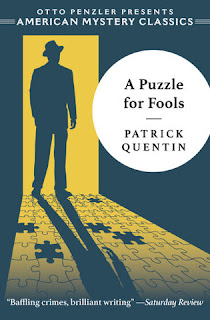
A Puzzle for Fools, by Patrick Quentin


 9781613161258
American Mystery Classics, Penzler Publishers
originally published 1936
237 pp

paperback


"It had been a puzzle for fools..."


A Puzzle for Fools is #21 on the Borges/Bioy Séptimo Círculo list, and it's a good one.  It is also the mystery series opener for the nine books featuring Peter Duluth, Broadway producer, ranging datewise from 1936 to 1954.    

Peter Duluth has known his share of tragedy.  His wife Magdalene had died in a fire in the theater, and as a result his life started to hit the skids.  After "drinking to an eight-hour-a-day schedule" over the last couple of years,  and not "particularly reluctant" to drink himself to death, he decided that some time in a sanitarium might be a good idea.  Detoxing was pretty tough at first, but he made it through the worst and now, under the care of a trusted psychiatrist, he seems to be doing pretty well.  His "spells of depression" are less frequent and his physical self was also improving.  As this story begins though, he's not sure sure of himself -- it seems that in the dark of his room, he hears his own voice whispering to him he must get away, and that "There will be murder."  He knows he's not saying these things, and his fright overtakes him until he speaks to his psychiatrist, Dr. Lenz,  who lets him know that "this is not the first disturbing thing which has been reported recently," and that whatever he sees or hears "out of the ordinary, that thing is real and has its basis in fact."   The doctor also feels that there is a "subversive influence" at work in his sanitarium, causing him to worry about the patients and asks Peter for his help. While patients might not reveal things to him that upset them, they might say something to a "fellow inmate."   

It isn't long until he learns about the strange things that are happening among the other patients, including a few who, like Peter,  have also heard themselves talking when they know they weren't.   More talk of murder follows, and it isn't too long until talk gives way to action and someone is actually killed in a way that leaves no traces of violence.  It's a bizarre crime on the impossible side, and while Peter has been allowed to keep up with the police and their investigation in confidence,  he has some ideas of his own as to how to discover who among them is a killer.   However, before he can make any real progress, the strange occurrences continue to plague the patients, and then there's another death. 

After my less than great experience with A Puzzle for Players I was more than a bit  reluctant to once again wade into this series, but  I was surprised at how very much I enjoyed this one.  For one thing, the atmosphere is set at the beginning and doesn't let up over the course of the story.  There's just something compelling about the scene of the crime being inside of a sanitarium with its darkened corridors, locked doors and secrets; even better, this story really is a puzzle -- the author offers any number of clues to put together to get to the heart of this mystery, and his characters are so nicely drawn that at some point I realized that nearly every person in the sanitarium was a potential candidate for suspect, and that ultimately in this story, you can't really trust anyone.   

Don't miss the introduction by Otto Penzler; while I don't quite agree with Penzler's assessment of Puzzle for Fools as a "suspense thriller in the Alfred Hitchcock mode," it still makes for a good few hours of fun and unputdownable reading.    Recommended to those readers who enjoy these older mysteries.  The armchair detective in me was highly satisfied -- I never guessed the who and so I was completely taken by surprise when all was revealed.  I call that a win. 


Friday, September 10, 2021

The Corpse in the Waxworks, by John Dickson Carr

"The purpose, the illusion, the spirit of a waxworks. It is an atmosphere of death."


9780712353731
British Library, 2021
originally published 1932
256 pp

paperback
(read earlier) 


A quotation from Poe's "Masque of the Red Death" serves as one of two epigraphs for this book and as it turns out, it is beyond appropriate.  Words like "grotesque," "phantasm," "delirious fancies," leap out immediately, but it's more Poe's conjuring of 
"much of the wanton, much of the bizarre, something of the terrible, and not a little of that which might have excited disgust" 

that truly fits the atmosphere, the setting, and the overall action in The Corpse in the Waxworks.   

More often than not I tend to forget that John Dickson Carr was an American author since he wrote so many novels set in the UK. He did spend a good twenty years there before returning back to the US, and according to most biographies, was one of only a very few American writers to be admitted into the Detection Club.    The Corpse in the Waxworks throws yet another curveball: it's set in France, and features M. Henri Bencolin, who is described in the book just prior to this one, The Lost Gallows (Poisoned Pen Press, 2021),   as "a tall and lazy Mephisto," as well as  "juge d'instruction of the Seine, the head of the Paris Police  and the most dangerous man in Europe" (4).   In the present book, he is  also noticed as a "man-hunting dandy," with an associate by the name of Jeff Marle who also serves as narrator.   

The "official" blurb for this British Library edition can be found here at the British Library's website; however, the one on the back of my old Collier paperback (1969) edition of this book is much more fun, with a teaser on the front that reads
"A Dead Girl in a Satyr's Arms -- A Club Devoted to Nocturnal Orgies"

 and then on the back the salacious detail of a "notorious club ... whose masked members revel in carefully planned orgies," as well as mentioning "nocturnal debauches."   


Seriously, who could resist?  

The action in this novel begins with the body of a young woman who had been stabbed and then found floating in the Seine.   Mademoiselle Odette Duchêne had last been seen alive going into the Musée Augustin, a wax museum complete with a "Gallery of Horrors."  Her fiancé, a certain Captain Chaumont, had spoken to her the day she went to the museum, when she phoned to cancel a date for tea with him and a friend "giving no reason."  Curious, he went to her home just in time to see her drive away in  a taxi, so he followed until she was let out in front of the museum.  With only half an hour until closing time, he waited, "and she did not come out."  Now she is dead, and he wants answers.  At the museum, Marle makes his way to the Gallery of Horrors, where he comes across the waxwork of a satyr.  After looking at it for a while, he makes his way back to the others who see that he's a bit unnerved, and when asked what's wrong, he tells them that the satyr figure  was "damned good, the whole expression of the satyr, and the woman in his arms."  There's just one problem, as M. Augustin informs him,  "There is no woman in the satyr's arms."  Well, as Bencolin notes, there is one now, "a real woman. And she is dead."  

But what about that club where they go for "carefully planned orgies" and "nocturnal debauches" you might ask, and all I will say is that as the investigation into the body found in the arms of the satyr gets rolling, the connections between the two will make themselves known.  The case begins in earnest with this second death, and the sleuthing begins. In typical Carr fashion, witnesses are discovered, spoken to, bits of information are given out carefully, and there's even a clever prime suspect.  The thing is though that Carr does a bit of sleight of hand here -- just when you believe he's given away the show much too early because there are still several chapters left in the book,  well, trust me, there are still a number of surprises waiting.  


The Corpse in the Waxworks is notable not just for the mystery at hand, but also for the atmosphere that Carr establishes from the beginning.  Marle's initial impressions of his first trip into the Gallery of Horrors are absolutely stunning, including the staircase that suggested "walls pressing in with the terrors so that you might not be able to escape,"  the exhibits imbued with a "pallor on each" face, the soundless terror caught on the faces of a particular group of wax figures,  the ghastliness of the  "shadowy people" who did not move, and the "choking stuffiness of wax and wigs" that left him needing "light and the knowledge of human presence."  But what really sets this book apart is the second half of the story, where pretty much everything that happens is completely unexpected.  And oh, that ending! Whoa! 

Don't miss Martin Edwards' fine introduction, and the added bonus of a short story (also featuring Bencolin), "The Murder in Number Four."  And my many thanks to the British Library for reprinting this novel, since my little Collier paperback is pretty much on its last legs.  Needless to say, I had a great time with this book, and it's one I can definitely recommend. 


Puzzle for Players, by Patrick Quentin


Mysterious Press/Open Road, 2018
originally published 1938
kindle version

294 pp


Moving on to book #17 on the Séptimo Círculo list,  I actually thought I would die of old age before getting through this one.  It is the rare book that tries my patience, but that's exactly what happened here.  The saving grace for me was that not only did I never guess the who, but when all was made known, it was someone I never would have suspected in a million years.  

Puzzle for Players is book number two in Quentin's series featuring Peter Duluth, but it is the first time I've read anything by this author.  The story begins as Duluth is hoping to make a bit of a comeback after having been "tabbed" as the "youngest has-been producer on record."  Re-entering the theatrical arena after having been "tentatively cured" of  a daily "two quarts of rye" drinking problem during his time in a sanitarium,  Duluth is now ready for his "big come-back," after having read the script of a new play called Troubled Waters.  A lot rides on Duluth's success, including regaining his "solvency" and  "lost self-respect," and the fact that the play is to make its appearance in a theater with a reputation of being "jinxed" means nothing to him.  It does, however, seem to make some of the cast of Troubled Waters nervous -- as part of its creepy past, for example, in 1902 a young woman had been discovered "hanging dead" in an actor's wardrobe, very likely a suicide.   But Duluth, while sympathetic, is convinced that this play will restore his reputation, and he's got a fine cast to help make that happen.  

It isn't long until the first of the weird incidents begin, but really, these are the least of Peter's problems. First,  some pretty shady people arrive on the scene, each with an agenda and all adding to Peter's woes.  Events begin taking their toll on the cast and especially on Peter himself, but above all, the show must go on.  However, after two strange deaths, he's not so sure that will be possible.

I have to say that I was quite taken with the haunted theater idea, and while the author it ran with it for a while, creepy atmosphere and all,  it just sort of fizzled.   A shame, really, because to me, there was much more he could have done with it and didn't.   The focus is very much the characters in this novel, many of whom are harboring secrets and some of whom are actively doing what they can to cause chaos while the cast is gearing up for opening night.  And while all of the mayhem is certainly engaging, the story tends to be weighed down by the psychological aspects brought in by Peter's doctor, various romance moments, and the sheer volume of red herrings that are added to the story so that by the time the end came, I was ready to be done.   Personally, I think that some careful editing might have given this story more teeth, which is what it needed, in my humble mystery-reader opinion. 

I will be encountering another Peter Duluth mystery shortly, A Puzzle for Fools from 1936, so I'm sort of wary at the moment.  I know there are any number of readers who enjoyed Puzzle for Players, but I can't really count myself among them.   I will say that the final revelation was completely unexpected, which is what saved this novel for me, but the reality is that a good solution does not necessarily a good mystery make. 


Thursday, August 5, 2021

Midsummer Murder, by Clifford Witting

 #16 on the Séptimo Círculo list, Clifford Witting's Midsummer Murder  brings me back to crime reading once again , although I had hoped to have read much more of that list by now. I've fallen so behind in everything that I'll likely spend the rest of the year catching up.  Oh well. 


Hodder and Stoughton, 1953
originally published 1937
184 pp

paperback

I went looking for older, contemporary reviews of this novel after finishing it, and in  googling "Midsummer Murder Witting" without the quotation marks, got thousands of results for Midsomer Murders.  I was a bit annoyed at first but then laughed because even though this book has nothing to do with Tom Barnaby and the gang from Causton CID, there is a character in this story who reminded me of Mrs. Rainbird from The Killings At Badger's Drift (which I recently read with a group on goodreads).  Not unlike that creepy lady who spied on everyone in her village in Caroline Graham's book,  there is a woman in this story who keeps a card file on everyone in her village.  I guess the Mrs. Busybody must be a reality in some villages; on the other hand, both Barnaby and the Inspector in this book, Harry Charlton, came to a point where information gleaned from these  respective sources became invaluable.  

Midsummer Murder is book number two in Witting's Harry Charlton series, which begins with Murder in Blue (1937).  I had to really go digging online for a copy of the edition of Midsummer Murder I have, but luckily, it seems that I won't have to work as hard to pick up the series opener, since the people at Galileo Publishers have seen fit to put that one back into circulation, to be released (at least here in the US) next month.  Pre-ordered, for sure, along with his Measure For Murder (1941, book #5).  His Catt Out of the Bag, book #4 from 1939 is already available for purchase, so I bought that one as well.  As all of this buying might reveal, I liked the lead character, Inspector Charlton.  I didn't particularly love the book itself, but the man intrigued me to the point where I would like to read more of his adventures in crime solving.  As for the novel, I was more than mildly annoyed with the underlying motive that connected all of the crimes (yes, there are more than one), which to me was tenuous, at best.   As an aside, anyone in 1953 who wasn't quite sure of the definition of that word could have easily turned to their Thorndike-Barnhart dictionary advertised on the back cover:


The story begins with a shooting in the Paulsfield Village square on market day, the first Tuesday of the Month.  Set between the wars in 1936, it was close to noon "and the tumult of the fortnighly gathering was at its zenith," including  all manner of livestock which "bleated, grunted and lowed," salesmen calling out their wares, a Punch-and-Judy show going on with a barrel organ for competition and construction complete with pneumatic drills.   It's a bustling, chaotic scene, and in its midst a bull escapes, and at that moment someone decides to let go with a gun and kill Thomas Earnshaw, the man cleaning the statue mid-square. 


frontispiece, the Square (oh! the map!!)


Inspector Charlton is called in to investigate, but finds an appalling lack of clues other than the bullet, a determination of the angle at which it had been fired into the victim, and sightings of a mysterious van that may or may not have something to do with the case.  All he can do at present is to talk to everyone around the square to see who might have a gun matching the murder weapon.  Progress on the case is little to none, and when a second person falls victim to the same fate, he reasons that  
"the murderer either had his intended victim playing right into his hands, or ... was waiting there like a watchful, blood-lusting spider for some innocent sacrifice to come along."

 Even worse, there is a third victim, and yet no one knows if these people had been randomly chosen or if there was some sort of link between the three in a "larger prearranged plan."  The killings have caused people to remain in their homes causing havoc for the shopkeepers, and while the police are starting to make connections, the question of who is responsible remains a mystery and leaves  the Paulsfield Sniper to remain at large.  

As this is my first experience with Clifford Witting's mystery novels, I have no idea whether or not he does this in all of his books, but here he leads the reader on quite a merry chase through the police investigation before we realize at the very end that we've been had in a nice bout of misdirection.   And I was fine up until that point, enjoying the mystery, putting the clues together in my head and even taking notes while reading.  Normally the author's sort of "gotcha" moment is a good one, meaning that he or she has put together a story whose solution I never would have guessed because I was following the trail of red herrings.  And while that happened here, when the killer was disclosed it was so out of left field that I had to go back and reread certain chapters just to try to figure it out.  Still, it was fun up to that point so I can't complain too much, but somehow that final moment  just didn't seem fair.  Be warned that this book ends so abruptly that I was looking for evidence that some of the pages had been torn out of my copy.  

Not great, but not bad, sort of middle of the road with an interesting lead character.  In my mind, not quite as nicely done as the previous  Séptimo Círculo books, but still a good read.