Showing posts with label American crime fiction. Show all posts

Friday, March 7, 2025

The Sister of Cain, by Mary Collins


97988866011296
Stark House Press, 2025
originally published 1943, Charles Scribner's Sons
196 pp

paperback

One of my greatest mystery-reading pleasures is discovering authors whose work has been around for a long time but who are new to me, especially women writers I've never heard of before.   I've found that joy here with The Sister of Cain, published by Stark House last month, by Mary Collins (1908 - 1979).

About this author I can find very little online, except for the brief blurb at the Stark House website, which tells me that she was born in St. Louis, MO, then moved along with her family to Berkeley at age three where later she would attend the University of California. She wrote "a few fiction stories" for a magazine called The Passing Show, eventually turning to mystery writing, with six novels written between 1941 and 1949: The Fog Comes, Dead Center, Only the Good (also reprinted by Stark House 2022),  The Sister of Cain, Death Warmed Over, and Dog Eat Dog.  It seems that she then "retired from writing" to give her time to her family.  There is also an archive of materials covering her mystery-writing years and a few years beyond, containing "correspondence, contracts, manuscripts, notes and scrapbooks, 1941-1953," for a scholarly someone who might want to delve further into her life.  

On to the novel now, which according to Curtis Evans in his introduction to this book, received a "rave review" from Dorothy B. Hughes and was also broadcast on radio in 1944 as part of  the Molle Mystery Theater Program  from NBC (I've just spent a couple of hours scanning that page and being completely awed at all the titles I know).   Hilda Moreau has arrived in San Francisco at the home of her husband David's family; more specifically, his six sisters Pauline, Sophie, Anne, Elise,  Marthe and Rose, varying in age from 51 to 20, Pauline being the eldest.  There was another sister, Berthe, but she had died fifteen years earlier.  David and Hilda had met while he was teaching and she, a teacher, had been attending a summer session where he worked.  They married just shortly after Pearl Harbor, and because of his Navy reserve commission, he had been called up for active duty, and the last time she'd seen him was a month earlier, in New York.   She has come to his family home while he was serving in the Atlantic because she had no family to speak of; the plan was that Hilda would find an apartment but still enjoy the security of being looked after by his sisters.  The Moreaus lived in "the oldest house still standing in San Francisco ... built in 1852," which Curtis Evans notes is based on a "real city mansion, built in 1852 and known locally as Humphrey's Circle." 


The Humphrey House, from Library of Congress

 Oh. And Hilda is pregnant, but neither she nor David have told anyone yet. 


 Original hardcover edition, from Abebooks

Instead of a warm and loving family, Hilda discovers the opposite.  Pauline, it seems, has complete control over the sisters, financially and otherwise, to the point where she will not allow any of the sisters to marry.  Hilda realizes early on how this woman has created an atmosphere of "fear and bitterness and hatred."  There is also a maid, Nanette, who has been with Pauline since she was born, who is as surly toward the sisters as can be.    Hilda quickly gets down to brass tacks with Pauline regarding her husband's portion of the family trust, but Pauline has other ideas.  It seems that the trust can only be broken by marriage, and since David is now married, all of the siblings should legally be able to come into their share.  Pauline refuses to speak to her about it, so Hilda tells her that she has no other choice but to use her power of attorney and to speak to a lawyer.  This situation doesn't sit well with Pauline, who has control over the trust.  Unfortunately, Hilda is pretty much stuck at the house for the time being, since housing is nearly impossible while the city was filled with "service people, shipyard workers, and government employees."  It isn't too long, however, until murder also finds its way into the house when Pauline is found dead, killed with a knife from the kitchen.  As one of the sisters says, "there's no grief in this house" over her death, since they'd all "wished her dead a thousand times."  But, as the detective says to Pauline, 
"The other people in this house have had their motives for a good many years, Mrs. Moreau. The fun didn't start until after you got here, did it?" 
While the police focus on Hilda as the possible murderer, and as long-buried secrets come cascading out that provide definite reasons for wanting Pauline dead,  Hilda does all that she can to find the real culprit in the house, but it won't be too long before there are more deaths and she finds herself in serious danger.

What a fun ride this novel is, and how incredibly hard it was to have to put this book down when I had to!  The gothic vibe is pretty strong here with Collins doing a great job establishing a dark, tension-filled atmosphere almost immediately.  While Pauline is a great villain for reasons I won't go into, it's really all eyes on Hilda here, who is an extremely strong woman, more than capable of taking care of herself and not averse to personal risk in her quest to clear her name and to bring the real murderer to justice.  I will say that it was rather cringeworthy to see her light up while pregnant, but ah, the things no one really knew back then.  The historian in me was also interested in her descriptions of wartime San Francisco which after all, she knew very well.  

I tried so hard to guess the killer's identity and absolutely couldn't, even as the number of people started dwindling, because there were just too many great suspects.    I consider that a true plus -- Collins really didn't make it easy.  I can certainly and highly recommend The Sister of Cain for vintage crime readers and for mystery lovers like myself who enjoy finding new and somewhat obscure writers from the past.  

As always, my many thanks to Stark House for my copy (these guys are so great), and I'm sure I'll be moseying over there to pick up a copy of another Mary Collins novel.  

One more thing: there is an amazing blogger by the name of Tim Welsh who has not only read this book, but has posted photos of the various locations described by the author.  Don't go there until you've read The Sister of Cain, but his blog, San Francisco Film Locations Then & Now: A Then and now Tour and History of San Francisco Through Films and Photography is well worth the visit when you've finished.  I bookmarked it so I'm sure I'll be spending time going through that rabbithole in the near future. 

Monday, February 12, 2024

double feature: Poor Harriet/The Silent Cousin, by Elizabeth Fenwick

 
9798886010763
Stark House Press, 2024
217 pp

paperback 

Released just recently, this two-books-in-one edition from Stark House features the work of a woman whose work may not be a household name among mystery readers, but deserves to be brought back into the light.  Elizabeth Fenwick (1916-1996), aka E.P. Fenwick, wrote her first novel just after high school.  It was rejected upon submission, and she moved on to other things, including French translations.  Evidently she wasn't one to give up -- in 1943 Farrar and Rinehart published her An Inconvenient Corpse and two more crime novels under the E.P. Fenwick pseudonym in 1944 and 1945.  She would return to crime fiction again in 1957 with Poor Harriet, but she hadn't sat idle in between, having written three non-crime books (and evidently a very busy life, according to Curtis Evans' introduction to this volume) before returning to the genre.  Wikipedia offers a list of her published works; I am fortunate enough to have picked up three of her crime novels published by Stark House some time ago: Two Names for Death (as E.P. Fenwick, 1945; part of their fabulous Black Gat series), and another two-for-one containing The Make-Believe Man from 1963 and A Friend of Mary Rose (1961), both written as Elizabeth Fenwick.  

In Poor Harriet, Marianne Hinkley does the books for Bryce Builders in Connecticut,  taking all of the financial woes of the company upon her own shoulders since Mr. Bryce's attitude is one of "To hell with what the books say!"  Money is tight, and the situation is not helped by Mrs. Irma Bryce, whose shopping bills are paid from company funds and who seems to be, as she puts it, "living out of the cash drawer."  On the day this novel opens, Irma is in the office, needing a thousand dollars, which Marianne assures her won't be happening.  Mrs. B has a plan in hand, though, taking out a diamond bracelet and telling Marianne that if she would go to a certain man in New York City, he would "buy this in a minute" and afterward, Mrs. Bryce would give Marianne a percentage of anything over the price Irma wants if she can sell it for more.   She can't go herself, she says, because word might get out; to sweeten the deal, she also promises Marianne that she won't ask for any more money until the new development the company has built has sold out.  That is an offer that Marianne can't refuse;  Irma makes the appointment and Marianne later makes her way to a particular address to make the sale.   The contact, a Mr. Moran, doesn't have the thousand but offers to set Marianne up with someone who does.  She is to wait there with Mrs. Moran, an older English woman named Harriet, while he makes arrangements.  Before Marianne goes with Harriet for tea in her room, however, she decides that she's done with these people and doesn't want to go somewhere else to make the deal, so she calls Irma to let her know it's off.   She makes arrangements to meet at Grand Central, where Marianne will wait for her until midnight.  She's set to go, but as a kindness decides to stay for one cup with Harriet before she leaves.  It's a decision that leaves serious repercussions in its wake, not least of which is murder.   This scenario could be the setup for any number of crime novels, but alongside the murder mystery, there is also a dark depiction of a woman tyrannized mentally and physically by an abusive spouse.  When I'd finished this novel,  I read the introduction, which led me to the excellent and informative introduction by Curtis Evans to The Make-Believe Man/A Friend of Mary Rose, where I discovered that Fenwick had sadly herself lived through this sort of situation, making the aftermath of my reading even more poignant.  


original cover of Poor Harriet, 1957. From Capitol Hill Books


The Silent Cousin also has its share of darkness, although this story is a bit more complicated in the reading than its predecessor and definitely more gothic in tone.    First things first: as Curtis Evans says in his intro, make yourself some sort of family tree or at least a list of who's who in this novel.  I didn't read the introduction until after I'd finished the entire book so I missed that advice, but as luck would have it, I ended up doing it anyway once I got tired of flipping back and forth through the pages.  Trust me, it is a lifesaver and will keep the reading flow going at a good pace with no interruption to the buildup of suspense going on here. 

The Onderdonk estate was established back before the turn of the twentieth century with the building of a grand house named Long Acre.  On the estate are three other dwellings:  the Hall, currently the home of Humphrey and Cora Onderdonk and their older daughters Louisa and Millie, a farmhouse where the estate manager MacDonald now lives, and a cottage originally called The Study in the Woods, which  Millicent Onderdonk (now deceased and daughter of the original Onderdonk) had refitted for her husband, a certain Dr. Potter.   All of the present-day Onderdonks live on the estate with the exception of the family of John Onderdonk, who had left for Chicago and whose grandson John Watson is the current heir.   To make a very long story short, the estate is tied up in trust in terms of both land and money; any requests pertaining to funds go through MacDonald.    

After spending his childhood with the Onderdonk cousins, as an adult, Dr. Potter's son Paul (affectionately known as "Polly") has returned each year (minus one) to spend his summers at the cottage.  While he has no legal claim to the place because Millicent was his stepmother, it is a fine retreat for him and he is welcomed back by the family each time, especially now that he is separated from his wife.  The remainder of the year he is a professor of history, although he had once been on track to becoming a doctor, going to medical school but giving it up due to an issue with a  "tricky memory."  However, he still has his own syringe, with which he administers prescribed drugs in cases where the doctor cannot get to the estate quickly.   As the novel opens, he is awaiting the arrival of his young daughter  when he is summoned by estate manager MacDonald to the farmhouse to help with  MacDonald's very ill wife.  The doctor had relayed that Potter should give Mrs. MacDonald an injection immediately, since the wife had been found "wandering" when she should have been in bed.   Found dead on the floor, Mrs. MacDonald won't be needing Potter's help, Too late to be of any help, he makes his way to the Hall to break the news.  Her death had been a bit of a surprise, because she had seemed to be "mending," and Aunt Cora makes her way to the farmhouse where she knows she'll be needed.  Another death is on the horizon though when poor Uncle Humphrey is found drowned in his fish pond.  It seems that his death happened not too long after Paul, Millicent and Louisa had had a serious discussion about the two women's futures as relating to the estate and the trust.   But there is another surprise yet to come for the Onderdonk family:  young John Watson has made his way to Long Acre with plans of his own.  As the blurb for this novel states, it seems that "Change is in the air," and this change "brings with it -- death." 


1966 cover, from Between the Covers (with some editing) 


I absolutely loved Poor Harriet, which, although written over sixty years ago, still sadly has great relevance to our own time with its frank depiction of domestic abuse/violence against women and the tragedy of mental illness, made even more heartbreaking because in this particular case there is no help in sight.   The core mystery is nicely done as well; I eventually figured out the who but not until very close to the end.  Unlike most of the time when I guess the culprit, I didn't care about that  -- what captured me most was the depth of humanity Fenwick managed to infuse into the character of  "Poor Harriet."  Mysteries come and go but Harriet (and this book) I won't soon forget.   The Silent Cousin is also quite good; Like Poor Harriet, this novel  also has an intense, psychological depth to it, in this case examining the effects of the burdens people silently carry for those they love, even in situations that are destined to end in failure.   It also has a chilling ending and a reveal that I never saw coming.  

These books are two examples of the type of crime I love to read, with the author's intense psychological scrutiny of her characters at work in and around the mysteries that are there to be solved.  Fenwick was a wonderful writer, and I'll look forward to reading the three I have now, plus any of her work published in the future.   Do not let the publication dates of these novels deter you -- her subject matter is still highly relevant and she can weave a hell of a tale together, keeping you hanging until the last page is turned.  Recommended for mystery/crime readers of the period, as well as to readers who appreciate some truly good writing.  

My many thanks to Stark House for my advanced reading copy!!

Monday, December 26, 2022

coming your way in January: Awake and Die, by Robert Ames


 9798860101
Stark House Press, 2023
178 pp

paperback

I just noticed that my last post here was in July. Ouch! On the other hand, July through September is usually spent reading the Booker Prize longlist, and truth be told, I haven't read my usual volume of books this year. According to goodreads, it's just 70 to date, but with this book, Awake and Die, we can up that to 71.  

In the brief author bio in the back of this book, we learn that  Robert Ames is the pseudonym of Charles Lee Clifford (1890-1991), who wrote two other books under this name:  The Devil Drives (1952) and  The Dangerous One (1954).  Memo to self: I need to have these.    Awake and Die is part of Stark House's  fantastic Black Gat collection, but was originally published in 1955,  number 518 in the old Fawcett Gold Medal series.  This  Stark House reprint duplicates the cover of the Gold Medal edition, minus the blurb 

"Murder was a pleasure and women were a pain." 

 Just to be very clear here, Awake and Die is not a whodunit; all you need to do is to read the basic outline  laid out on the back cover blurb to know that this is not an armchair detective sort of thing.  More importantly though, at the very beginning of the novel the narrator, Will Peters, wants the reader to judge whether he is a "cold-blooded killer" or if he "was off in the head," recounting events that take him up to the present day.  As he also says, "it wasn't anybody's fault, except fate's," which in my opinion sort of also challenges the reader to decide whether or not that's how it was.  


from Bookscans

It seems that Peters had been injured during the war in Korea when a bullet had pushed a piece of his helmet into his head.   After three operations, doctors finally managed to get it "all cleaned out."  Being "an outside man," after his surgeries Peters makes his way home to New Jersey to a place called Bayhaven, where he works as a clamdigger; he is to report every couple of weeks  "to be checked" by an Army Reserve doctor in the area.  One day as he lifts his basket of clams out of his boat (to be given to the doctor, a Dr. Algee, as thanks), he notices a gorgeous woman who offers her help with the heavy load, and it seems to be a mutual, instant attraction.  Claire Grace is her name, and after a while he learns among other things that she lives in the "richer part" of Bayhaven and that she's married.  After they spend some time at a bar with a couple of drinks and a dance, she scoots off after Will invites her to his place, making the excuse of not realizing how late it was.  Still, Will can't get his mind off of her, thinking that Claire was "the kind of woman a man ought to have."  

When he finally makes it back to his place, he notices a light on in the house and thinks maybe Claire might have taken him up on his offer.  The thought makes him "feverish," but it's only his former girlfriend Mae there, with her "brassy-dyed hair," her "glaring white makeup with bright-red lipstick" and her fake British accent, waving her cigarette around.   As Peters notes, "it was remembering Claire Grace, and comparing her with this drunken babe, that so enraged me."   Suffice it to say that this is the point when this story truly takes off, leaving bodies to pile up one after the other, a detective with a need to prove himself  who will not give up under any circumstances, and yet another woman who could very easily put Peters in the big house for life.  

Even though this is not a whodunit (as I noted earlier),  there is more than enough here to satisfy any reader of older crime fiction, especially because of  the many twists the author throws into the basic plot, some expected, some definitely not.     Ames lays on the sleaze factor a bit thickly in this story, which given the time of its writing is not unusual, but on the flip side, he was a fine plotter and a pretty good writer, keeping me reading and not wanting to put the book down, tying up a lot of loose ends so that I wasn't left in the dark about anything.    Evidently he was also not without a sense of humor.  One of Peters' neighbors is an old recluse who speaks to others via his seagull, his dog and his cat, each with its own distinct personality and voice; it seems that any one of them (she says, tongue-in-cheek) could potentially make the rest of Will's life miserable. [I really had to chuckle at this bit -- my dog often answers me back or makes comments in a thick New Yawk accent when I'm feeling a bit silly.]  

 My many and very grateful thanks to Stark House for my copy -- I've just recently bought a couple of their books, Only the Good, by Mary Collins (1942) and a two-volumes-in-one edition of The Make-Believe Man (1963) and A Friend of Mary Rose (1961) written by Elizabeth Fenwick, but looking through the little book pamphlet included with those, I'm super, super excited about reading Jay Dratler's Pitfall, which they list as "First in a series of Film Noir Classics."  I'm actually so stoked about that one that I'm going to go buy it now.    

Awake and Die is a big yes for me and it should most certainly be for those people who enjoy indulging in crime from yesteryear.  Recommended, definitely. 

Tuesday, February 1, 2022

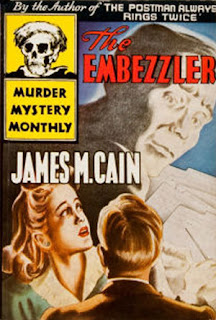
The Embezzler, by James M. Cain


Avon Book Company, 1944
(Avon Murder Mystery Monthly No. 20)
originally serialized as "Money and the Woman" 1938
108 pp


paperback


Ask someone which books they've read by James M. Cain, and my guess is that the answers won't likely include this book, The Embezzler.  Actually, until I started reading my way through the séptimo circulo list, I didn't even know it existed, and I'm sure I'm not alone here.   

Set in the Los Angeles area, bank vice president Dave Bennett has been sent from the home office to a Glendale to check up on "not what was wrong" with the Anita Avenue branch, but rather "what was right with it."  The ratio of savings deposits to commercial was "over twice" that of any other branch, and he'd been tasked by his boss to find out "what the trick was" so that it might be something that could be used at the other branches.    When the novel begins, he's working as acting cashier.  The man responsible for such great numbers is the head teller, Charles Brent, but  Bennett likes neither his method nor the man himself, the latter for reasons he doesn't quite understand.    

Two weeks after Bennett arrives, he receives a phone call and a visit at his home from Charles' wife Sheila, who has a strange request.  Charles, it seems, needs an operation immediately to repair a duodenal ulcer, "verging on perforation," but he is worried that things will "go to ruin" at the bank if he's not there.  Would Bennett let her take his place at the bank?  She's definitely qualified, having worked at the bank in the past, and she knows "every detail" of her husband's work. As he considers his answer, it strikes him as a good idea, not only because of the "general shake-up" Brent's absence would cause, but also because he'd "liked this dame from the start."   So Sheila's in, and one day while she's out trying to bring in a loan, Dave takes over her window and discovers just that Brent's work success hides something else -- an $8500 discrepancy in the books.  Even worse, he discovers that Sheila knows all about it, but he's in love with her -- what to do?   Everything rests on Dave's decisions from this point on.  

By this point in the novel, I already had a feel for what was about to come, and for the most part, I was right.  What kept me reading wasn't so much the action here but my deep  mistrust of Sheila pretty much to the end so I had to see what happened on that front.  I mean, Cain had  already written Double Indemnity, albeit in serialized form (1935 -- it also appears along with The Embezzler in Three of a Kind in 1943)  so I couldn't help but wonder if Dave's judgment would be clouded by his instant infatuation with Sheila, or if she was going to turn out to be another Phyllis Nirdlinger taking Dave down the road to destruction.  No spoilers from me on that score. 

All in all a decent read, but I was more than a bit disappointed with the ending which one reader on goodreads described appropriately as a "major no no" for noir.   No spoilers from me, but jeez -- given all that had come before it just did not work.   Think "sappy" and you've pretty much got it.  


from IMDb

I would love to watch the film made from this novel in 1940, and I found a place that has transferred it to dvd, mine for only $25. Done, making me a happy person.    Unfortunately the shipping was like $45, making me an unhappy person,  so I guess I'll wait and hope to find a copy another time.   

If you're a fan of James M. Cain's books and want to read beyond the better-known novels, this would be a good place to start; in any case it's much better than his The Cocktail Waitress, which was just sleaze, and not good sleaze at that.  This one was just okay. 


Friday, September 17, 2021

A James Ellroy Double Feature: Brown's Requiem and Clandestine


9780593312209
Vintage, 2021
originally published 1981
321 pp

paperback 
(read earlier)

I hadn't really intended to read more of Ellroy at the moment, but back around mid-August I read his My Dark Places and there he was, back in my head and under my skin again. The only way to exorcise his presence was to read more Ellroy, and I decided to start with his earliest work.  Brown's Requiem is his first novel, followed by Clandestine, and I read both.   

 In the introduction to this edition of Brown's Requiem, Ellroy notes from the outset that he was "determined to write an autobiographical epic second to none," but he also realized that his life was "essentially an inward journey that would not lend itself all that well to fiction," which, based on his life as described in My Dark Places,  is probably true.  His response:

 "I then ladled a big load of violent intrigue into my already simmering, tres personal plot -- and the result is the novel you are about to read."

This book is much more a PI novel than anything else he wrote (at least of the books I've read), a fact he makes known in his introduction where he says that this book is "heavily beholden" to  Raymond Chandler.  He also notes that he owes Chandler a "two-fold debt" -- for getting him going and showing him "that imitating him was a dead-end street on GenreHack Boulevard." The Chandler influence shows.   Fritz Brown is an ex-cop, now private investigator whose main source of income as the novel opens is repossessing cars.  The PI business is slow; before making money from the "repo racket" he'd handled "a few cases," but now his office is more like his reading room; the business much more a tax front than an active concern.   Enter Freddy "Fat Dog" Baker, a caddy with a pocket full of bills, who comes to Brown with concerns about his sister.  It seems that 28 year-old Jane has been staying with an older "rich guy," who evidently wants Jane to have nothing to do with her brother.  There's "no sex stuff" going on -- "it ain't like that," but Fat Dog feels that the man is "not right somehow," and that he is "using my sister for something."  He wants Brown to tail the guy, to see what he's into because "he's fucking her around somehow," and Fat Dog wants to know what's going on.  Brown likes the idea of a "surveillance job," one he can work around the repo schedule, so he agrees.   On his first sight of the older man, Sol Kupferman, Brown recognizes him, and his mind goes back to the Club Utopia,"a sleazy neighborhood cocktail lounge"  that had been firebombed in 1968, causing the deaths of six people.  Three culprits were caught, owned up to what they'd done, but had named a "fourth man" as the mastermind, a story that  the cops never believed.  While on the force, Brown hadn't been involved with that case (he was a rookie at the time), but he had been to the Club Utopia with his patrol buddies before it had gone up in flames, and had seen Sol Kupferman there at the time.  As the face of his investigation begins to change,  his finds his own past becoming inextricably intertwined with the case at hand.  


While my description doesn't do this novel the justice it deserves (and of course, there are plots, subplots and characters that I haven't gone into because of time), it's easy to see the first inklings of what to expect in Ellroy's future writings, especially Ellroy's penchant for writing novels that are dark with a capital D.    In Brown's Requiem the prose is more tame, less zippy than in his LA Quartet, but given that it's his first novel, you can see still detect faint strains of the originality of yet to come.  It's interesting to go back and reread Ellroy from the start, especially knowing that  the first book of his excellent LA Quartet  would be published only six years later.    Recommended for those so inclined, mainly people who've enjoyed Ellroy's books and know what to expect. 


Avon, 1999
originally published 1982
paperback, 328 pp


With  Clandestine Ellroy gets more personal, more autobiographical than in Brown's Requiem, tackling his mother's 1958 murder, albeit in fictional form.  It's so very easy to spot, of course, having read this novel after reading Ellroy's My Dark Places, but he also admits to it in a 1996 interview with Laura Miller at Salon where he says that Clandestine was a "chronologically-altered, greatly fictionalized account" of her murder.  Unlike real life though, in Clandestine he also "solved the case."  My Dark Places also allowed for recognizing a fictional young James Ellroy in this book who under a different name, makes an appearance here as well.  

In 1951 Fred Underhill is a young policeman working Wilshire Patrol. When not on the job, he "played a lot of golf and sought out the company of lonely women for one-night stands."   On the job, after roll call one morning, he and his partner were out warning the owner of a small butcher shop/market about a two-man stickup team hitting small markets and a liquor store, and while there they was called to the horrific scene of Underhill's  first murder, a woman identified as Leona Jensen.  Not too much after that, his partner is killed, and later Underhill was sent to the "tragic sinkhole" of the Seventy-seventh Street Division, Watts.   News of a second murder reaches him, that of Maggie Cadwallader, a woman with whom he'd once had a one-night stand after meeting her in a bar called The Silver Star.  It strikes him as more than coincidence that he'd found a matchbook from the Silver Star at the scene of Leona Jensen's death; as he noted, "it was slight, but enough."  Eventually he tracks down the man he believes might be the perpetrator, and thinking about his case, his suspect, his revenge, his collar, his "glory and gravy train," reports his findings to his Captain, only to be slapped down as a "supremely arrogant young man," for whom justice is certainly not a motivation.  Rather than being suspended from duty, however, the Captain sets up a meeting with a certain Lieutenant Dudley Smith, who will be in charge of deciding "the course of this investigation."   And here is where the story actually begins, in my opinion, as Underhill's ambition gets the better of him, making decisions for which the outcome will bring serious repercussions both personally and professionally.    It isn't until he sees the story of the "dead nurse" that he realizes he may have a shot at justice for the dead, as well as for his own personal redemption.

In Clandestine, Ellroy introduces a number of characters (and themes as well) that will reappear in later work, most notably Dudley Smith, a truly bad guy even here, with more than enough hints of what will happen to anyone who crosses him.  This certainly book is more future Ellroy than its predecessor, reading very much like a prequel to the LA Quartet; it would be a great place to start for anyone who's considering Ellroy's work.  Beware: it's good, but it  ain't pretty.  


Saturday, April 10, 2021

Laura, by Vera Caspary

 read in March

9780743400107
ibooks, 2000
236 pp


paperback

I meant to post about this novel some time ago, but in between my reading of the book and now, there's literally been an avalanche of things going on here that have required my focus elsewhere.  I also had  to really consider how to talk about this novel,  sort of mentally pulling my hair out over how not to give too much away, which is no easy feat.   Let's face it -- if you've seen the movie then you're already aware of the surprises in store,  but I am going to try to  avoid mentioning any spoilers here just in case. As a result, this will be reading journal post light. I hadn't seen the film until I'd finished reading the novel (just standard operating procedure), and while I enjoyed the movie very much, for me reading the book is the better experience by far.  

Like most crime/mystery fiction I enjoy reading, Laura is a complex,  twisty and suspenseful story that moves beyond the realm of standard whodunits into the more literary zone where human nature is put under a microscope.  And oh my -- the range of psyches in this book definitely merit close examination.   At the center of this story is Laura Hunt and the people in her immediate orbit, and then there's the detective on the case who discovers her only after she's been murdered. 

In telling this story, Caspary uses a series of first-person narratives, utilizing, as A.B. Emrys reveals in her essay "All My Lives: Vera Caspary's Life, Times, and Fiction" (which does not appear in my edition, but as an afterword in my Feminist Press edition of Caspary's Bedelia, 198), "the Wilkie Collins method of multiple narrators."*   These begin on a Sunday with the account of  well-to-do (and quite snobbish) columnist, collector and aesthete Waldo Lydecker,  as he finds himself grieving over the "sudden and violent" death of his friend Laura Hunt the previous Friday night. Violent death  indeed -- Laura  had been shot at close range on Friday night in her apartment, the buckshot also severely damaging her face.  On that last day of her life, she  had announced to her fiancé Shelby Carpenter (to whom she was supposed to have been married the next Thursday)  that she would need  "four or five days of loneliness" before the honeymoon, especially after having launched her latest successful advertising campaign.   She still planned on having her weekly dinner with  Lydecker that evening, after which she would catch a train to Connecticut where she had a house, returning on Wednesday.  But for some unknown reason, Laura  had canceled her dinner date;  evidently she had changed her mind at the last minute.   Assigned to the case of Laura's murder is Detective Mark McPherson, the second narrator, who had learned from Lydecker that if he wants "to solve the puzzle of her death," he must first "resolve the mystery of Laura's life."   

In attempting to do so, McPherson listens to what the other men in her life have to say about her, but he also develops a personal interest in Laura as well. He comes into the case viewing her as "just a dame" until his interest grows slowly into obsession, taking his time, for example, to go through her apartment, touching her clothes and possessions as a way to understand her.  It is mainly through the gaze of each of the men in this novel that we see Laura, but the author has also included a narrative in which we discover her true nature, that of a "modern" and fiercely independent person concerned about being her own woman, having "given so much of everything else," but always withholding herself, with too much to lose otherwise.  While the story does eventually reveal the "who," in my opinion, it is the question of why that is much more pertinent:  what exactly was it that made Laura a target for murder? 


original 1943 cover from Wikipedia


I did say that I would not post any spoilers, but the truth is that I could seriously go on forever about this book because there is so much to tell.   Unfortunately, that would involve spilling much more about the characters, about the story and about the twists involved throughout, and that's not going to happen here.   I did feel that the author sort of tipped her hand in one very telling scene making it easy to figure out the who far ahead of the actual solution, which was a bit disappointing, but in the long run Laura is a definite no-miss, and not just because of the crime element -- it is much more a study in character that brings out a number of issues that remain pertinent today.   

Don't miss the film, although quite honestly the book is so much better.

As I said, reading journal post light. 


*9781558615076
Feminist Press, 2005


Friday, February 26, 2021

The Conjure-Man Dies: A Mystery Tale of Dark Harlem, by Rudolph Fisher


9780008216450
Harper Collins, 2017
originally published 1932
293 pp

hardcover

It is really sad that the author of this book, Rudolph Fisher,  died at such a young age, because after reading The Conjure-Man Dies, my thinking is that had he gone on to write more, I would have probably enjoyed reading everything this man would have produced.   An African-American writer of the Harlem Renaissance,  Fisher died at the young age of 37;  according to Sean Carlson in his recent article about the author for Motifon his death Zora Neale Hurston sent a telegram to Fisher's wife saying that "The world has lost a genius." Langston Hughes would later write that "... Fisher was too brilliant and too talented to stay long on this earth."  Written in 1932 and set completely in Harlem,  the book is the first crime novel to feature an all-Black cast of characters.  

The "conjure-man" is one N'Gana Frimbo, "A native African, a Harvard graduate, a student of philosophy -- and a sorcerer."   He works as a fortune teller/psychic out of an apartment in a house owned by the local undertaker in a room, "almost entirely in darkness," except for the illumination from  "an odd spotlight."  One night Jinx Jenkins and his friend Bubber Brown had gone to visit Frimbo, to get some advice about a business venture -- Jinx went in while Brown waited outside in the waiting room.  It wasn't long until Jinx came running out, grabbed Bubber and took him back to Frimbo's  consulting  room, where they found Frimbo dead. According to Jinx, he'd just   "stopped talkin', " after which Jinx turned the spotlight on the foturne teller and "there he was." It was "an hour before midnight" when the two ran across the street to Doctor John Archer for help, and on returning with them to Frimbo's apartment, Archer pronounces the conjure-man dead.  It is a true mystery; the wound on his head wouldn't have killed him, but on further examination, it turns out that the handkerchief stuffed down Frimbo's throat was more likely the cause of death.   The police are notified, and  Detective Perry Dart grabs the case.  

Dart is one of ten African-American Harlem cops who had been promoted from patrolmen to detective, and "knew Harlem from lowest dive to loftiest temple." The case should have been simple, since there  were only a limited number of suspects, all of whom had been who had either been to see Frimbo or were waiting to see him that night, yet it was anything but.  In the long run it will be four detectives who contribute to its solution, as  Dart and Archer enlist the help of Bubber and Jinx,  who had been  hoping to start a private detective business of their own, to help round up the people who had dealings with Frimbo that night.  All I will say is that all of them are in for a number of surprises before the case of the dead conjure-man is solved. 


from Black Past


I've read a lot of reader reviews in which most people figured out  the "who" pretty quickly, but I did not and it was a case of constant guessing right up until the end.  While that made me rather happy, what I found much more interesting was roaming the Harlem streets as Bubber and Jinx go out to round up the suspects.  When these people are interviewed,  their stories work outside of the mystery to provide a look at Harlem of the time, which is actually the reason I wanted to read this book.   As Scott Adlerburg from the LA Review of Books says in his revealing, in-depth article about The Conjure-Man Dies, Fisher adapts the mystery story "to his own concerns as a Harlem Renaissance novelist." 

In his 1971 introduction to this edition, Stanley Ellin states that in writing The Conjure-Man Dies, Rudolph Fisher "invests" his story with the "qualities of a social document recording a time and place without seeming to,"  and that's precisely what he's done.  Adlerburg notes that Fisher  "paved the way for the Harlem novels of Chester Himes," and that he "wrote something that has lasted" by offering the people of Harlem "as he actually saw them." 

It is a bit strange in the telling; on the other hand it is great fun and I laughed out loud more than once,  thoroughly enjoying every bit of this book for the crime and much, much more.   It won't be for everyone, but for readers who want a bit more in their mysteries or for readers who (like me) are more than interested in the literature of the Harlem Renaissance, it's a great match. 


Wednesday, October 7, 2020

and thus we come to the end: White Jazz, by James Ellroy


 " ... it's dues time." 


White Jazz closes out Ellroy's LA Quartet, and in doing so, takes us into the life of  Dave Klein, Ad Vice lieutenant in the LAPD.   Unlike The Black Dahlia, The Big Nowhere and LA Confidential, Ellroy's writing style is dialed up full throttle, set at pure, raw energy here as he moves his reader into Klein's head 

"his voice clipped, sharp, often as brutal as the events he's describing -- taking us with him on a journey through a world shaped by monstrous ambition, avarice, and pervision."

Klein is telling this story years after the events of White Jazz, looking backward with his beginning in the fall of 1958:

"Newsprint: link the dots. Names, events -- so brutal they beg to be connected. Years down -- the story stays dispersed. The names are dead or too guilty to tell." 

Afraid he'll forget: 

"I killed innocent men. I betrayed sacred oaths. I reaped profit from horror. Fever -- that time burning. I want to go with the music -- spin fall with it."

 Mind you, we haven't moved into the actual story yet and right away we have a preview of not only what's coming down the pike for Klein, who lived to tell the tale if one could actually call it living,    but of Ellroy's superb jazzed-up prose style as well.  

Aside from his police job, Klein has ties to local bad guy Mickey Cohen, Howard Hughes and mobster Sam Giancana. He is paid well to work as hit man, strike breaker, or to kneecap someone if necessary. He's also a slumlord and a law-school grad.  After the death of a federal witness in Klein's custody,  the case that takes center stage in White Jazz, one which will eventually take everyone involved to places they couldn't possibly have foreseen as ""the City of Angels begins to seem like the City of the Devils," starts with a burglary and the murder of two Dobermans at the home of JC Kafesjian, "LAPD's sanctioned pusher," and the owner of a chain of dry-cleaning establishments.  He is protected by Dan Wilhite of Narco;  Klein is called in "to square things," as Kafesjian insists on no investigation.  Ed Exley, now Chief of Detectives, decides otherwise, and Klein is partnered with Sgt. George "Junior" Stemmons to take care of it.   Away from the job, he is hired by Howard Hughes to keep tabs on a young actress by the name of Glenda Bledsoe, "with an eye toward securing contract-violating information."  In the meantime, as if this all wasn't enough, the  Justice Department investigators are beginning a " 'minutely detailed, complex and far reaching' probe into racketeering in South-Central Los Angeles," part of which would involve rumors of the LAPD allowing vice to flourish and rarely investigating "homicides involving both Negro victims and perpetrators."  Eventually Klein will come to realize that he's been tagged as scapegoat by the powers that be who want to keep their secrets to themselves.  He also knows that he's being used as a pawn in a much bigger rivalry.   He's not going to take either of these lying down -- as the back cover says, for Klein, "it's dues time."  

I really don't want to reveal  anything more about this book plotwise because at this juncture getting into the nitty-gritty of things would just kill it for anyone who hasn't read this book and may want to do so down the road.  There's also the fact that to try to enumerate the subplots found here would just be folly, and there's no way I can possibly describe the bleakness tied to the characters or the way in which things spiral out of control throughout the story.  I will say that while the books that came before this one were dark, this one is downright claustrophobic, a connected web of murder, revenge, sick and damaged souls, making the reader wonder if there is any possibility of justice at all in this hellish vision of LA.   

It also ends the LA Quartet, picking up the speed toward the finish in a way that only Ellroy could make happen as he moved across twelve years from 1947 to 1959.  More accurately it ends what is often labeled as the Dudley Smith Trio that had its roots in The Big Nowhere and comes to a head in White Jazz; although   The Black Dahlia  has little to do with the characters of the three novels that follow, it is most certainly the foundation of Ellroy's vision and as such necessary to understand many of the themes that make their way through all four books.  Word to the wise: do not under any circumstances make White Jazz your starting point -- you will be lost.  

 I think there have only been two other series I've read that have come close to this one in terms of sheer darkness of vision and which out-noir noir,  Derek Raymond's Factory series and David Peace's Red Riding Quartet.   While Ellroy's Quartet novels are, as I've been saying all along, not easy to get through on a number of different levels,  reading these four novels has been an experience in itself and I wouldn't have missed it.  I'm genuinely sad that it's over.  

happier reads now, I think! 

Friday, October 2, 2020

L.A. Confidential, by James Ellroy


-- read earlier

"It was a once-in-a-lifetime case and the price for clearing it was very, very high."


I'm one of those weirdos who actually preferred the novel to the film adaptation, and I think it's because it had been so long since I'd seen the movie that it I'd forgotten about it.   I recently watched the film again after finishing the novel and was a bit thrown off -- not only had the story been cut, which due to its complexity I'd expected, but parts of the plot were changed as well, even down to who was killed in the Nite Owl Coffee Shop.   James Ellroy himself said about the film that it was "about as deep as a tortilla." 

Luckily that's not the case with the novel. There is nothing shallow about  LA Confidential, which goes straight for the jugular and doesn't let go.   

As was the case in The Big Nowhere, three police officers are at the center of the story. Sgt. Jack Vincennes  has fifteen years on the force, yet he is not well respected by his superiors.  He was given a fitness rating of D+ by his own supervisor who also remarked that he is "barely adequate."  Jack has a side gig as technical advisor to a TV cop show (think Jack Webb and Dragnet) and also provides celebrity fodder for Sid Hughes' tabloid Hush-Hush, giving Sid the heads up when an arrest is about to be made allowing the magazine a leg up on press scoops. He also wants to leave Ad Vice and return to Narco before he retires,  and is told that if he can "make a major case," in a "Picture-book smut" investigation he'll get his wish.  Like many of Ellroy's tormented characters, Jack has a secret from his past which if uncovered would cost him everything.  Wendell "Bud" White has no use for men who beat women; as a boy he witnessed his mother's murder at the hands of his father.  Lieutenant Ed Exley, former war hero,  lives in the shadow of his father, a retired legendary cop now construction bigwig who is currently bringing a Disneyland-type park and a freeway to Los Angeles.  Exley "works poorly with partners and well by himself;" he is also regarded as a "coward" because he does not use violence against suspects.  Aside from his inner rivalry with his father, he too harbors a secret that he would prefer to keep hidden, and after he rats out the culprit in a jail beatdown by cops during a drunken Christmas Eve party, everyone hates him.  

The main case at the novel's  heart is the shooting at the Nite Owl Coffee Shop, "The first all-Bureau call-in in history."  Six people died when at 3 a.m. three men entered and shot the place up. The police have one hot lead on the case: over the previous two weeks, three men had been seen "discharging shotguns" into the air at Griffith Park.  They had been seen driving a purple Mercury coupe at the time and it was a purple Mercury coupe that a witness had seen parked across from the coffee shop at the same time the massacre went down.  But since this is James Ellroy we're talking about there, this case will quickly unfurl well beyond its center and as it spins, it will drag the three cops along with it, catching up to them in ways no one could predict.   And that's an understatement.  

LA Confidential has been criticized by readers for its rather labyrinthine complexity involving numerous subplots, but I didn't have an issue with it and frankly, could care less, since after having read its predecessors The Black Dahlia and The Big Nowhere, I've become used to Ellroy's penchant for grandiose, and I was caught up in each and every turn taken by this story.  What I really want to say is that it's a firecracker of a  read that sucked me so far down the rabbit hole of Ellroy's 1950s Los Angeles that is was a relief when I finally got out.   Again, not perfect, but pretty damn close.  

It's another book that is uberbleak, not for the squeamish, should come with warning labels, and yes, it's long in the reading, but I enjoyed every second of it.  Every nanosecond of it.  


Monday, September 21, 2020

The Big Nowhere, by James Ellroy


With two books left to read in  the LA Quartet, after finishing The Black Dahlia and Big Nowhere I had to take a break.  They're excellent novels, but even I, someone who lives on a steady reading diet of bleak,  had to take a break before going on.  I didn't stay away for too long though -- these novels are like serious noir-reading crack.

It's 1950, and just three hours into the new year, acting watch commander Detective Deputy Sheriff Danny Upshaw ("a rookie squadroom dick") has already decided that the 1950s "were going to be a shit show."  He eventually becomes caught up in investigating a series of grisly, sexually-motivated murders, all the while fighting the territorial rivalry between the LAPD and the LASD as well as a department that doesn't want too much public attention called to these killings. Upshaw believes that solving this case will "make his name as a cop," but he has to make a deal to work as lead  jointly with both departments, bringing him into a team tasked with getting the goods on "lefties" associated with Communism in Los Angeles, specifically targeting the United Alliance of Extras and Stagehands. The task force  consists of  Lieutenant Mal Considine from the DA's Criminal Investigation Bureau and Turner "Buzz" Meeks, an ex- Narco division cop, now "Fixer, errand boy, hatchet wielder" for gangster Mickey Cohen and head of security at Hughes Aircraft, where his real work is as a "glorified pimp for Howard Hughes."   Lieutenant Dudley Smith of the LAPD is also attached to the team, serving along with Mal as a chief investigator.  The novel follows these two threads as they slowly intersect, moving outward into various connecting subplots while moving inward deep into the minds of the three main characters to reveal how, as the back-cover blurb notes, "All three men have purchased tickets to a nightmare."  

Once again Ellroy brings us into an LA that is based on a foundation of fact, allowing him to construct his fiction around reality.  It's genius, really, when you think about it.   But in trying to describe this book or the others, the truth is as Tom Nolan says in his introduction to the Everyman's Library edition of The LA Quartet,  "Thumbnail sketches do not suffice" (xii).    With The Big Nowhere there is no possible way to encapsulate Ellroy's characterizations,  for example, or the movement toward the intersection of the lives of the three main players who all have their own their personal demons to confront while all the while having to contend with forces from the outside.  Without giving anything away, it's so hard not to feel some measure of sympathy for each and everyone of the these three people, despite what they've done.    It is a book that you feel rather than simply read, and it's visceral. 

 The Big Nowhere is not perfect, but it is a hell of a ride.  Definitely not for the faint of heart.  It is  not a book I'd choose as an initial leap into noir;  it's bleaker than bleak, twisted, unbelievably intense and difficult to read,  but I have nothing but serious praise for this novel. 


Friday, September 18, 2020

The Black Dahlia, by James Ellroy


"...our partnership was nothing but a bungling road to the Dahlia. And in the end, she was to own the two of us completely." 


 In the Afterword section of this book, Ellroy says the following: 
"A personal story attends the Black Dahlia, both novel and film. It inextricably links me to two women savaged eleven years apart."

Those two women  are his mother  (Geneva) Jean Hilliker, who was raped and murdered by an unknown killer who then left her body in a Los Angeles roadside in 1958, and Elisabeth Short, aka "The Black Dahlia" whose body in 1947 was discovered in a lot on an LA street after having been horrifically murdered and mutilated.  Ellroy had first encountered Elisabeth Short's story at the age of eleven, after his mother's death, while reading Jack Webb's The Badge, and from there,  "Jean Hilliker and Betty Short" became "one in transmogrification." Over the years this "Jean-Betty confluence" led to the writing of The Black Dahlia, in which Ellroy, as noted in a 2006 article in Slate,   

"transformed the murky facts surrounding Short's life and death into art, the unknown 'dead white woman' becoming a tabula rasa on which the author could wrestle with his anger and affection toward his mother." 

The Black Dahlia not only lays bare Ellroy's demons, but in his version of the Black Dahlia case, it turns out that no one involved is left unscathed.  

Just briefly so as not to ruin it for potential readers,  it's 1946.  The promise of a coveted spot in LAPD's Warrants Division as well as chance to be a department hero prompts Officer  Dwight "Bucky" Bleichert to agree to a boxing match  that will hopefully result in good PR and a five-million dollar bond for the LAPD.  His opponent is Officer Lee Blanchard; together they become known (appropriately)  as Mr. Fire and Mr. Ice.   A solid partnership builds between the two men, who also become close friends as Bleichert eventually finds himself teamed with Blanchard in Warrants.  Fast forward to January 15, 1947 when the partners get info about a guy they've been trying to find and arrest.  Arriving at the place he's supposed to be, the bust gets sidelined when Bleichert looks out a window and notices a lot of police activity down below at 39th and Norton.   When they go to check it out, Bucky sees a cop "knocking back a drink in full view of a half dozen officers," and "glimpsed horror in his eyes."   It is, as he hears, "the worst crime on a woman" any of the cops have seen.  They have found the body of a young woman who had been bisected at the waist, obviously tortured and horribly mutilated, with her mouth, "cut ear to ear into a smile that leered up at you," and Bucky tells himself that he would "carry that smile" to his grave.  

The body belongs to Elisabeth Short, who will in time be dubbed "The Black Dahlia" by the press.  Even though they're not working Homicide, Bleichert and Blanchard are pulled into the investigation, although it isn't too long before Bleichert wants out.  For various reasons peculiar to each of these men, the horrific death of Elisabeth Short becomes an obsession; eventually,  as Bleichert reveals in the prelude to this novel, The Dahlia "was to own the two of us completely."  Set against the backdrop of an emerging, post-WWII  Los Angeles, it is this obsession with her death and her life that Ellroy explores in this novel,  as well as the psychological and other repercussions that move from character to character.  

The Black Dahlia is book one of four in Ellroy's LA Quartet.  An excellent blend of fiction and reality, it  messed with my head, kept me awake and chilled me to the bone.  As dark and disturbing as it is, and while in my opinion it falters a bit in the reveal, it is also one of the best crime novels I've ever read, and I knew immediately that there was no way that I was not going to read the remaining three books.  More on those to come. 

After reading this one, find a place outside to let the sun shine down on you.  You'll need it.  

Tuesday, July 28, 2020

The Red Right Hand, by Joel Townsley Rogers.

"... it was a pretty good play, as criminal plays go."


Two of my favorite mystery/crime novels within the last year or so have come from Penzler Publishers American Mystery Classics series.  First on the list is Dorothy Hughes' excellent Dread Journey, and now there's this one, The Red Right Hand, by Joel Townsley Rogers.


9781613161654
Penzler Publishers, 2020
230 pp
paperback

Originally published in 1945, The Red Right Hand  begins with our narrator puzzling over a number of "baffling aspects" of the story that we are about to read, starting with how it was that he completely missed a car that had to have been
"so close that its door latches must have almost scraped me, and the pebbles shot out by its streaking tires have flicked against my ankles, and the killer's grinning face behind the wheel been within an arm's length of my own as he shot by?"
 Was there, asks Dr. Henry N. Riddle,
"something impossible about that rushing car, about its red-eyed sawed-off little driver and its dead passenger that caused me to miss it complete?" 
But the "most important" thing "in all the dark mystery of tonight,"  is the question that opens this book as he ponders
"how that ugly little auburn-haired red-eyed man, with his torn ear and his sharp dog-pointed teeth, with his twisted corkscrew legs and his truncated height, and all the other extraordinary details about him, could have got away and vanished so completely from the face of the countryside after killing Inis St. Erme."
Sitting at the desk of a certain Professor MacComerou, he goes back in his mind to  "set the facts down," so that he can "examine the problem," thereby launching this most strange but genuinely satisfying mystery story that kept me baffled right up until the end.  It all begins in New York when  Inis St. Erme borrows a friend's Cadillac so that he and Elinor Darrie can run up to Connecticut to be married.  Not wanting to wait the mandatory three days in New York, they make their way to Danbury, where they discover that they'd have to wait five days, so there's a change in plan: they'll be moving on to Vermont to tie the knot. First though, they make a stop at a local grocery and decide to have a picnic at a quaint little place called Dead Bridegroom's Pond  recommended by the grocer.   Along the way they pick up a hitchhiker who waits in the car while Inis and Elinor go on down to the lake. But their romantic picnic is interrupted when their passenger attacks St. Erme and goes after Elinor before driving away with the car, leaving her there frightened but unhurt.  Obviously, the same can't be said for St. Erme, as we know from Riddle at the very beginning that he's been killed.    Dr. Riddle, as stated on the back-cover blurb, "discovers a series of bizarre coincidences that leave him questioning both his sanity and his own innocence," but he is most seriously disturbed by how he could have missed the Cadillac as he was walking on the very road from which the car emerged at the very same time that he was there. But things are going to become even more weird before we catch up with the good doctor in real time, at which point the entire bizarre plot unfolds and all is revealed.

To say any more about the plot of The Red Right Hand would be absolutely criminal.


my growing Penzler Publishers American Mystery Classics shelf, appropriately shaded in a sort of noirish shadow. 


I love the originality displayed here in terms of plot and especially style.  This is not just another average mystery from the 40s, to be sure; it moves away from the norm from the get-go.  As author Joe Lansdale says in his introduction to this edition,
"The story moves back and forth in time, akin to the natural thought process, as if the whole thing were spilling out of the narrator's brain from moment to moment, and we were seeing all the in-betweens of thought."
 He also notes the "near stream-of-consciousness" style used by Rogers, and I don't think it would have had the same impact done any other way.  I've seen this book described a few times by readers as "surreal," and that's not an exaggeration -- at one point a dancer weighs in on how to solve the many riddles nested within this case:
"You need to wear a leopard skin, a chiffon nightgown, and a feather duster on your tail, and dance the beautiful dance of the corkscrew and the bottle."
Red herrings abound, so much so that I was completely baffled; there is quite a bit of repetition as well as a number of bizarre coincidences that run throughout this novel, two elements I normally detest and yet, somehow it all seems necessary here and more importantly, it works. As one of the policemen says toward the end of this book, "... it was a pretty good play, as criminal plays go."  I couldn't have said it better myself. 

Joe Lansdale's own reading experience with this novel sort of mirrors my own when he says that at times he
"... felt as if I were seeing the world through a dark and grease-smeared window pane that would frequently turn clear and light up in spewing colors like a firework display on the Fourth of July. At the same time there was that sensation of something dark and damp creeping up behind me, a cold chill on the back on my neck."
I felt that "cold chill" more than once during my time with this book.  It is genuinely one of the most bizarre mysteries I've ever read, with a solution that I never saw coming, one that is completely and utterly satisfying, an ahhhh read to be sure.    I can honestly think of nothing negative at all to say here.

very much recommended; it should delight readers of old mysteries and readers who are looking for something out of the box in their crime fiction.


Wednesday, March 25, 2020

The Woman on the Roof, by Helen Nielsen


97819444520137
Black Gat Books/Stark House Press, 2016
originally published 1954
194 pp

paperback


A couple of months ago the lovely people at Stark House Press sent me an advanced reading copy of a novel
in their Black Gat line of books, Two Names for Death, by EP Fenwick, which comes out mid-April so I'll defer talking about it for the time being (although I will say that it's really, really good and that vintage mystery/crime readers definitely have something to look forward to).  After I'd finished that one, I started looking at the catalogue of other Black Gat Books, especially those written by women and bought this one, The Woman on the Roof by Helen Nielsen, and two other titles as well. 

According to Fantastic Fiction, Helen Nielsen (1918-2002) authored nineteen novels; she also wrote for television, including the old series Alfred Hitchcock PresentsThe Alfred Hitchcock Hour, Perry Mason, and Tales of the Unexpected.  

The titular "woman on the roof" is Wilma Rathjen, whose brother Curtis has set her up in a garage apartment that looks down onto the six-unit apartment complex below.   We discover right away that Wilma has spent time in a sanitarium; she also has a job at a local bakery.   It is actually a muddle with a certain birthday cake ordered by one of the apartment dwellers that not only has her in a bit of a tizzy as the novel opens, but also leads to the discovery of the same woman in a bathtub in one of the apartments that Wilma can see into from her vantage point.  Because her previous trouble that had landed her in the sanitarium had to do with "tall tales" told to the police, and had upset her reputation-fearful, wealthy-businessman brother and made him threaten to send her back if it happened again, she keeps quiet about it, believing that someone else will eventually find the dead Jeri Lynn.   When the body is discovered, the police at first view her death as an accident, until circumstances and a little more digging reveal that her death is actually a case of murder.   Unfortunately for Wilma, she finds herself smack in the middle of it all, and the killer sets out to take advantage of her troubled past while believing that she knows more than she actually does. 


from Goodreads

If you are thinking that perhaps you've read this plot before, you probably haven't.  The author set up this novel so that it moves between two points of view beginning with that of Wilma before moving to  that of the lead detective on the case, John Osgood.  It is cleverly done; we know from the start that Wilma has some issues and that people consider her to be unbalanced.  I have to give serious credit to Nielsen here -- at one point she references a road-company production of The Snake Pit, but she never takes her readers down that road.  What she focuses on instead are Wilma's underlying worries and insecurities about what her brother will think and her fear of being sent back to the sanitarium now that her life is on somewhat of an even keel.  For his part, Osgood (who has his own demons to contend with) has the good sense to realize that
"Even a crazy woman should have a chance to speak for herself. How else could anyone tell the sane from the insane?"
He just knows that somewhere in what others perceive as her chaotic ramblings, she has something important and worthwhile to say and that perhaps she isn't "crazy" at all -- maybe she just has a different way of seeing and expressing things.  It is this slow realization, along with the fact that he must somehow try to impress on others to see things his way  and the slowly-growing trust between Wilma and Osgood  that allows for The Woman on the Roof to become more than just your average crime novel. 

 The list of suspects in this novel is a lengthy one, motives abound, and I never guessed the who.  But my reading focus is always on the people in crime novels, so for me it is a win-win, and a vintage mystery I can highly recommend.  The fact that Helen Nielsen was heretofore unknown to me but  is now on my reading radar is also a plus, and my many and sincere thanks to Stark House for putting her there. 

I'll be back in a couple of weeks with the previously-mentioned Two Names for Death that like this one spotlights another woman crime writer I've never heard of, and after that another, and then the two I recently bought ...  my Stark House reading future looks more than promising.