Showing posts with label Italian crime fiction. Show all posts

Wednesday, November 8, 2023

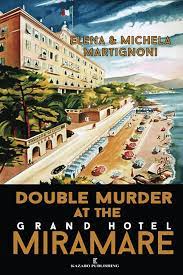
Double Murder at the Grand Hotel Miramare, by Elena and Michela Martignoni


9781948104241
Kazabo Publishing, 2023
originally published as Doppio delitto al Miramare, 2015
178 pp 

paperback

I really enjoy reading translated fiction, no matter the genre.  My last couple of reads (outside of crime) came from Argentina and Mexico, and I'm always delighted when something new in translation comes along.   I'm not quite sure who specifically translated this book, Double Murder at the Grand Hotel Miramare, but there is a baker's dozen of translators listed as being on the translation team, which is something I hadn't encountered before.    According to goodreads, this book is number five of the thirteen in the series featuring Deputy Assistant Chief of Police Luigi Berté,  written by these two women under the name of Emilio Martini.  [sidebar:  one of the books on the goodreads list is shown as number 4.5 so I have no idea what that means, exactly -- how do you write half a book?  It's always tough starting a series that's obviously well underway,  and  although the authors allude to some past events in Berté's life (a messy breakup, some sort of trouble in Milan and a move to his current location in Lungariva along the Ligurian coast),   I feel like I didn't quite have the entire story, which was a wee bit frustrating;  on the other hand, the holes in my knowledge didn't exactly hinder my reading experience too much so it was okay.  

It's Easter Monday, and Berté has his heart set on both a wonderful lunch at the Pensione Aurora and seeing Marzia, the married woman with whom he is in a secret relationship.  But, as he says after a phone call from his sergeant,  "a double murder has a way of distracting you from your thoughts, as well as ruining your plans."  Called to the luxe Hotel Miramare, he finds the two victims, "permanent guests" there,  together in bed in one of the hotel rooms, evidently shot while sleeping by someone  in a "blind rage" who was neither a professional nor someone too familiar with the use of weapons.  Both of them are employed by Countess Licia Trevisan, a very wealthy woman whose husband, the Count Van Der Meer, had made his fortune in South Africa. She is, as the manager notes, "one of our most important clients."   The male victim is Roberto Sommariva, an accountant, while the female victim, Ornella Ferrari, is the Countess' secretary.    After talking to his boss, Berté learns that along with his regular colleagues Pasquale Parodi and Francesca Belli, he has been assigned help from a homicide unit and a forensics team from Genoa.  He will need it -- not only is the hotel packed with guests who are all potential suspects,  but the Countess, who may just be a suspect herself, is being rather tight lipped with the police.  And quite frankly, she rubs Berté the wrong way from the start.  As the two teams get to work,  they discover that there is plenty of motive to go around; the further they get into the investigation, they realize that there are also plenty of secrets being kept that need to be unraveled if there is any hope at all of catching the killer. 


from Corbaccio


I enjoyed this book so much that when I'd finished it, I asked Chiara from Kazabo if any more of these books had been translated.  I got a no for an answer, but the point is that I was ready to hit the buy button if they had.  There's a lot to like here, beginning with the main character, who banters with his conscience that he's named "The Bastard" (whose words appear in italics), who is constantly razzed about this ponytail, and who has a good working relationship with his two main colleagues as well as with the team from Genoa.  Berté has a temper, can get angry in his job and likes to do things his way; at least he's smart enough to realize that in this investigation at least, there are times when he's walking on thin ice.  Like his father, also a member of the police force,  he is a huge fan of detective novels, and the authors have scattered different titles and writers throughout the novel that shed light on Berté's favorites (and obviously, their own influences in crime writing).    I also want to highlight the fact that the core mystery itself connects distant past with present, which I love in a novel of any genre.   And while there is romance involved here, it's not so distracting as to mess with the investigation/crime solving narrative, which I've seen happen all too often.  Finally,  Double Murder at the Grand Hotel Miramare is a nicely-plotted,  old-fashioned murder mystery written without gore or gratuitous sex,  making it a pleasure to read.   How often does that happen these days if you're not a cozy reader? 

I would like to thank Chiara for offering me the opportunity to read this novel and sending me an e-pub version, which I promptly forgot about until her much-needed but gentle nudge made me feel so guilty about sitting on it that I actually bought a copy.  I love what Kazabo does, offering crime fiction (and other books)  in translation from authors whose work has not yet reached an English-speaking readership.  I would recommend this book to anyone who is a fan of translated crime/mystery fiction, as well as to readers who just want to curl up with a good mystery novel where the focus is actually on the mystery itself.  


Saturday, February 20, 2021

The German Client, by Bruno Morchio


9781948104180
Kazabo Publishing, 2020
originally published 2008 as Rossoamaro

kindle edition

A few days ago I received an email from Kazabo reminding me that in March of 2020 I had said that I would be very interested in reading and posting about this novel.  I was actually horrified that I had completely spaced on doing that, so I bought a kindle copy right away (even though the lovely people at Kazabo had sent me an ecopy -- the least I could do, really), and then  yesterday I dropped everything to spend the day reading.   All I can say is that in March of 2020, on top of everything else going on, coronavirus became a new and intense stressor in our home;  quite honestly, I'm not surprised that I dropped the ball.  So to Chiara, my humble and sincere apologies.  

Bruno Morchio (short bio here)  is the author of a number of books featuring private detective Bacci Pagano; while his work is well known in Italy, The German Client is the first of his novels to be translated into English.  The story begins in Genoa's Sestri Ponente  in January of 1944,  as a young girl makes her way to her boyfriend and "his comrades" who are waiting for her on Mount Gazzo, all partisans in a patriotic action group (PAG).   The Sestri Ponente had been the "center of industry" with "more workers than anywhere else," making it "the heart of Genoese Resistance."    Unfortunately for Tilde, she is out after curfew and is arrested.  She is suspected of being part of a "partisan relay" and spends the night in jail before she is released the next day. Fast forward to the present day.  Bacci Pagano waits outside of a guarded hospital room where a woman, Jasmine,  is fighting for her life. As the book blurb states, if she survives,"her testimony will shatter a notorious human trafficking ring."   As he sits outside of her door, he is approached by a certain Kurt Hessen from Köln who has a job for him.  It seems that he would like help in finding his brother, about whom he knows virtually  nothing except that "he is the son of an an Italian woman named Nicla" who may have been active in the Resistance and that he might live in Sestri Ponente. He knows no first name, no last name, and he has never seen a photo of the guy; what he does know is that he too is Nicla's son, and that his father had been stationed in Genoa as an officer of the Wehrmacht before being killed by a bomb at a local movie theater in May of 1944.  Hessen is dying, and he would like to find his brother to leave him a substantial inheritance.    At first Bacci is reluctant to take on the case but changes his mind.   He knows that he will have to start with former members of the Resistance, which he does, but when he begins asking questions, he soon realizes that even though World War II has been over a very long time, there are some things that these old Resistance partisans would rather not discuss.   Bacci also discovers that by talking about the past,  he "seems to have uncovered a world that had been safely buried." The story moves back and forth between present and past until these buried secrets are eventually revealed. 

The German Client is a fine historical crime drama as well as a reminder that while history is never forgotten, for those who were actually a part of it there are perhaps some things just too painful to speak of.  It's a fascinating book, especially when we're in the Sestri Ponente during 1944 along with the Resistance fighters.  The author sets up an ongoing tension there that highlights not only the dangers of being involved in these PAGs, but also the necessary secrecy and the questions of whom one can actually trust.  These pages were flipped like crazy because I was so involved; the present narrative is also done very well, always linked to the past, with one exception:  the story of how Jasmine came to be in the hospital, staged in the manner of a more contemporary-style thriller.  While I'm not a huge fan of that sort of thing, the mysteries of the past that connected to the mysteries of the present were more than enough to satisfy. 

One more thing: at the end of the kindle edition of this book is a link to Kazabo's website, so of course, I went there.  I was happily surprised looking at their "Criminal Destinations" series, all of which will be coming to my home at some point over the next couple months.  It's high time more of these books are translated and made available to an English-speaking mystery-reading public, so good on you, Kazabo! 


Tuesday, November 27, 2018

and now, back with my old friends from Italy once again: The Pyramid of Mud, by Andrea Camilleri

9780143128083
Penguin, 2018
originally published 2014 as La pirimide di fango
translated by Stephen Sartarelli
256 pp

paperback

Well, here we are at book 22 in this series, and I'm still in love with Inspector Montalbano and have no intention of ever falling out of love with him.  I'm looking at the Camilleri page at Stop You're Killing Me  and there seem to be only two more novels coming our way.  Oh, what a sad day turning the last page of the last book will be, but I'll enjoy them while I can.

I actually read this book back in October so I had to give it a quick reread before posting.  Montalbano's seen plenty of corpses in his career, but this particular dead man found in a tunnel at a construction site doesn't sit well with the inspector.  The barefoot  man was wearing only a pair of underpants and an undershirt, and had been shot in the back. Evidently, he had gone outside like this earlier that morning, and to top matters, he had come to the construction area on a bicycle.  But here's the thing: how could he have ridden the bike uphill, mortally wounded,  in the middle of a storm where it was "raining like there was no tomorrow?"   The inspector begins with the assumption that the man was fleeing from someone, but who? And what did it mean that he went into the tunnel? Was there some kind of message there?   He quickly gets an ID on the dead man and makes his way to the house, where another surprise awaits which launches Montalbano headlong into an investigation that, as the back-cover blurb says, takes him into a world "just as slimy and impenetrable as mud."

Without going into too many details here, The Pyramid of Mud is another good one from Camilleri; at the same time it's a bit darker in tone than many of the other books in this series.  It ventures into the realm of corruption, and while that's nothing new in a Montalbano novel, we find Salvo despairing, comparing the crime scene and mingling of blood with mud with the state of things in Italy:
"...the mud had entered the blood, become an integral part of it. The mud of corruption, of payoffs, of phony reimbursements, of tax evasion, cams, faked balance sheets, secret slush funds, tax havens, bunga bunga... it was all a symbol of the situation in which the whole country found itself at that moment." 
 What makes this book a bit darker in my opinion is that while he's having to cope with solving this crime, which, as in other Montalbano stories is just the tip of the iceberg,  he realizes that his mind is just not on his work.   It is, as he says,
"as though the real Montalbano had gone away and delegated matters to a rough copy of himself, a stand-in devoid of hunches and ideas, unable to make connections and draw conclusions, lacking energy, passion, vitality ..."
proceeding through the investigation  "with the same enthusiasm with which he normally signed memos in his office."  It all relates to Livia, who is having a very difficult time coping with life after events from a previous book.  It's not our usual Salvo here, and as a long-time fangirl of this character, it's really quite difficult to be caught up in his pain.  Gah -- even now I'm starting to choke up just thinking about it.


all 22 Montalbano books on the shelf, and I wouldn't part with them for the world


  LOL -- I don't usually get this involved with characters who live in crime novels, but these people are like friends whose lives entered mine some years ago and have never left.   Quite frankly, as I've said before, the people in these books are what keeps me buying and reading them, well, that plus Camilleri's savvy examination of the ongoing problems faced by his country, as well as the humor in pretty much every story and okay, the ideas I get from the food.

As I say each time, do NOT start late in the series.  Not only am I pretty much OCD when it comes to reading series novels in order, but with these books, readers who start at random will miss what came before, and each book builds on the others.  I love Inspector Montalbano and the people who surround him, and I seriously doubt that there's ever been a mystery series that has given me as much joy as this one.   And yes, book #23 was pre-ordered long ago.


Monday, September 4, 2017

back to the present with A Nest of Vipers, by Andrea Camilleri

9780143126652
Penguin, 2017
originally written in 2013 as Un covo di vipere
translated by Stephen Sartarelli
261 pp

paperback

"... it was one thing to send the killer of a good man to jail, and it was something else entirely to put away someone who had killed a stinking scoundrel."  -- 43

Here we are at book 21 -- I don't believe that I've ever stuck with a single crime series for this long, but anyone who's even read one of my Camilleri posts knows what a fangirl I am for the escapades of Salvo Montalbano and his colleagues.  According to stopyourekillingme.com there are only three more books left to be translated/published as of 2016, and it will seriously be the end of an era for yours truly when the last one is released. As for this one, the title is beyond appropriate and although I won't say why or how, it moves into a zone of darkness in which  Camilleri found himself  lacking  "courage" enough to fully explore at one time in his writing career.  I don't mean to be intentionally cryptic, but once you read this novel, you'll understand.


The Dream, by Henri Rousseau, from MOMA

Those dream sequences that have been used by Camilleri to open these books for the last several years are not just throwaways -- they will, in time, come back around to have something to do with the actual plot. That is very much the case here as Montalbano becomes involved in the case of the murdered Cosimo Barletta, a wealthy widower who was found dead in his seaside home.  With very little to go on except for some strands of hair, the police start looking into Barletta's background and discover that he had not only, as the cover blurb notes, "a history full of greed and corruption" including loan sharking, but also a rather sadistic hobby involving a number of young women, any of whom may have had a motive to kill him.  That's about all I give away about plot and even that can be found from the cover description, but the story, as I said, reveals a darker side that just might start twisting your guts as it starts winding down to a solution.

Normally I would have nothing but praise for one of Camilleri's novels, but this time around I think that Camilleri didn't go his normal distance.  To be sure, the things I enjoy about this series are still here -- the camaraderie between Salvo and his colleagues, the jokes built around the prosecutor and the doctor, the lovely feel of this little slice of Sicily and Salvo himself -- but despite the somewhat horrific story which unfolds, this is definitely not up there with the author's best books in the series. First of all, I cottoned on to what was going on long before Salvo figured it out which is never good; second, there's the introduction of a somewhat enigmatic character whose purpose isn't quite clear until the end, where he provides a sort of verbal  deus ex machina (that I won't discuss) that gives Salvo a bit of  a nudge in the right direction.  Considering that Camilleri had actually written (but not published) this novel in 2008 after writing The Potter's Field (2007) which later won him the International Dagger Award,  well, it could have been a much stronger book than it actually turned out to be. 

Still, as I said, once I became aware of where this story was headed, my stomach was churning, so it did provoke a strong reaction; I was also quite impressed by one of the main themes in this book in which Montalbano spends time pondering,  as the back-cover blurb and  the quotation with which I opened this post reveals,  "where justice lies," and in this case, readers are left with an outright serious conundrum. And now that I'm actually thinking about it, the way in which Camilleri sets up the question within the titular "nest of vipers" is very nicely done. It's too bad I can't explain this thought in more detail  but careful readers will understand.  

 I am pretty much unyielding (okay, downright persnickety)  about reading books in series order, so my advice is to not let A Nest of Vipers become your starting point in this series -- each book builds on the previous so you'll miss way too much if you don't read them in order.  And while it may not be Camilleri's  best, this book is still well worth reading, especially for die-hard fans of the series among whom I count myself. 


crime fiction from Italy


Saturday, February 25, 2017

A Voice in the Night, by Andrea Camilleri

9780143126447
Penguin, 2016
originally published as Una voce di notte, 2012
translated by Stephen Sartarelli
274 pp

paperback

I don't think I've ever kept up with a crime fiction/mystery series for as long as I have with this one, but A Voice in the Night is the 20th (!) installment in Camilleri's series featuring Salvo Montalbano. To say that I love this series is an understatement -- it's light but not too light, funny,  and yet at the same time, Camilleri never fails to draw attention to some aspect of political or social issues in his own country.  More importantly, though, Montalbano and his cohorts are like old friends at this point; they are people I enjoy revisiting every now and then. I don't think that there is another crime fiction series out there (and I've read TONS) that has given me so much pleasure, which is another reason that I love these books.

There are two cases at work here, both of which have the dubious distinction of setting Montalbano (and his superiors) between the proverbial rock and a hard place.  First, there is what seems to be an ordinary supermarket robbery, which turns out to be anything but ordinary.  Second, a young man who a) turns out to be the son of the provincial president,  and b) pushes Montalbano's road-rage buttons by driving erratically turns up again to report the murder of his girlfriend.  Both cases have to be handled with kid gloves and Montalbano has to come up with some clever workarounds to ensure that justice is served. Around the action, once again we find Salvo in his own head, musing about old age (the book starts on his 58th birthday), politics, the media, and lack of respect for the elderly among other things.

For me to stick with a series for so long is unheard of -- what I've discovered over the years is that some authors would be better served letting their series run take a rest.  As someone once told me when I was very upset with the end of the excellent Wallander series, sometimes it's better to go out gracefully and leave your readers with good memories rather than to drag something out forever and get stale.  After 20 books I can honestly say that I don't see how Montalbano and his motley crew can go down that second road --  I have so much fun with Montalbano that I've already pre-ordered the next one (due out in August), A Nest of Vipers. As long as Camilleri's novels continue to be published, I'll continue to read them.


crime fiction from Italy


Sunday, September 11, 2016

Off to Italy this time with The Disappearance of Signora Giulia, by Piero Chiara

9781782271048
Pushkin Vertigo, 2015
originally published as I giovedi della signora giulia, 1970
translated by Jill Foulston
122 pp

paperback

Set in 1955, The Disappearance of Signora Giulia is one of the most truly baffling mysteries I've read in quite some time.  By the time I finished this book, I was totally perplexed.  And trust me -- after having read thousands of mystery novels in my time,  "baffling" is not a term I throw about willy nilly, but I'm certainly not going to spill my guts as to why I found it so.  

 Commissario Corrado Sciancalepre returns from a conference with the Chief Constable in the "small town of M_____" in Northern Lombardy and gets a big surprise.  Waiting in his office is Esengrini, the area's "most agile and authoritative criminal lawyer" who is there with an "incredibly serious matter," which, as he puts it, will likely turn his entire life "upside down."  It seems that his wife, the titular "Signora Giulia," has left home, and Esengrini needs Sciancalepre's help in trying to find her.  La Signora was supposed to have caught a train that day for Milan, which she does every Thursday, to see their daughter Emilia at her boarding school, to make the rounds of various places in the city, and to do things for her friends while she's there, catching the two p.m. train and coming home by 7:30 in the evening.  On this particular Thursday though,  it seems that Signora Giulia never caught the train.  When Sciancalepre returns with Esengrini to his home, he discovers that perhaps she'd been planning to stay longer than her usual few hours this time -- her bedroom is "a complete mess," a lot of clothing has gone with her and so has her jewelry.  Her husband had also heard her "moving around continually, opening drawers, shifting chairs" the night before, and according to him, she was "agitated."  But wait. It's here that the first of a number of secrets pervading this novel comes tumbling out, as Esengrini confesses to the Commissario that he'd known for some time she'd been seeing other men on those Thursdays, using the visits to her daughter as a cover.  He'd even had her followed four months earlier because Giulia, 38, had started turning cold toward her 60 year-old spouse in the last year, and Esengrini had wanted to know why.  Sciancalepre offers to try to find her, but this is 1955, and he needs Esengrini to bring a charge against her so he can do so.  Esengrini decides it's going to be a case of "abandoning the marital home," which is enough for our Commissario to begin his search.  But this is definitely NOT going to be an easy or simple case of finding a runaway wife, and Sciancalepre doesn't realize at the time that this case is will be years in the solving, and even then ....

Despite some minor lulls here and there in the telling, The Disappearance of Signora Giulia is beyond compelling and it's certainly one of the most unconventional crime stories I've ever read. It is a true whodunit in every sense of the term, with a big, no make that huge,  twist I never saw coming.  When I finished it, the first words coming out of my mouth were "that's just brilliant," and if anyone reading this post decides to read it, you'll see why.  I pondered over that ending for some time and when a book makes me do that, well, I call it a good one.

Very much recommended, especially for readers of older crime novels, for readers of international crime, and for readers of crime fiction who enjoy something completely different.

Sunday, May 15, 2016

and we're back, with a Pushkin Vertigo double feature: The Murdered Banker and The Hotel of the Three Roses, by Augusto de Angelis


I have just loved the Pushkin Vertigo books I've read so far, enough to where I've preordered every single book with this imprint that I don't already have. One I had to go to the UK to buy (not physically, obviously), but I'm good through December of this year. I hope this imprint goes on for a very, very long time -- much like my favorite press Valancourt Books, PV is bringing back some old vintage crime stories that have either been long forgotten or frankly, novels which I've never heard of.   The crime novels by Italian author Augusto de Angelis are a great example of a series I didn't even know existed; I've read two now and really, really, really want to read more.

The Murdered Banker and The Hotel of Three Roses both absolutely  hit the spot while sitting out on my hotel balcony last week during my vacation. Written in the 1930s, the mysteries in these books for me are highly satisfying, but they are also notable for their explorations of human nature. In the first one de Angelis introduces his main character, Police Inspector Carlo DeVincenzi, Commissioner of Public Safety in Milan, whose raison d’être as a police officer is "an interest in human justice."  However, de Vincenzi often finds it difficult to solve his cases because of reluctant witnesses who may tell a part of what they know, but for their own reasons tend to hold back on information that would actually allow DeVincenzi to do his job in a timely manner.  In the two I've read, de Angelis has characters who have been heavily burdened with secrets; his people run the gamut from starving artist to wealthy financiers, each with his or her own conflicts, desires, weaknesses and strengths,  which if not actually having some bearing on the solution of the crimes,  still offer a picture of what made people tick at a certain time in a certain place.  


9781782271703
Pushkin Vertigo, 2016
paperback, 187 pp
"...above all, there's an interest in human justice, which I believe in and which I must uphold..."

Any time a mystery novel opens in the fog, I do a little happy dance since I know that what's coming is going to be hazy, murky, and a bit of a challenge in terms of seeing things clearly.  This is definitely the case in The Murdered Banker,  where a "bituminous lake of fog" has settled on Milan, making it nearly impossible to see anything.  The opening scene captures two men "moving across the piazza," as "ghostlike shadows." As it turns out, one of these men is the main character Inspector Carlo de Vincenzi, who is heading into the station just after midnight.  After a while de Vincenzi settles in to read his book, Lawrence's  The Plumed Serpent (not Pirandello, as someone else guessed).   While inwardly musing about why he's a cop, and why he'd become the Commissioner for Public Saftety, he is joined some time later, about 1:30 a.m., by his friend and former classmate Gianetto Aurigi, who has just come in after a night at La Scala seeing Verdi's Aida.  He had watched the opera in the box belonging to Count Marchionni and his family; Marchionni is Aurigi's future father-in-law, as he is engaged to his daughter Maria Giovanna. He claims he's been walking around since and that his wandering had brought him to the station to see the inspector.  But soon he opens up with his financial troubles, revealing that he needs "half a million" -- it seems that he owes this sum to someone, and that it is due that very day.  He can't tell Marchionni without facing the prospect of losing his bride-to-be. While they are talking, the phone rings, calling de Vincenzi to a crime scene. After he hangs up, the inspector instructs Aurigi to remain at the station and leaves an officer to ensure that Aurigi doesn't leave. The reason is not that the inspector wants to continue the conversation when he returns, but that the crime he's been called out to just happens to have occurred in Aurigi's apartment.  As he begins his investigation, it all adds up to Aurigi as chief suspect, but through his "intuition and psychological impressions" the Inspector knows that he's the wrong guy.  As other suspects are brought into the case, each with his or her own secrets, de Vincenzi realizes that if he doesn't get to the truth of the matter, the innocent may be caught up in the "machine that will grind them up." His mission -- to save the innocent, and to bring the guilty to justice.

De Vincenzi believes that a crime, when "not a crime of passion," is "a work of art! A work perversely and criminally artistic," and it's obvious to me that De Augusto's writing reflects this idea.  At the same time, it's not so artistic that the whodunit element gets lost -- The Murdered Banker is a solid mystery story that is not only enjoyable, but also very well laid out in terms of buried secrets that could easily serve as motive, creating a group of possible suspects whom de Vincenzi must eliminate one by one to solve the crime.  He takes his time getting there, but that also is part of the author's craft -- creating the reluctant witness who doesn't want those secrets to come out at any cost.  By the time the actual culprit is discovered, it's a rather eye-opening moment, something I look forward to in any mystery novel.  Here it's done right, and done well, although sometimes the writing itself can be a bit overdone, but a) it's the first in a series which is often touchy, and b) the crime and the investigation are both so well plotted that it's forgivable. 

De Vincenzi is definitely not your ordinary police inspector -- he works, as noted above, through his impressions and his gut feelings. His reading material speaks volumes about who he is as a person -- Plato's Eros, for example can be found in his desk drawer at work. As a policeman, though, it's all about feeling "the poetry of this profession" -- as he notes
"because I am perhaps a poet, ... I feel the poetry of this profession of mine, the poetry of this dusty grey room, of this shabby old table, of the poor old stove, whose every joint suffers in order to keep me warm. And the poetry of the telephone! The poetry of the nights of waiting, with the fog in the piazza coming right up into the courtyard of this old convent -- now home to the police station, housing criminals in place of saints! Of nights in which nothing and everything happens, because in this huge, sleeping city, even as we speak, there are infinite dramas, even if they're not all bloody. Actually, the worst ones don't end in shooting or with a knife." 
He has this ability to size up situations and people, and often sets things up like a stage director, moving his characters here and there, putting different people together to see what happens, etc. etc. until conditions are just right for him to see everything  -- you know, that moment when the fog lifts and things are visible once more.

It is a fine start to a series that so far I am really enjoying.

Moving on to the second book (although seventh in actual publication order),


9781782271710
Pushkin Vertigo, 2016
220 pp
paperback

we come to The Hotel of the Three Roses, the blurb of which promises a "chilling gothic mystery" and "bloody drama." It is an example of one of my favorite sorts of mystery tales in which a tragic, horrific past comes flying back full throttle into the present, and oh, what a chilling tale there is to tell here. 

It's 1919, and Inspector De Vincenzi has received a very strange anonymous letter about things at The Hotel of the Three Roses, "an unknown third-rate hotel...not the kind you just just stumble upon," in Milan: 
"...A horrible drama is brewing, one that will blow up if the police don't intervene in time...the devil is grinning from every corner of that house."
 De Vincenzi is asked by a colleague if he thinks it's a joke, but the Inspector  realizes that "precisely because it is so ridiculous,"  there is something strange going on and that indeed it is definitely not a joke. Just to be on the safe side, he gets the lowdown on the people who are staying there at the moment.  Then, as if on cue, he receives word that there is a dead man at the hotel, one of the five on whom he has gathered information.  Feeling "profoundly disturbed," the Inspector had a "vague presentiment that he was about to experience something dreadful."  After beginning the official investigation into the death, which looks like a suicide, he realizes that it is actually indeed a murder.   The main question for De Vincenzi going into this investigation is precisely this: "Who was Douglas Layng?  And how had this young Englishman ...come to be killed in Italy?"   He realizes right away that this is no ordinary crime, and  that "He would have to battle with the devil. Flush him out, give chase." He also knows that "only the psychological aspects of the crime can reveal the truth."  But before he can devote his full attention to the Layng murder, he finds a clue that warns that  Layng's death just might be the opening salvo in "the beginning of a series." And sure enough, there's another murder. Time is of the essence, and De Vincenzi must solve this one quickly, since as he realizes,
"His adversary was the sort who never misses a chance, and never loses."
However, as in The Murdered Banker, he is again confronted by a hotel filled with suspects, each of whom is reticent to share his or her secrets.

The Hotel of the Three Roses is a fine mystery story with its roots in the past.  Here the inspector finds himself "groping around in the darkness," trying to fit all of the little snippets of clues he's gathered before anyone else becomes a victim.  He also has to figure out how the people currently at the Hotel of the Three Roses are tied together, making for a solid piece of detective fiction.  Once again, though, it's his need for justice that pushes him toward the truth.  As he says,
"What's done is done, unfortunately. The dead don't come back. But human justice does exist, and it must act to defend society." 
Much of this novel is based on the idea of justice -- maybe not in the way that De Vincenzi thinks about it, but justice all the same. Sadly, I can't really say how this is so,  because I don't want to spoil anything for the next reader.

 This book was extremely satisfying for me in terms of the mystery itself, the variety of characters and especially in terms of the process of crime solving.  Again -- often a little overblown writing-wise here and there, but as with The Murdered Banker, the mystery is intense and good enough that the writing just isn't that much of an issue.  I am growing rather fond of the Inspector, so I hope that Pushkin Vertigo continues the series and that more of  de Angelis'  books continue to be  translated for eager readers like myself who love  vintage crime.

both books are definitely recommended!!

Thursday, September 3, 2015

A Beam of Light, by Andrea Camilleri


9780143126430
Penguin, 2015
270 pp
originally published as Una lama di luce, 2010
translated by Stephen Sarterelli 

paperback

One thing I really enjoy about this entire series is that the tone of each story, as well as brief hints to what's coming, are both established right at the outset.  Many years and many books ago, Camilleri began to start these novels with  Montalbano in a sound sleep and deep in a dream before being rudely awakened by someone at the office who's looking for him. After the first couple of times I was like "well, that's definitely gimmicky," but as time's gone by, the author has really refined how that entire sequence relates to the rest of story. He has actually outdone himself with that technique in this installment (number 19) -- I won't say why, but he nails it this time.  He's also nailed the story -- A Beam of Light is, like its predecessor, trading much of the quirkiness of  many of the earlier books for a more serious story here, one that gets downright sad.  I'll go on record as saying that it offers readers a glimpse of Montalbano at his most mature self  as compared to his character in the preceding novels.  

At the opening of a new art gallery Montalbano meets and finds himself instantly attracted to the gallery's owner, Marian.  The two hit it off right away, but Marian is soon tasked by a buyer with finding some works of art that will take her out of town.  Luckily, there are a couple of different cases to fill his time until she gets back.  First, a young woman is robbed of a large sum of money at gunpoint late at night by someone laying in wait,  after which she is subjected to a kiss by the bandit.  The story doesn't quite ring true to the inspector, so the team goes to work to try to ferret out the truth.  While that's going on, Salvo is also occupied with looking for a pair of Tunisians who just may or may not be involved in the arms trade and who have gone missing shortly after he'd come to talk to them.  Then there's the case of the body left burning in a car, where the evidence points to possible Mafia involvement.   While he's kept very busy running here and there between investigations,  Salvo spends  most of his time coming to terms with his feelings about both Marian and Livia. 

While there are some truly funny moments here, mostly centering around Mimi Augello and his undercover work as an attorney, A Beam of Light is more about Montalbano reaching a sort of crossroads in his life and having to make some important decisions about the future.  While the crimes are intriguing, most especially the case of the kissing bandit, it's the inspector's personal life that takes center stage in this one.  People who've been with the series since its beginning will definitely appreciate this particular story more than someone who hasn't, although sadly, I can't say why.   I don't mind saying that the ending made me a bit teary-eyed, but to find out why, well, I suppose you'll just have to read the novel. 


Regular fans will NOT want to miss this newest book, and as I always say, do not let this latest installment be your introduction to this excellent series, most especially because of what happens here.  I also have to say that I don't often get so attached to fictional characters, but after reading these books for so long now it's really impossible not to with this odd group of quirky people, and I'm particularly fond of Montalbano himself. He's like an old friend that I hear from now and then as we both get older.  Granted it's a one-way conversation, but I love hearing from him.


crime fiction from Italy


Saturday, August 29, 2015

an Italian crime double feature: Game of Mirrors, by Andrea Camilleri and Black Run, by Antonio Manzini


Two crime novels from Italy which couldn't possibly be any more different from each other are the topic of today's conversation.  For one thing, Game of Mirrors is Camilleri's 18th series entry while Manzini makes his crime debut with Black Run.  For another, the two main characters, Montalbano and Schiavone are like polar opposites of each other.  Montalbano is the good-natured detective we've all come to know and love, while Schiavone, if you'll pardon the bluntness of my expression here, starts out as a complete asshat.  In Schiavone's defense, there are a number of reasons for why things are like this with him (one big one you don't really comprehend until  the last pages of the book), but he is definitely what I'd call a most unlikable kind of guy.  However, I'm not someone who needs to love the characters in books I read, and when all is said and done Black Run is a good series opener. But more later.  First, Game of Mirrors.


97801431223774 
Penguin, 2015 
 originally published as Il Gioco degli specchi (2011) 
 translated by Stephen Sartarelli  
 277 pp, paperback

As I said at the outset, Game of Mirrors is the 18th installment in Camilleri's Montalbano series, and from day one I've thoroughly enjoyed each and every book.  That hasn't changed, although it does seem to me that Camilleri has taken a more serious direction this time around.  Salvo is still Salvo though, still eating at Enzo's trattoria, still taking time to meditate on his rock, and still getting in trouble with the ladies while Livia isn't around.  This time it's his new neighbor, the knock-out Signora Liliana Lombardo.  

As usual, Montalbano's strange dream opens the novel, interrupted (thankfully) by a call reporting that a bomb has gone off somewhere.  No one is hurt, thank goodness, but trying to discover who set it off and why is the squad's major challenge.  As the investigation proceeds, Liliana is doing all she can to seduce the Inspector both publicly and privately, leading Salvo to question her motivation.  Not that he's not an attractive man, but still -- even to him she's overdoing it.  While the bombing investigation proceeds, Salvo finds himself under fire from his TV-reporter nemesis Ragonese, but when things start to escalate and dead bodies start turning up, Salvo realizes that someone really has it in for him.  By the time things come to this point, the hunt is on for exactly who this might be, and more specifically, why Salvo himself has become a target.  He is, in short, "faced with a a series of occurrences without any apparent reason behind them." 

Reading this novel, you might notice that this book isn't quite as funny or as critical as the past installments have been and that here the focus seems to be much more on trying to connect the dots between a series of strange crimes.  At the same time, the story has all the same characters, relationships, and dialogue that together with Montalbano's quirkiness have kept me reading through eighteen books.  I think what I enjoy most about this book beyond the usual craziness and the convoluted crimes is Camilleri's flair for catching the people whom one might run into on the streets.  There's a great scene (184,185), for example,  where an old man is sitting in a building's courtyard, smoking a pipe, complaining that he doesn't talk to his daughter because she doesn't want him smoking inside the house.  The old guy is just so perfectly captured here that you can't help but laugh, especially when he punctuates his complaints by spitting "a clot of dense brown material that looked like prune jam."   But please, PLEASE do not let this book be your first introduction to Camilleri's novels -- you will have missed precisely what makes these books so wonderful and so worth the wait for each and every new book.  Getting back to the oddball combination of realistic crazy people in these books is the highlight of each installment.  I will be SO incredibly bummed when this series is over.  

And now, to the new guy, Antonio Manzani and his Black Run.  Frankly, I feel a bit badly about writing 


9780062310040
HarperCollins, 2015
originally published 2013 as Pista nera
translated by Antony Shugaar
255 pp
hardcover

about the two books in the same space, because reading the two is really like reading apples and oranges, if you'll excuse the borrowing of the cliché.  On the back cover, there's a blurb by Camilleri which reads
"Manzini devotes more space to his characters than to events, and the detective story is a pretext for talking brilliantly about Italian society."
and I would have to agree with him wholeheartedly.  Set in the alpine mountains of Val D'Aosta in Italy, the book starts off with a gruesome scene, beginning with a snocat operator  making his way in the dark down  a mountain ski track heading into the village of Crest at the Champoluc ski resort.  He's singing out loud, "hitting the high notes," while cheerfully listening to Ligabue on the radio.  Suddenly, he realizes that the snocat has hit something.  He gets out, and notices feathers being blown about by the wind.  Still uncomprehending, he walks on, until he runs into an "enormous" red stain, "churned into the white blanket of snow."  The next look he takes has him throwing up -- and this is where we meet Deputy Police Chief Rocco Schiavone, who is awakened during a sound sleep and sent out to have a look.  The discovery of a mangled body puts Schiavone in charge of a case that has any number of potential suspects once the dead person is identified.


Schiavone is not, I repeat NOT, your typical crime-solving Chief Inspector. For one thing, he has this bizarre habit of meeting a person and giving them some sort of animal equivalent in his head, genus, species, order, suborder. He's prone to ridicule those who serve underneath him if he finds them lacking.  He is a definite ladies' man but at the same time, comes off as a misogynist; he is also prone to using violence or threats as a means of putting fear into people.  He scoffs at the people of Val D'Aosta as they seem to be beneath him somehow, and he's crooked.   Everything gets compared to Rome, where he'd previously worked before he was sent seemingly into exile where he is right now.  The story of what happened in Rome has to wait until later in the book, but when it comes out, it does sort of give you an idea of why he became what I called an "asshat" at the beginning of this post.  However, he is very, very good at what he does even if you don't agree with his methods or you don't think that's how cops ought to work, and by the end of the book, I actually felt kind of sorry for the guy.  In coming to understand him, something popped out at me right as the book was about to end, where the author describes him as someone who was 
"...struggling to leave behind the ugliest things he'd lived through. Who was trying to forget the evil committed and the evil received. The blood, the screams, the dead -- who presented themselves behind his eyelids every time he shut his eyes." 
He finds himself in "a swamp," which "was always there," where
"... the boundary between good and evil, between right and wrong, no longer exists. And there are no nuances in the swamp. Either you plunge in headfirst or you stay out. There is no middle ground."
While the mystery itself is kind of run of the mill,  as far as the bigger picture goes as Camilleri says, the focus is all on the characters.  As he also notes, Manzini doesn't hesitate to draw attention to problems in "Italian society," which I'll leave the reader to discover.  The bottom line to me is that  while it is definitely tough to warm up to Schiavone until you see where he's coming from, I'm drawn way more to character than to plot so Black Run is most definitely in my wheelhouse.  Personally, I think that readers who've given low ratings to this novel are looking more for a thriller sort of thing that they didn't get and that perhaps they've sort of misunderstood Manzini's emphasis on his main character.  Oh well.  I thought it was a fine debut series novel and I will definitely be waiting for the next one.


crime fiction from Italy


Tuesday, October 14, 2014

back to my old tbr pile with Angelica's Smile, by Andrea Camilleri

9780143123767
Penguin, 2014
originally published as Il sorriso di Angelica, 2010
translated by Stephen Sartarelli
293 pp

paperback

"The game cositts o' doin' a most damage y'can do to the apposing couple, who'd be the avversary, bu' also trying' a proteck y'r own partner from danger." --- Catarella, 226. 

It is so nice to finally get back to my original big giant pile of crime fiction novels  that have just been sitting here stagnating for what seems like forever. And what a way to start, with one of my all-time favorite crime novelists, Andrea Camilleri.  Angelica's Smile is seventeenth in Camilleri's Montalbano series, with what seems to be four still yet to be translated into English.   As usual with these books, the focus in this story isn't so much on the crime or the crime solving,  but instead on Montalbano and the people surrounding him. This one is a little more on the personal side, with less reference to the social, economic and political issues that Camilleri usually brings to his work.

Our beloved inspector is now just two years short of sixty, and as in the last few books, he continues to muse about aging and growing older throughout the novel. He's still with long-time girlfriend Livia, and as the story opens, she is at Marinella with him for a few days.  As he's worrying about someone named Carlo she mentioned while talking in her sleep, and getting more upset by the moment, he is called to the scene of an odd burglary.  The couple that was robbed had been at their seaside home, where they'd awakened at six a.m. only to discover that they'd been "knocked out with some sort of gas," while the burglars "had the run of the place."  It was their anniversary, and they were entertaining each other at the time, so neither person heard any sort of break in.  Among a long list of valuables taken from the seaside house, the thieves stole their car and then proceeded to rob their regular residence. The only people who knew that the couple were going to be away were fifteen of their friends. As things turn out, there had been another burglary, "an exact duplicate," just three days earlier - and it isn't too long before the same thing happens again. When Montalbano is called out on yet another, he meets the titular and beautiful Angelica, the victim and also the "spitting image" of a woman he used to lust over as a teen in  Dore's illustrations of Ludovico Ariosto's 1516 work Orlando Furiosio, a  "poem about war and love and the romantic ideal of chivalry."  After seeing her for the first time, he's immediately swept off his feet -- and definitely attracted.


But even while he's mentally and physically lusting after his Angelica, as well as playing the role of her rescuer, there is still a number of crimes to solve -- including a murder -- and as an added distraction, the mastermind of the crimes is taunting the police, and then there's Livia, of course.

While it's pretty funny to see Montalbano as a loopy, lovesick puppy completely smitten by this reincarnation of  his teenage fantasies,  and while Camilleri continues his long-standing tradition of inserting colorful characters into the mix, let me offer a word of warning here as far as the crime solving goes. I made the huge mistake of going to Sartarelli's notes in the back re the poem Orlando Furioso (a natural inclination),  and twigged the entire plot all at once. Not the why of it, mind you, but trust me - if you read carefully, it's all there metaphorically speaking.  I figured out much more than I should have at an early stage, and ended up being disappointed, and that's not an adjective I generally use when it comes to this series of books.   And then there's this: I'm wondering if the author is getting a little tired -- this book just didn't seem to have the same oomph as his earlier Montalbano adventures that have been so lively up to this point. Still, it's a fun read, and in that vein I have to say that I probably haven't had so many good laughs with any other crime fiction series as I have with this one.  Like I've said before, you don't read Camilleri's novels for the crime -- it's all about the characters.

Thursday, January 30, 2014

Gold, Frankincense and Dust, by Valerio Varesi

9781906694371
MacLehose Press, 2013
originally published as Oro, Incenso e Polvere, 2007
translated by Joseph Farrell

paperback (UK)

"Precariousness is the human condition."

Gold, Frankincense and Dust is the third book in the Commissario Soneri series after River of Shadows and The Dark Valley. River of Shadows was okay, and I loved The Dark Valleywith its rich atmosphere and excellent characterizations, and I realized after reading that novel that Varesi was an author I'd watch in the future. So when I saw that this book had been published, I bought it and well, frankly, it wasn't all I'd hoped it would be. On one level, there's a really good mystery here and some well-outlined and important social issues; on another, though, it was overshadowed by way too much of Soneri's personal life to the point that it detracted my reading from the punch that the core mystery might have delivered without it.  Then again, it's a personal preference of mine to prefer edgy crime over a main character's inner angst, so it's one you absolutely have to read and decide about for yourself

Gold, Frankincense and Dust has a great opening -- Soneri is called to the scene of "one hell of a pile-up" on the autostrada, even though it's really a case for the flying squad. His expert knowledge of the Lower Po Valley is why he must go, especially because there's a heck of a fog that's settled in.  Once he arrives, there's chaos within a somewhat surreal atmosphere -- bulls are roaming around with a cow and a herd of a pigs, causing his partner, Juvara, to pose the question of whether or not they've landed in Animal Farm.  Disco music is blaring in the background at a fairground. Smoke is everywhere, adding to the fog's confusion.  As the police and firefighters arrive and start looking around, they discover a body which has been badly burned.  Soneri, despite opinions that the body must have been thrown from the car during the accident, believes that this was not the case -- that the body had been burned somewhere else and then brought to where it was found.  Through a stroke of good luck, there is a clue as to the body's identity, and it is identified as being that of a young Romanian girl named Nina Iliescu.  It doesn't take long for Soneri and his colleagues to realize that this is no ordinary woman, and that her life is filled to overflowing with secrets. Add to this  the old man who got on a bus with twenty euros and two photos and never made it to his destination alive -- and our Commissario has his hands full.  But keeping himself focused is tough for Soneri -- his personal situation with Angela has become a bit iffy, making him fearful that "loneliness lay in wait" if  she decides that he's not really the man she wants in her life. 

As in his other works, Varesi's finest talent lies in his ability to evoke atmosphere and maintain it throughout the novel.  The first scene in the fog sets the tone for the rest of the novel, as his investigations uncover a host of things that lay hidden, and not just in the life of the dead girl.   Being able to navigate in the mist in the Po Valley is one thing; trying to navigate his way through a murky personal life where he can't see the outcome is another.  He's also good at writing characters, and the mystery of the dead girl brings out people from many very different walks of life.  And then there's Soneri himself -- whom

"in every victim, ...  found the frustrations of all human affairs, and for this reason he always felt close to them."
In this book, one of the main themes running throughout the story is that of "precariousness," as revealed through Soneri's personal life and his interactions with those who live on the edge of poverty and on the margins of society.  Varesi carries this theme throughout the book and he does it well.  Unfortunately, considering everything this book has going for it, Soneri's constant worries about being a middle-aged man teetering on the brink of loneliness because of Angela's tendency to wiffle back and forth about her future  took away a lot of the fun of the crime solving.  By the time it got to the end, I really wanted this book to be over.  On a personal level, that's  tough for me to say, because I normally enjoy reading this author's work.

But then again, as I noted above, my preference leans toward edgy without much inner angst within the characters (unless it's noir, then bring it on) so my complaint about all the personal stuff interfering with the crime solving may not be something that bothers other readers.  It's a little involved for cozy readers,  and doesn't have the edge loved by readers of noir, so I'd place it within the police procedural bracket with an added middle-age crisis sideline.  And finally, although this book didn't really do it for me, I will be waiting somewhat impatiently for Varesi's next book to be published.


Wednesday, September 25, 2013

Treasure Hunt, by Andrea Camilleri

9780143122623
Penguin, 2013
originally published as La caccia al tesoro,  2010
translated by (who else!) Stephen Sartarelli

278 pp
softcover

"... it wasn't a fiction, but a reality, though a reality so absurd as to be very nearly a fiction."


When I opened this book yesterday afternoon, I knew that everything else on the planet would just have to wait because it was going to be my best friend for the next few hours. I even got up at 4:30 this morning to finish it because I wanted absolutely no noise, no interruptions, no nothing to come between me and the latest exploits of Inspector Salvo Montalbano.  For me mystery series come and they go; sometimes I might try one or two before I beg off and move on looking for something better than the last -- but Camilleri's Montalbano novels are among my favorite books in my crime fiction library, not so much for their "whodunit" quality or for the crimes contained between their covers, but because of the people in these books.  I've been with Montalbano and his crew since the beginning, so by now, in my head,  they've become sort of like old friends.  Treasure Hunt marks the 16th installment of this fantastic series, and it made me laugh out loud through much of the first half.  While the actual crime solving feels like laziness on Camilleri's part (or so it seems to me), the novel is filled with all of the familiar components that make these novels consistently unique and a pleasure to read. 

One day in the midst of a calm season for crime, criminals, and the cops,  there's something new in Vigàta for all and sundry to see -- a banner hanging off of an apartment balcony belonging to Gregorio and Caterina Pamisano, "a couple of senile old dotards who happen to be religious fanatics,"  telling sinners to repent.  A week later, another banner appears warning sinners that these "dotards" will punish them.  As the third week rolls around, the cops take notice, or at least Montalbano, when a third banner warns

"WE WILL MAKE YOU PAY FOR YOUR SINS WITH YOUR LIFE!!!"

Salvo takes it seriously enough to order a municipal policeman to remove the banners.  Not a good idea -- the residents, indeed two elderly siblings who are extremely religious -- start shooting at the cop.  Down below, people are getting out of the way, as the shooters start to rain gunfire on the crowd.  The arrival of a fire truck  equipped with a long ladder allows Salvo to gain entry, and soon the situation is under control. The siblings are taken into custody, the elderly sister looking "as if she'd just stepped out of a horror novel," but there are more disturbing things found in the apartment, among them a "decrepit"  inflatable doll laying in the brother's bed. It had lost some hair, "was missing an eye, had one deflated tit and little circles and rectangles of gray rubber scattered all over its body."  As the author notes, "For a horror film, it wasn't a bad beginning."  After everything's taken care of there, things slide back into crimeless tedium until later the police receive a call about a body in a dumpster which turns out to be another inflatable doll, identical to the one found earlier in the shooters' creepy apartment, down to the the little patches all over its body.  While Salvo's busy trying to figure out what's going on, he remembers a letter he'd received and stuffed in a pocket, marked "Treasure Hunt" on the outside of the envelope.  At first, it seems like a good diversion from the sheer ennui of waiting for something to happen,  but soon things begin to go from "curious" to deadly serious, leading Salvo to realize that the treasure hunt may not be such a big joke after all.

Let me just get on with the negative bit first.  Actually, there's only one, having to do with the real crime in this book, but sadly, if I say why this part is a disappointment,  I'll give away the show so I really can't discuss it.  Okay, I'm being purposely vague, but someone may thank me later. Or maybe not. If you're a serious crime fiction reader, you'll hit on the problem in no time.

The opening of the novel sets the tone for the rest of the book --  here not so much with the action scenes, but via the whole play on horror film/novel scenarios, beginning with the inside of the Palmisano's apartment.  The crosses, the other rooms of bizarre things including a piano-playing rat in the darkness, the appearances of the brother and sister, the inflatable doll and Gregorio's reaction to Montalbano's examination of the doll on his bed all conjure up creepy images one would expect to find in a movie or book destined to be the stuff of nightmare, perfect for a dark and stormy night.   Yet as Montalbano tries to come to terms with the fact that he seems to be the only one of his men unnerved by the experience, he also understands that what he saw "wasn't a fiction, but a reality, though a reality so absurd as to be very nearly a fiction."  As events progress throughout the story, the reader will realize exactly how appropriate his thought turns out to be.

Even though the crime's solution may be nothing to write home about, as I'm so fond of saying, the crime solving and the actual police work is not really why I love and continue to read these novels -- it's all about the people, the places, and the writing, and above all, Inspector Montalbano, who manages to find himself in the strangest situations.  The first part of the book  is filled with laugh-out-loud funny scenes involving Salvo's handling of the two inflatable dolls, as well as a running gag about them being discovered by different people.  There are the usual snarky references to ongoing social and political issues in Italy, even down to why the criminals seem to be taking time off.  Livia and Salvo have words, the crew at the police station are once again in fine form, and Salvo's age is once again the focal point of ongoing worries that spark conversations between Montalbano One and Montalbano Two.  Ever present through each and every novel -- and Treasure Hunt is no exception --  is  Salvo's ongoing love affair with mouth-watering local cuisine, and Camilleri's seemingly effortless ability to drop the reader right into the Sicilian landscape.

Treasure Hunt is just one more book in an already excellent series of sixteen (there are more, but they haven't yet been translated); if you're reading this book for the crime plot it may feel a bit disappointing, but true fans will still find a lot to love here. As usual, my advice is to not start with book sixteen -- each book builds on the other so go back and start at the beginning. 

Tuesday, July 16, 2013

Death in Sardinia, by Marco Vichi

9781444712278
Hodder and Stoughton, 2012
originally published as Il Nuovo Venuto, 2004
translated by Stephen Sartarelli
454 pp

paper, UK
american edition: 2014, Pegasus books

"A policeman must do his duty to the best of his ability ... But above anything else, he must be ... fair ..." 

Just when I thought I'd had it with Inspector Bordelli and his long-winded war reveries, and flirtations with giving up smoking,  along comes Death in Sardinia to change my mind.  This book is much more on task than the previous two, enough so that I've already preordered Vichi's  Death in Florence, which I should get in November some time. 


It's 1965, Christmas is fast approaching, and Bordelli is called out to investigate the death of a notorious loan shark named Badalamenti,  who has ended up with a pair of scissors deep in his neck.  Bordelli had once tried to investigate Badalamenti, but was denied;  now that he's dead, the inspector has full access.  The coroner performing the autopsy pulls an engraved ring out of the dead man's stomach, and he lets Bordelli know a bit of information about the killer to help Bordelli narrow down his search.  Going through the loan shark's apartment, Bordelli stumbles upon a hidden space filled with promissory notes, compromising photos of a woman, and a collection of wedding rings. He also finds pictures of a young girl, with the name "Marisa" on the back.   Going through all of the names on the notes, and looking at the photos,  Bordelli decides that Badalamenti's murderer must be among them, and sets about returning the notes to Badalamenti's customers while sizing up each one as to whether or not he is the killer. In the meantime, his trusty sidekick Piras has gone home to Sardinia to recuperate after being shot while in the line of duty; while there, a family friend shoots himself, causing no end of grief for friends and family, but Piras realizes that something's not right -- and after the funeral it dawns on him: where was the shell from the shot?  Both men have their hands full trying to sort things out. 

Death in Sardinia tackles not only these crimes, but also gets more fully into Bordelli's character.  He realizes that he's not getting any younger, and waxes about aging; he also realizes that although the war that is always on his mind has been over now for two decades, it may be time for him to "stop looking at the world through its prism." Besides, in this day and age, the new generation of young people 

"could no longer bear hearing the older people's complaints about the war and having to queue up for bread.  The tears to be cried had already been shed. Now it was time to start living again, and having fun. Maybe they were right." 

More importantly, Bordelli comes to realize that the letter of the law doesn't cover every situation, and that he must apply principles of fairness and understanding while on the track of justice.

This book moved much more quickly than its two predecessors, and there was more of a clear path from crime to investigation to solution than in the earlier novels.  Although there was still the war reminiscing and memories to fill the pages, and although there was quite a bit that could have been taken out to move the book along and make it much tighter, it really is the best of the series so far. As in his other two novels, past and present meaningfully intersect in this story, here maybe more so, a quality I actually like in these books.  And while there's a good mystery here, it's not so edgy or gritty,  so it's perfect for those who enjoy lighter crime fare.

crime fiction from Italy