Showing posts with label Penzler Publishers American Mystery Classics. Show all posts

Tuesday, March 8, 2022

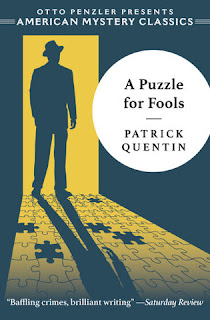
A Puzzle for Fools, by Patrick Quentin


 9781613161258
American Mystery Classics, Penzler Publishers
originally published 1936
237 pp

paperback


"It had been a puzzle for fools..."


A Puzzle for Fools is #21 on the Borges/Bioy Séptimo Círculo list, and it's a good one.  It is also the mystery series opener for the nine books featuring Peter Duluth, Broadway producer, ranging datewise from 1936 to 1954.    

Peter Duluth has known his share of tragedy.  His wife Magdalene had died in a fire in the theater, and as a result his life started to hit the skids.  After "drinking to an eight-hour-a-day schedule" over the last couple of years,  and not "particularly reluctant" to drink himself to death, he decided that some time in a sanitarium might be a good idea.  Detoxing was pretty tough at first, but he made it through the worst and now, under the care of a trusted psychiatrist, he seems to be doing pretty well.  His "spells of depression" are less frequent and his physical self was also improving.  As this story begins though, he's not sure sure of himself -- it seems that in the dark of his room, he hears his own voice whispering to him he must get away, and that "There will be murder."  He knows he's not saying these things, and his fright overtakes him until he speaks to his psychiatrist, Dr. Lenz,  who lets him know that "this is not the first disturbing thing which has been reported recently," and that whatever he sees or hears "out of the ordinary, that thing is real and has its basis in fact."   The doctor also feels that there is a "subversive influence" at work in his sanitarium, causing him to worry about the patients and asks Peter for his help. While patients might not reveal things to him that upset them, they might say something to a "fellow inmate."   

It isn't long until he learns about the strange things that are happening among the other patients, including a few who, like Peter,  have also heard themselves talking when they know they weren't.   More talk of murder follows, and it isn't too long until talk gives way to action and someone is actually killed in a way that leaves no traces of violence.  It's a bizarre crime on the impossible side, and while Peter has been allowed to keep up with the police and their investigation in confidence,  he has some ideas of his own as to how to discover who among them is a killer.   However, before he can make any real progress, the strange occurrences continue to plague the patients, and then there's another death. 

After my less than great experience with A Puzzle for Players I was more than a bit  reluctant to once again wade into this series, but  I was surprised at how very much I enjoyed this one.  For one thing, the atmosphere is set at the beginning and doesn't let up over the course of the story.  There's just something compelling about the scene of the crime being inside of a sanitarium with its darkened corridors, locked doors and secrets; even better, this story really is a puzzle -- the author offers any number of clues to put together to get to the heart of this mystery, and his characters are so nicely drawn that at some point I realized that nearly every person in the sanitarium was a potential candidate for suspect, and that ultimately in this story, you can't really trust anyone.   

Don't miss the introduction by Otto Penzler; while I don't quite agree with Penzler's assessment of Puzzle for Fools as a "suspense thriller in the Alfred Hitchcock mode," it still makes for a good few hours of fun and unputdownable reading.    Recommended to those readers who enjoy these older mysteries.  The armchair detective in me was highly satisfied -- I never guessed the who and so I was completely taken by surprise when all was revealed.  I call that a win. 


Tuesday, July 28, 2020

The Red Right Hand, by Joel Townsley Rogers.

"... it was a pretty good play, as criminal plays go."


Two of my favorite mystery/crime novels within the last year or so have come from Penzler Publishers American Mystery Classics series.  First on the list is Dorothy Hughes' excellent Dread Journey, and now there's this one, The Red Right Hand, by Joel Townsley Rogers.


9781613161654
Penzler Publishers, 2020
230 pp
paperback

Originally published in 1945, The Red Right Hand  begins with our narrator puzzling over a number of "baffling aspects" of the story that we are about to read, starting with how it was that he completely missed a car that had to have been
"so close that its door latches must have almost scraped me, and the pebbles shot out by its streaking tires have flicked against my ankles, and the killer's grinning face behind the wheel been within an arm's length of my own as he shot by?"
 Was there, asks Dr. Henry N. Riddle,
"something impossible about that rushing car, about its red-eyed sawed-off little driver and its dead passenger that caused me to miss it complete?" 
But the "most important" thing "in all the dark mystery of tonight,"  is the question that opens this book as he ponders
"how that ugly little auburn-haired red-eyed man, with his torn ear and his sharp dog-pointed teeth, with his twisted corkscrew legs and his truncated height, and all the other extraordinary details about him, could have got away and vanished so completely from the face of the countryside after killing Inis St. Erme."
Sitting at the desk of a certain Professor MacComerou, he goes back in his mind to  "set the facts down," so that he can "examine the problem," thereby launching this most strange but genuinely satisfying mystery story that kept me baffled right up until the end.  It all begins in New York when  Inis St. Erme borrows a friend's Cadillac so that he and Elinor Darrie can run up to Connecticut to be married.  Not wanting to wait the mandatory three days in New York, they make their way to Danbury, where they discover that they'd have to wait five days, so there's a change in plan: they'll be moving on to Vermont to tie the knot. First though, they make a stop at a local grocery and decide to have a picnic at a quaint little place called Dead Bridegroom's Pond  recommended by the grocer.   Along the way they pick up a hitchhiker who waits in the car while Inis and Elinor go on down to the lake. But their romantic picnic is interrupted when their passenger attacks St. Erme and goes after Elinor before driving away with the car, leaving her there frightened but unhurt.  Obviously, the same can't be said for St. Erme, as we know from Riddle at the very beginning that he's been killed.    Dr. Riddle, as stated on the back-cover blurb, "discovers a series of bizarre coincidences that leave him questioning both his sanity and his own innocence," but he is most seriously disturbed by how he could have missed the Cadillac as he was walking on the very road from which the car emerged at the very same time that he was there. But things are going to become even more weird before we catch up with the good doctor in real time, at which point the entire bizarre plot unfolds and all is revealed.

To say any more about the plot of The Red Right Hand would be absolutely criminal.


my growing Penzler Publishers American Mystery Classics shelf, appropriately shaded in a sort of noirish shadow. 


I love the originality displayed here in terms of plot and especially style.  This is not just another average mystery from the 40s, to be sure; it moves away from the norm from the get-go.  As author Joe Lansdale says in his introduction to this edition,
"The story moves back and forth in time, akin to the natural thought process, as if the whole thing were spilling out of the narrator's brain from moment to moment, and we were seeing all the in-betweens of thought."
 He also notes the "near stream-of-consciousness" style used by Rogers, and I don't think it would have had the same impact done any other way.  I've seen this book described a few times by readers as "surreal," and that's not an exaggeration -- at one point a dancer weighs in on how to solve the many riddles nested within this case:
"You need to wear a leopard skin, a chiffon nightgown, and a feather duster on your tail, and dance the beautiful dance of the corkscrew and the bottle."
Red herrings abound, so much so that I was completely baffled; there is quite a bit of repetition as well as a number of bizarre coincidences that run throughout this novel, two elements I normally detest and yet, somehow it all seems necessary here and more importantly, it works. As one of the policemen says toward the end of this book, "... it was a pretty good play, as criminal plays go."  I couldn't have said it better myself. 

Joe Lansdale's own reading experience with this novel sort of mirrors my own when he says that at times he
"... felt as if I were seeing the world through a dark and grease-smeared window pane that would frequently turn clear and light up in spewing colors like a firework display on the Fourth of July. At the same time there was that sensation of something dark and damp creeping up behind me, a cold chill on the back on my neck."
I felt that "cold chill" more than once during my time with this book.  It is genuinely one of the most bizarre mysteries I've ever read, with a solution that I never saw coming, one that is completely and utterly satisfying, an ahhhh read to be sure.    I can honestly think of nothing negative at all to say here.

very much recommended; it should delight readers of old mysteries and readers who are looking for something out of the box in their crime fiction.


Thursday, January 16, 2020

pure writing excellence: Dread Journey, by Dorothy Hughes


9781613161463
Penzler Publishers/American Mystery Classics, 2019
187 pp 

paperback

Every once in a while (with mega-apologies for the cliché about to be used), I run into a novel that not only knocks my socks off storywise  but also leaves me confident that for the duration of my reading I am in the hands of a master of the craft.   Dread Journey is one of those, and I have to wholeheartedly agree with Anthony Boucher who said of this book (to quote one of the editorial reviews on Amazon)  that it is "Not to be missed under any circumstances."

 Dread Journey is certainly not your average mystery story.  I had an inkling that such was the case on reading the first words of the novel:
"I'm afraid." 
The woman who spoke those words hadn't meant to say them out loud, and it isn't too long before we find out a bit more of what's behind her reasoning:
"It wasn't a tremble of fear. It was a dark hood hanging over her head. She was meant to die. That was why she was on the Chief speeding eastward. This was her bier."
Movie actress Katherina (Kitten) Agnew realizes that it doesn't have to be this way, since she has another option open to her.  She could go to the director of the film she is scheduled to star in (also on the train) and "release him of all obligation," and "from the verdict of death."  Vivien Spender would then be free to star his "newest discovery," young Gratia Shawn, as Clavdia Chauchat in his planned movie production of Mann's The Magic Mountain, the role which he had had in mind for Kitten when he'd first discovered her.   The thing is though, that Kitten won't back down.  Knowing what had happened to those who had come before her, the "innumerable Clavdias," encompassing

"The one in a home for alcoholics. The one picked up soliciting. The one who jumped from a window while Viv was in Florida with the new. And the others, returned to the drabness from which they had once hopefully emerged, walled behind counters, playing walk-ons"

she had hired an attorney to draw up an "unbreakable contract for the role."  But Spender wants Gratia, and Kitten knows from past experience with the man that he usually gets what he wants.  Hence the "Dread Journey," and the suspense begins from Kitten's not-meant-to-be-spoken-out-loud comment and is maintained throughout the story to the point where the book becomes absolutely unputdownable.  

Had this been the sum total of the novel, it still would have been good, but Hughes puts her characters under serious scrutiny here.   As Sarah Weinman notes in her excellent introduction, the author's use of "omniscient viewpoints," allows the reader to examine

"the characters' inner sancta and excavates their fears, their desires, their jealousies, their dreams with the most exacting literary scalpel."

Along with the building suspense, it is Hughes' ability to get her readers directly inside of her characters' heads that elevates Dread Journey well beyond just another crime/mystery/suspense novel, pushing it well into the literary zone, as she has done with the other books of hers I've read. 


 1947 Pocket Books edition, from Goodreads


As just one of the many characters populating this novel, it is the porter James Cobbett who is the most interesting of them all.    He is a man who "had pride in himself," someone who "didn't consider a man equal to him unless he were equal in dignity and pride."  Given that he is African-American, it's to Hughes' credit that she didn't stoop to the racist stereotypes of her time or those which came before.   Cobbett is a sort of outsider, detached from the action of Kitten, Spender, and the other members of this drama; at the same time after  years of doing this job, he has an incredible understanding of human nature.  He sees himself as "responsible for this car and its tenants," and knew instinctively when "something was wrong."    In one absolutely perfect run of prose that lasts for nearly five pages in Chapter Six, it is through Corbett's observations that we see what's happening as he watches his group of passengers while suffering under an unshakeable "weight of depression," and it is not too far off the mark here to say that when "Something cold touched the root of his spine" as he sat watching,  something cold also touched the root of my own spine.  It is a most chilling five pages that I will  never forget.

I love Hughes' books,  and this one is no exception.   It is all about the writing and her ability to direct us immediately into the minds of her characters here, and on top of all that I've mentioned so far in this post, she has an underlying story about the abuses of power and a look at how things really worked in the Hollywood of her time, which is not at all pretty.  It is also a window on the times, with characters down on their luck and affected by the war.  There is so much happening in this little book that keeps it from being just another crime story, and  I'm delighted that Penzler Publishers has released this new edition of Dread Journey.  Despite the fact that Hughes' books are great, she is still widely unknown, so hopefully people will pick up a copy and discover her writing genius for themselves.    I'd recommend it to Hughes readers who perhaps haven't made their way to this novel or readers who, like me, prefer the more literary side to their reading across genres.

I LOVED this book -- it is pure writing excellence and pure reading pleasure.  I can't ask for more.