Showing posts with label séptimo circulo. Show all posts

Sunday, June 19, 2022

A Taste for Honey, by H.F. Heard


 9781613161210
Penzler Publishers, American Mystery Classics, 2019
originally published 1941
197  pp

paperback

Still following the séptimo circulo list, up next after Night Over Fitch's Pond comes H.F. Heard's A Taste for Honey (#25),  published in 1941 and reprinted in 2019 via Penzler Publishers' American Mystery Classics series.    The book was made into a 1966 film called The Deadly Bees, but more on that later.  

Last week my insomnia flared up again and I grabbed this book  hoping I'd read until drifting off.  The complete opposite happened -- once I started it I couldn't stop.  It wasn't because it's a great book, but more because what happens here was so far out of the range of most mystery/crime novels of the period and so completely unexpected that I knew there would be no sleep that night.    The story is related by Mr. Sydney Silchester, a reclusive  sort of fellow who had come to a small village in the countryside for peace and quiet. He lives under a self-made rule of "keeping myself to myself," wanting to be "left alone, at peace," preferring his own company to that of others.   Evidently something has happened to shatter his solitude and he feels the need to "set it all down" so that his record (narrated retrospectively), will let people know that he had very little blame in the matter, the whole thing having been "forced" upon him.  What follows is not exactly a mystery but a sort of bizarre story that borders on pulpy horror (not the supernatural type but more like a sort of mad-scientist adventure caper), and while there is some  detection involved here,  this is by no means a whodunit.   And it all begins with Silchester's fondness for honey, which he buys regularly from a certain Mr. Heregrove, the local village apiarist.   At one point Silchester discovers that he's running low on the stuff, and while considering his next visit to the Heregrove's farm, he learns from his house cleaner that Mrs. Heregrove had met an untimely end after being stung to death by her husband's bees.  Though the coroner's inquest arrives at a verdict of accidental death, Heregrove has been ordered to destroy his hives, which leaves Silchester without a supplier.  Not keen on asking around the village due to his "dread of business dealings" that might lead to "social entanglements," he finds himself in luck one day while out on a long walk, when he happens upon a sign advertising "a certain amount of honey" for sale.   Happy to find a new supplier,   he goes on to meet the man who posted it, a certain Mr. Mycroft, who, along with the honey, also provides him with an interesting theory.   As the back-cover blurb says, Mr. Mycroft "senses the bloody hand of murder,"  meaning that he believes that Mrs. Heregrove's death was not an accident at all.   That will be it for plot, I'm afraid, because there is no way that I'm going to ruin the show for potential readers.  

Despite some testing of my patience with Silchester and Mycroft because of their often lengthy expositions on various topics,  I had great fun with this novel.   I have to seriously offer a tip of my hat to the author on even coming up with this crazy plot, which had it not been for Mycroft's habit to  (and pardon the pun) drone on and on, might have made for better reading.  On the other hand, the nature of the villainy revealed here allows for the author to discourse about the limitations of the law which, in this case, leaves these two men no alternative but to handle things themselves.    As Mycroft notes,
"The law protects us from the sudden, unpremeditated violence of the untamed blackguard. It is helpless against the calculating malice of a man who patiently and deliberately studies to get around its limitations  When you have really faced up to the fact ... that the law, the magistrate and the village policeman are helpless to protect you, then you will be free to consider the unavoidability of step two of doing what we can do."
The situation comes down to a battle of the minds, with uncountable lives at stake if things go wrong.

 I should warn potential readers to leave the introduction for last as Otto Penzler reveals "one of the surprises in this book" in his assumption that "the secret has been revealed often enough that few readers will be astounded."  I suppose he never thought that perhaps there are still some readers like me who have neither read this book nor discussed it with anyone before, so that's certainly a big oopsie on his part.   And as to that secret, well, it's not hard to figure it out pretty much right away with all of the clues offered by the author. Trust me, that's the least concern in this novel.  Also, if you are one of those readers who must find something likeable or relatable about the characters, it's very likely you won't find it here.  All in all it was a fun read, not perfect by any means, but still very much worth the time.  
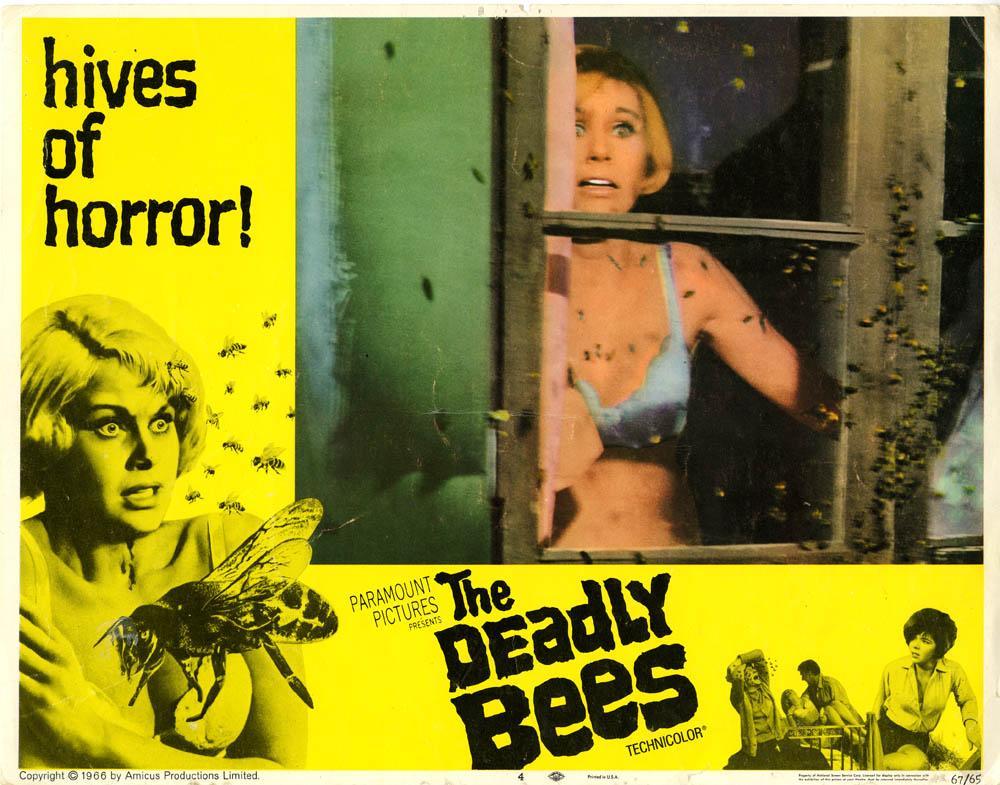


movie poster, from filmaffinity


As to that movie (an Amicus production) I mentioned earlier, the original screenplay was written by Robert Bloch,  but the director of the film, Freddie Francis, evidently didn't like it and along with Anthony Marriott, decided to change it.  That's a shame really, and according to the B&S About Movies blog, Bloch never saw the film but did say that Deadly Bees "buzzed off into critical oblivion, unwept, unhonoured and unstung."   It would probably appeal only to true-blue diehard connoisseurs of old horror films because it was pretty bad, with the plot centering around a pop singer who has gone to Heregrove's farm for a rest after fainting from exhaustion during a television performance.  The roles are actually flipped in this film, with Mr. Mycroft (still painfully expository) as the bad guy.    I couldn't actually lay hands on a copy to watch but I did find an MST3K (of which I've been a huge fan for eons) episode on youtube which didn't actually quite deaden the pain; even the sarcastic bot banter couldn't save the experience. 
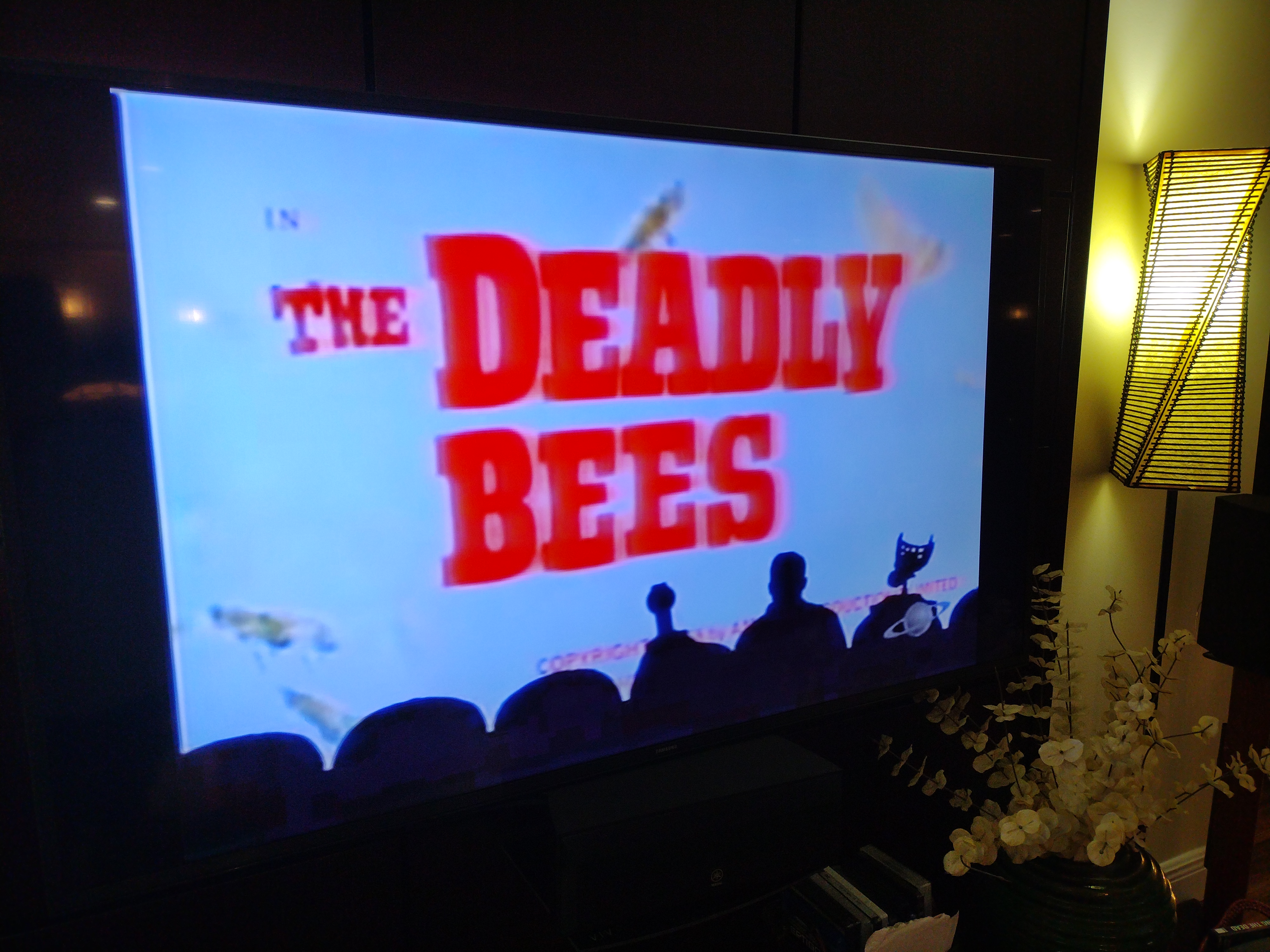


MST3K version, my photo


I  also watched an episode of the Elgin Hour, "Sting of Death" (1955), which stars Boris Karloff and hews much closer to the novel than the later 1966 film.  This one is worth the watch, although  the scope is rather limited, I suppose,  due to the allotted television time. It also won the Edgar Award for best TV episode in a series in 1956.  


Boris Karloff as Mr. Mycroft


Bottom line: book fun, movie bad; book recommended just because it's so very different and strange, movie is definitely skippable unless you are a masochist.  


Friday, June 3, 2022

Night Over Fitch's Pond, by Cora Jarrett


Houghton Mifflin Company, Riverside Press, 1933
292 pp
hardcover


"There's a moment in the history of any tie between human beings that settles for good the question of who's going to be top dog." 


Night Over Fitch's Pond is number 24 on the Borges/Bioy list of mystery novels, and it is my introduction to author Cora Jarrett (1877-1969).  As a brief aside, I did read number 23, ECR Lorac's Black Beadle (1939), but it was a long while ago, I didn't really care for it all that much, and I was well behind reading schedule so I didn't post about it.  Oh well.  Things are FINALLY settling here at home (after what, two-plus years?)  so I'll just be moving on.   

One particular thing I'm enjoying about going through the Borges/Bioy list of books is that  it affords me the opportunity to read novels I have never read before, and in this case, an author I'd not heard of before starting this project.   Cora Hardy was born in Norfolk, Virginia, and after studying at Bryn Mawr, The Sorbonne and Oxford,  she entered into what would become a lengthy teaching career and married Edmund Seton Jarrett in 1906.   According to a blurb about her book The Ginkgo Tree at Abebooks, she "began writing in her 50s,"  with Night Over Fitch's Pond  her first novel.  She would go on to write five more novels, a number of short stories and a play, and as Barrie Hayne notes in Reilly's Twentieth Century Mystery and Crime Writers , Jarrett's books are "deep probings into abnormal psychology" (Springer, 2015; 858), which is very likely one reason I liked Night Over Fitch's Pond as much as I did.  

The novel begins as our narrator, Walter Drake, sits by the body of Julius Nettleton in a cottage on Fitch's Pond, "a small solitary lake of great beauty."  Reflecting back on events that led to Julius' death, his mind replays what had happened over that particular summer, looking for any kind of clues as to what might have happened out on the lake that caused Julius to die.   

Julius and Mary Nettleton had first come to Fitch's Pond to visit their son George at a camp on the lake owned and run by a man named Maxon. They had discovered two abandoned cottages there, and Julius bought them both -- one for his family and one to be rented out.   Later, after the Nettletons had spent four summers on the lake, Julius had invited Walter to spend his summer at Fitch's Pond as a guest in their cabin.  Walter soon realizes that the Nettletons are no ordinary couple -- Julius, as he notes, wanted Mary to be  "a housemate only, a housekeeper, a serviceable kind of companion," while Mary had decided to "bear with humors of Julius."  Life at the Nettletons, both at home and at the lake, it seems, is built around what "Julius will want..." with Mary acceding to his wishes despite what she might want.  Walter, it seems, is also secretly in love with Mary but doesn't understand why she caves in so easily to what her husband wants.   


The real trouble begins when new tenants, Rolf and Eloise Deming,  move into the second cottage.  On first meeting Eloise, Drake comes to the conclusion (eventually proving correct) that Eloise would "go over the lot of us like a steam-roller," and secretly hopes that Julius would "get his proper come-uppance from this woman he had brought among us." He also realizes  that it would be Mary who "would pay," also a spot-on insight, especially when it hits him that Mary and Rolf had quietly fallen for each other and that Eloise knows.  Drake goes on to describe a  campaign of mental tortures inflicted on Mary by Eloise  taking readers to that "one fatal evening," which had "brought our whole precarious cardhouse of outward appearance at Fitch's Pond slithering and toppling down."   "Abnormal psychology" indeed -- there's a reason why Eloise is referred to as "an Iago in petticoats," but the one really deserving reader scrutiny here is Julius, as Drake spends that long night "laboring to plumb ... the bottomless dark" of his mind.  

While reading, my thoughts often came back to a  passage I'd marked earlier in the novel where Drake is told by a friend that 
There's a moment in the history of any tie between human beings that settles for good the question of who's going to be top dog," 
 and without giving anything away, all I will say is that there is much more than a kernel of truth in that statement, played out right up until the end.  To say much else would be criminal; in the long run, while Night Over Fitch's Pond  may not be a typical mystery story,  after the first few slow-ish chapters, I couldn't put it down.  The truth is that I enjoyed it so very much that I bought a copy of Jarrett's Pattern in Red and Black (1934; Coachwhip, 2017)  written under her alias Faraday Keene.  This character-driven story may not be for everyone, but there's just something about the deep delve into people's dark psyches  that appealed to me.  

Recommended, mainly to readers of older mysteries, as well as to people who, like myself, are always on the lookout for something different and who love finding the writings of authors whose works have pretty much faded away into obscurity.   


Tuesday, February 1, 2022

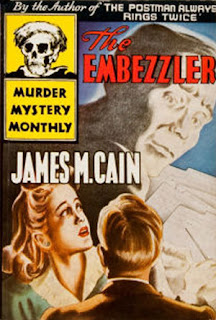
The Embezzler, by James M. Cain


Avon Book Company, 1944
(Avon Murder Mystery Monthly No. 20)
originally serialized as "Money and the Woman" 1938
108 pp


paperback


Ask someone which books they've read by James M. Cain, and my guess is that the answers won't likely include this book, The Embezzler.  Actually, until I started reading my way through the séptimo circulo list, I didn't even know it existed, and I'm sure I'm not alone here.   

Set in the Los Angeles area, bank vice president Dave Bennett has been sent from the home office to a Glendale to check up on "not what was wrong" with the Anita Avenue branch, but rather "what was right with it."  The ratio of savings deposits to commercial was "over twice" that of any other branch, and he'd been tasked by his boss to find out "what the trick was" so that it might be something that could be used at the other branches.    When the novel begins, he's working as acting cashier.  The man responsible for such great numbers is the head teller, Charles Brent, but  Bennett likes neither his method nor the man himself, the latter for reasons he doesn't quite understand.    

Two weeks after Bennett arrives, he receives a phone call and a visit at his home from Charles' wife Sheila, who has a strange request.  Charles, it seems, needs an operation immediately to repair a duodenal ulcer, "verging on perforation," but he is worried that things will "go to ruin" at the bank if he's not there.  Would Bennett let her take his place at the bank?  She's definitely qualified, having worked at the bank in the past, and she knows "every detail" of her husband's work. As he considers his answer, it strikes him as a good idea, not only because of the "general shake-up" Brent's absence would cause, but also because he'd "liked this dame from the start."   So Sheila's in, and one day while she's out trying to bring in a loan, Dave takes over her window and discovers just that Brent's work success hides something else -- an $8500 discrepancy in the books.  Even worse, he discovers that Sheila knows all about it, but he's in love with her -- what to do?   Everything rests on Dave's decisions from this point on.  

By this point in the novel, I already had a feel for what was about to come, and for the most part, I was right.  What kept me reading wasn't so much the action here but my deep  mistrust of Sheila pretty much to the end so I had to see what happened on that front.  I mean, Cain had  already written Double Indemnity, albeit in serialized form (1935 -- it also appears along with The Embezzler in Three of a Kind in 1943)  so I couldn't help but wonder if Dave's judgment would be clouded by his instant infatuation with Sheila, or if she was going to turn out to be another Phyllis Nirdlinger taking Dave down the road to destruction.  No spoilers from me on that score. 

All in all a decent read, but I was more than a bit disappointed with the ending which one reader on goodreads described appropriately as a "major no no" for noir.   No spoilers from me, but jeez -- given all that had come before it just did not work.   Think "sappy" and you've pretty much got it.  


from IMDb

I would love to watch the film made from this novel in 1940, and I found a place that has transferred it to dvd, mine for only $25. Done, making me a happy person.    Unfortunately the shipping was like $45, making me an unhappy person,  so I guess I'll wait and hope to find a copy another time.   

If you're a fan of James M. Cain's books and want to read beyond the better-known novels, this would be a good place to start; in any case it's much better than his The Cocktail Waitress, which was just sleaze, and not good sleaze at that.  This one was just okay. 


Saturday, April 10, 2021

Laura, by Vera Caspary

 read in March

9780743400107
ibooks, 2000
236 pp


paperback

I meant to post about this novel some time ago, but in between my reading of the book and now, there's literally been an avalanche of things going on here that have required my focus elsewhere.  I also had  to really consider how to talk about this novel,  sort of mentally pulling my hair out over how not to give too much away, which is no easy feat.   Let's face it -- if you've seen the movie then you're already aware of the surprises in store,  but I am going to try to  avoid mentioning any spoilers here just in case. As a result, this will be reading journal post light. I hadn't seen the film until I'd finished reading the novel (just standard operating procedure), and while I enjoyed the movie very much, for me reading the book is the better experience by far.  

Like most crime/mystery fiction I enjoy reading, Laura is a complex,  twisty and suspenseful story that moves beyond the realm of standard whodunits into the more literary zone where human nature is put under a microscope.  And oh my -- the range of psyches in this book definitely merit close examination.   At the center of this story is Laura Hunt and the people in her immediate orbit, and then there's the detective on the case who discovers her only after she's been murdered. 

In telling this story, Caspary uses a series of first-person narratives, utilizing, as A.B. Emrys reveals in her essay "All My Lives: Vera Caspary's Life, Times, and Fiction" (which does not appear in my edition, but as an afterword in my Feminist Press edition of Caspary's Bedelia, 198), "the Wilkie Collins method of multiple narrators."*   These begin on a Sunday with the account of  well-to-do (and quite snobbish) columnist, collector and aesthete Waldo Lydecker,  as he finds himself grieving over the "sudden and violent" death of his friend Laura Hunt the previous Friday night. Violent death  indeed -- Laura  had been shot at close range on Friday night in her apartment, the buckshot also severely damaging her face.  On that last day of her life, she  had announced to her fiancé Shelby Carpenter (to whom she was supposed to have been married the next Thursday)  that she would need  "four or five days of loneliness" before the honeymoon, especially after having launched her latest successful advertising campaign.   She still planned on having her weekly dinner with  Lydecker that evening, after which she would catch a train to Connecticut where she had a house, returning on Wednesday.  But for some unknown reason, Laura  had canceled her dinner date;  evidently she had changed her mind at the last minute.   Assigned to the case of Laura's murder is Detective Mark McPherson, the second narrator, who had learned from Lydecker that if he wants "to solve the puzzle of her death," he must first "resolve the mystery of Laura's life."   

In attempting to do so, McPherson listens to what the other men in her life have to say about her, but he also develops a personal interest in Laura as well. He comes into the case viewing her as "just a dame" until his interest grows slowly into obsession, taking his time, for example, to go through her apartment, touching her clothes and possessions as a way to understand her.  It is mainly through the gaze of each of the men in this novel that we see Laura, but the author has also included a narrative in which we discover her true nature, that of a "modern" and fiercely independent person concerned about being her own woman, having "given so much of everything else," but always withholding herself, with too much to lose otherwise.  While the story does eventually reveal the "who," in my opinion, it is the question of why that is much more pertinent:  what exactly was it that made Laura a target for murder? 


original 1943 cover from Wikipedia


I did say that I would not post any spoilers, but the truth is that I could seriously go on forever about this book because there is so much to tell.   Unfortunately, that would involve spilling much more about the characters, about the story and about the twists involved throughout, and that's not going to happen here.   I did feel that the author sort of tipped her hand in one very telling scene making it easy to figure out the who far ahead of the actual solution, which was a bit disappointing, but in the long run Laura is a definite no-miss, and not just because of the crime element -- it is much more a study in character that brings out a number of issues that remain pertinent today.   

Don't miss the film, although quite honestly the book is so much better.

As I said, reading journal post light. 


*9781558615076
Feminist Press, 2005


Sunday, January 10, 2021

The Beast Must Die, by Nicholas Blake


9781911295945
ipso books, 2017
originally published 1938
251 pp

paperback

While I'm very a much a mystery series purist, meaning I have to read them in order, over the rest of this year I'll be making a lot of exceptions, including this book which is number four in the series featuring Blake's private detective Nigel Strangeways.   There's a reason for this -- my crime/mystery shelves are overflowing with books I've picked up here and there over the decades that I've never read, so in trying to get through at least some of them, I needed some organizational help.  I found it by chance while reading through a book called Serial Crime Fiction: Dying for More (eds. Jean Anderson, Carolina Miranda and Barbara Pezzotti; Palgrave MacMillan 2015) when I came across Miranda's chapter entitled "More Than the Sum of its Parts: Borges, Bioy Casares and the Phenomenon of the Séptimo Circulo Collection" (31-40).     Fascinated, I went online to discover exactly which titles were included, landing here.  As I read through the list, I realized that I owned more than quite a few of these books, and thus the decision was made to read as many as I can  this year and very likely on into the next.  Problem solved. 

Just a bit about the Séptimo Circulo Collection before moving on.  According to an article at the blog of the International Crime Fiction Research Group ,  this series of books was the creation of Jorge Luis Borges and Adolfo Bioy Casares which began in 1945.  The name derives from  the seventh circle of Hell, à la Dante's Divine Comedy,  the outer ring of which is reserved for various types of violent criminals.  You can read more about how this collection came about in an excellent article by Scott Adlerberg at Crimereads ,  but basically the idea is that prior to the publication of this series,  mystery/crime fiction in Argentina had been classified as "literatura de kiosco"  or newsstand literature, looked down on by as Carolina Miranda notes, " 'serious' Argentine writers,"  but that all changed in the hands of "a close circle of educated writers, translators and editors" including sisters Silvina and Victoria Ocampo, with Borges and Bioy Casares at "the core."   One main influence that would help turn what Scott Adlerberg  refers to as "amusing confections, at best" into a  "literary phenomenon worthy of the educated reader" as well as a "popular ... form of entertainment available to the less educated reader"  was Victoria Ocampo's influential literary magazine Sur, which served "as a platform promoting and validating the collection," publishing seven articles between 1940 and 1948  "specifically referring to Séptimo Circulo titles" (Miranda, 34).   There's much, much  more to this story, of course, but any of the links I've provided will fill in the gaps here, and there are a number of articles online in Spanish as well.  


Original 1938 UK edition.  Photo from John Atkinson Fine and Rare Books 


All right -- back to the book now, which is, if I may say so, a brilliant piece of writing, worthy of the mental round of applause I gave it upon finishing.   It is a solid whodunit -- I went through more than one round of  "it was him/her" and still did not get it right.   It's also a story about which I won't be saying very much, since any hint of what happens here would be a crime in itself.   The barebones outline is this: Frank Cairnes, a writer of crime novels under the name of Felix Lane, is out to get whoever it was that was responsible for the death of his young son in a hit-and-run accident.  As the novel opens, we are made privy to Felix Lane's diary entry of 20 June 1937, which begins as follows:  
"I'm going to kill a man. I don't know his name, I don't know where he lives, I have no idea what he looks like. But I am going to find him and kill him ..."

Writing the first part of this book as Cairnes' diary is a move of sheer genius on the author's part, as there is no way anyone will put the book down at that point.  Aside from Cairnes' desire for revenge, and his plans to "kill a man," just some nine days later we discover that he has slowly pieced together the identity of the driver as well as the woman in the car at the time. It's no spoiler to reveal that Cairnes now has his sights set on George Rattery (it's right there on the back-cover blurb), who lives with his wife, his son and his mother in Gloucestershire.  Eventually he meets Rattery, and not too long afterwards has ingratiated his way into the Rattery home as Felix Lane, where he has devised (and detailed) the perfect method of exacting his revenge, with the added bonus of making George's death look like an accident.   One would think that knowing what's going to happen would not leave much room for surprise, but the author  is not quite finished with his reader yet.  After a shift in viewpoint that begins part two, it seems that not only is Cairnes' murder attempt thwarted, but later, someone back at the Rattery home has taken it upon himself or herself to finish the job, albeit in a different way.   A phone call brings in private detective Nigel Strangeways, who agrees to help Cairnes, as he has now become the prime suspect in the eyes of the police even though he swears he is innocent.     

Not one more word of plot shall pass my lips (okay, in this case my fingertips) but I will say that my first venture into the mind of Nicholas Blake has been a successful one.   Not only is it worthy of my picky inner armchair-detective self,  but it also offers an insightful character study as well as the ingenious use of literary references that clicked into place in my head only after finishing the book.  Definitely not your typical 1930s, golden-age mystery, and it's one I can most certainly recommend.  I loved Georgia Strangeways; I'll now have to backtrack and go back to book number one to find out more about Nigel. 

My advice: do NOT read reviews of this book that want to take you to the big reveal. You'll kick yourself if you do, trust me.