Showing posts with label Chinese crime fiction. Show all posts

Wednesday, December 28, 2022

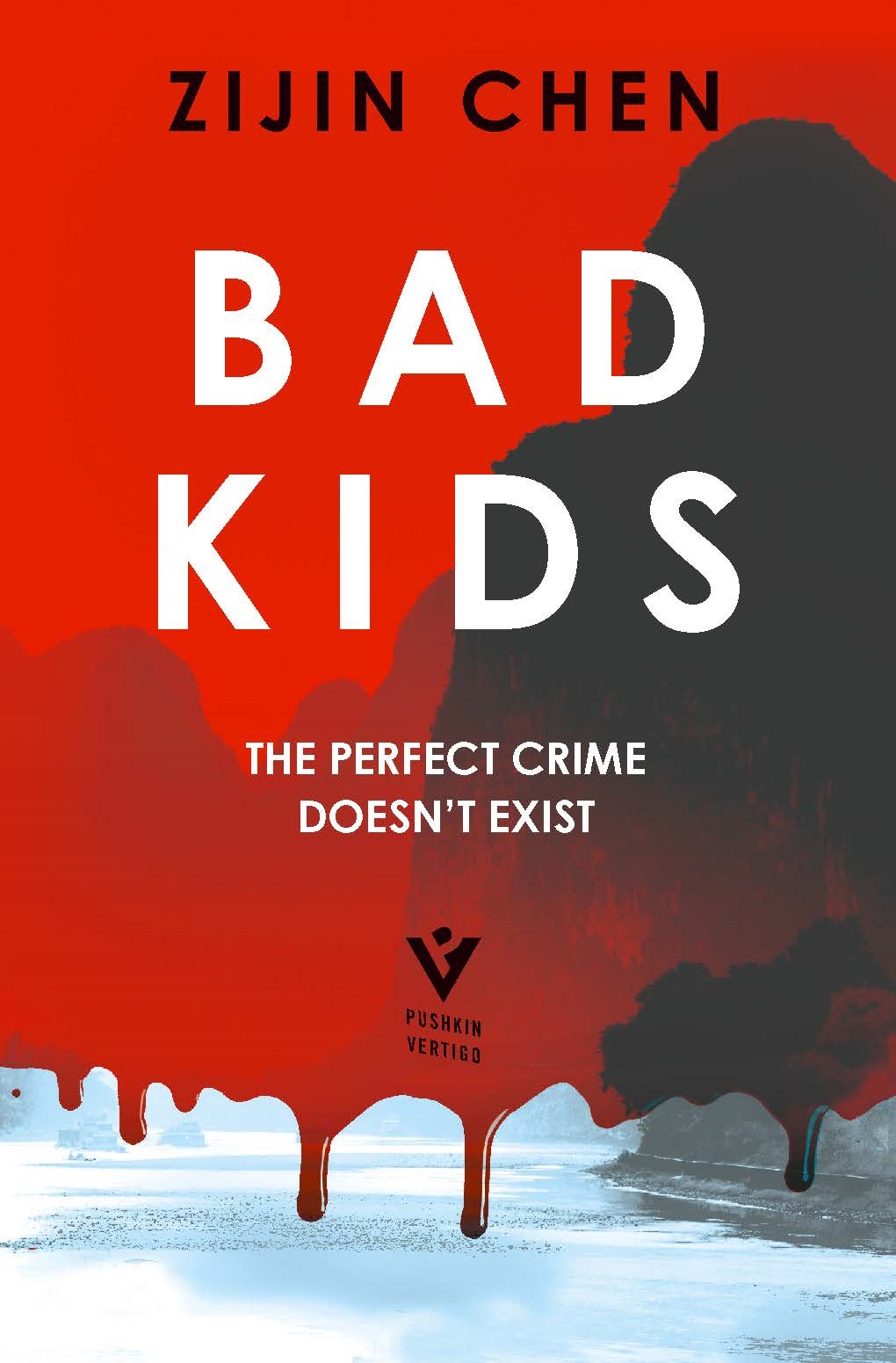
Bad Kids, by Zijin Chen


9781782277620
Pushkin Vertigo, 2022
translated by Michelle Deeter
332 pp

paperback (read earlier this month) 


Continuing to try to catch up on my posts here,  Bad Kids by Zijin Chen is yet another book in the Pushkin Vertigo collection, available in English for the first time.   There is another book by this author that has been translated from Chinese to English by Michelle Deeter, The Untouched Crime, published by Amazon Crossing.  Needless to say, when I found out about that one, I hit the buy button immediately.   

A brief word about Bad Kids:  the back-cover blurb labels this novel as "Dark, heart-stopping and violent," and I'll agree to dark and certainly to violent, but "heart-stopping" is a bit over the top.  However,  it is certainly one of the most twisty novels I've enjoyed in a while, meaning that just when you think the endgame has played out, there's more.  And then some.  

It's July, 2013, and Zhang Dongsheng has taken his wife's parents for an outing at Sanmingshan, "the most famous mountain in Ningbo," and now a nature park. The in-laws are happy to be there -- it's a popular and crowded place on holidays but on the day of their visit the park is "practically empty."   The "filial son-in-law" suggests that they make their way to an observation point,  where they'll take a break.  Once there, he looks around and sees no one nearby except three kids "clowning around near a pavilion," but "dismissed them as unimportant," then offers to take the in-laws-  picture with the great view behind them as backdrop, convincing them that they should sit on the wall for a better photo.  Once they've done that, he puts his hands on their shoulders as if to position them just so, and then, with a smile on his face, picks up their legs and it's 再见 (zaijian, bye-bye) to the in-laws as they go tumbling down the mountain.  Zhang knows that there is no way they could have survived that fall, yet a few people had heard the in-laws scream so he has to make it look legit and calls for help.   Outwardly he looks panicked; inwardly he's smiling at the thought that he'd committed the perfect crime; even the police label it accidental death.   What he doesn't know (and this is not spoiler territory -- it's on the back cover) is that while he thinks he got away with it,  those "unimportant" kids have inadvertently caught it all on video.  


Two of the three kids,  a boy by the name of Ding Hao and his friend, a girl called Pupu, had run away from an abusive situation in an orphanage  in Beijing,  and not wanting to return to their respective homes, had made their way to Ningbo and to the home of the third, Zhu Chaoyang, Ding Hao's friend in primary school.  To make a very long and complicated story a bit shorter,  Chaoyang's father gives him an old camera, and the kids decide to go to the nature park at Sanmingshan, where Chaoyang's mother works; it just so happens that they were there at the same time that Zhang Dongsheng was knocking off his in-laws.  The kids spend time taking photos, making videos and goofing around with the camera, and after arriving back at Chaoyang's place (and just before heading to KFC), Pupu discovers that they've picked up something completely unexpected on video -- the death of Zhang Dongsheng's in-laws as it really happened.   Chaoyang is ready to report the murder to the police, but is stopped by Pupu, who reminds him that the police just might ask who the other kids were on the video, and would likely send them back to the orphanage, which is an unacceptable choice.  As the back cover blurb notes, "an opportunity for blackmail presents itself," with Pupu deciding that she and Ding Hao could use the cash for their futures.   And so it begins ... with consequences unforeseen for all involved.  

If this were all there was to the plot, it would still be good.  But Zijin Chen isn't quite finished with his readers yet.  There's much more going on outside of the blackmail as one of the characters takes it upon himself to commit a horrific act that will also generate some serious fallout for everyone involved, and then, well let's just say that there will be more deaths than those of Zhang Donsheng's in-laws.   There is, of course, a police inspector looking into these, but for me the story was less about the investigation than the choices that were made in each instance and the resulting consequences.  

Bad Kids was a fun novel to read, and little by little as all of the unexpected twists and turns came into play, and characters played various battles of wit with each other,  it was seriously difficult to put the book down.  I have to admit to a few eyerolls here and there and thoughts of "as if" at different points, but the novel makes for hours of entertainment even as the author shines a light on the complicated nature of family relationships and more than a few social issues that show up within the story.  And by the way, the ending was perfect.  After reading this one,   I would really love to see more Chinese crime novels in translation (hint hint, Pushkin Vertigo).   

Recommended to people who enjoy twisty crime novels and who don't mind going deep into the dark in their reading.  

Saturday, April 14, 2018

The Borrowed, by Chan Ho-Kei

9780802125880
Black Cat/Grove Atlantic, 2017
originally published 2014
translated by Jeremy Tiang
490 pp

paperback

The length of this book may seem daunting and potential readers may be wondering if a good mystery/crime novel can actually sustain itself over nearly 500 pages.  I had the same concern myself, but the author's done something very different here that put my worries to rest.  Instead of one long narrative, he offers us six shorter ones all connected via the main character and Hong Kong itself, ranging from 2013 to 1967.  No, I did not mean 1967 to 2013 -- this book runs chronologically backwards.  The Borrowed is a series of six crime puzzles to be solved, combined with a hefty dose of social realism; it's also a page turner with lots of unexpected twists along the way. 

At the end of this book the author explains that his original intention was to write a "classic detective novel," but decided against a book solely focused on "criminal cases." Instead, he says, his idea was to write "the story of a personality, a city, and an era." This "pivot" culminated in a series of six "stand-alone novellas,
"each one fuelled by mysteries and clues, but all six fitting together to form a complete portrait of society." 
 The star of this show is Kwan Chun-dok, who as the first story opens, lies dying of cancer in a hospital.  He is a retired police superintendent, respected and revered by his superiors and those below him in rank as well. He's that rare legendary figure, whose powers of deduction and his ability to take in everything about a case has given him the moniker of "The Eye of Heaven."  Kwan is also mentor to the other major (and younger) figure in this book, Sonny Lok.  Reading backwards, we follow the Superintendent's career from his latter days back to his origins as a beat cop; Sonny Lok also grows from rookie status to Inspector.  At the same time, the time frames in which each story plays out says something about different moments in Hong Kong's history; as just one example, the handover of Hong Kong from British to Chinese rule in 1997 plays a role in one of these stories.  They are all, as I said, puzzles to be solved, with plots ranging from the murder of a high-profile family member down to a series of politically-motivated bombings that launched Kwan's career.


Hong Kong, from Hong Wrong
The crime-solving aspects of this book are highly original, at least in comparison to most police procedural novels I've encountered.  I have to admit that the first story, "The Truth Between Black and White: 2013," nearly sent this book flying across the room because of what I felt was a wholly unbelievable premise. Cue inner groaning and eyeroll.  However, I stuck with it  and was rewarded with a big laugh -- it seems that the joke was entirely on me.  I mention this bit of information because what happens here might cause other serious crime readers to have my same reaction, so hang in there.  And while they're all quite good, my favorite of the six is "The Prisoner's Dilemma: 2003," which involves the struggle between two major triads, drugs,  and the case of a missing young woman.  The major twist in this tale blew me away completely, using a device that I thought was a stroke of genius on the author's part.

Whether or not you get the "complete portrait of society" in this book over time as the author intended will probably come down to reader perspective.  I will say that the book moves around various areas of Hong Kong and does include all manner of people within them, from the highest of the elites down to people on the street.  Mr. Chan takes us through turbulent political times and upheavals, examines the rampant corruption within the police department, resentment against the British as colonial masters; he sends us through the famous Hong Kong street markets, and on into neighborhood streets and then into areas ruled by competing Triads, etc., with much of the action taking place in the same areas over time.  And then there's the question that ran through my head the entire time of why this book goes backwards in time.  I'm thinking that perhaps it's more than just highlighting the career of the Superintendent and how things change yet remain the same over time;  at the end, for me (without giving away any spoilers on my part), it came down to one simple question that brings everything full circle back to the beginning of the book.  Hint: you have to be on mental alert for this one -- it's all in a name.  It also, I think, gives great insight into why Kwan has such a 360-degree view when it comes to crime solving, all stemming from a single event.

Overall, The Borrowed is definitely a no-miss book for readers who enjoy moving well out of the crime fiction mainstream and into something completely different.  And while I don't think it's perfect, it ended up being a page turner that I absolutely could not put down once I started it in earnest. Its originality will shake anyone out of his or her mainstream reading rut for sure -- after you read it, standard crime fiction fare will seem blah and tame in comparison.