Showing posts with label British mysteries/UK crime fiction. Show all posts

Wednesday, June 18, 2025

Marble Hall Murders, by Anthony Horowitz


9780063305700
Harper Collins, 2025
582 pp

hardcover


We've just returned from a very long vacation which gave me the opportunity to read this book,  the third novel in this series featuring Susan Ryeland and yes, for series followers, Atticus Pünd is back as well.   While I won't be giving top much away here, I will mention that before the book even begins, there is a caveat to the reader that "the solution to Magpie Murders is revealed in this book," so to anyone considering Marble Hall Murders who hasn't yet read Magpie Murders and may be considering doing so, you've been warned.  

For those readers who are familiar with the previous two novels (the aforementioned Magpie Murders and Moonflower Murders), Susan Ryeland has returned to the UK after her time in Crete, where she and her partner Andreas came to the end of their road, each realizing that they were "no longer in love." As she came to realize, "My head was in London while my heart was no longer in Crete,"  so it's back home she goes, working as a freelance associate editor for Causton Books (nice little nod to Midsomer Murders there).   Her boss hands her the first thirty-thousand words of a manuscript which is and a  continuation novel featuring Atticus Pünd, which "follows on from Magpie Murders."  The author is Eliot Crace,  the title, Pünd's Last Case. Susan has reservations about the project from the beginning, but she feels she has no choice due to financial considerations plus the fact that Causton Books "was the one place in town" that just might take her on full time in a badly-needed senior position. Crace came from a wealthy family; his grandmother, Miriam Crace, had been the author of a series of well-loved children's books that had been "turned into graphic novels, a cartoon series on ITV, a hugely popular musical ..., three feature films, a ride at Universal Studios," not to mention the merchandise and an upcoming Netflix five-season deal.   As with the other two books in the series, as Susan begins reading the manuscript, we too delve into Pünd's Last Case, which, as the dustjacket blurb reveals, is
"set in the South of France and revolves around the mysterious death of Lady Margaret Chalfont, days before she was about to change her will. But when it is revealed that Lady Margaret was poisoned, alarm bells begin to ring."
 Susan picks up on a few things in the manuscript that lead her to believe that Eliot may have based Pünd's Last Case on his own family, and hearkening back to the dustjacket blurb, "once again, the real and the fictional worlds have become dangerously entangled."  As readers of the previous two books in this series know, that is precisely how those stories have played out, but the stakes become a bit higher now as the body count rises and Susan finds herself at the center of it all.  

It sounds like it should be a great story, right?, and most readers on Goodreads believe it is, garnering an average and staggering 4.38-star review score.  I'm very likely the outlier here, because I didn't find this book nearly as enjoyable as I did the other two that came before. The usual book-within-a-book was quite honestly, underwhelming.  Normally I care more for the Atticus Pünd stories than for what's happening in Susan's present, but that didn't happen here.  Worse, I figured out the who in the Pünd story long before the actual reveal because it was beyond obvious.  Like, HELLO!!!   My other major issue is that the author only decides it's time to bring out the major twist in the Susan Ryeland story way too close to the final part of the book,  giving a really rushed feel to the novel's ending. There are more niggly things, but this post is getting a bit long.   On the other hand, I have to admit that it entertained me for well over two days, so that can't be a bad thing.  When all is said and done,  it just wasn't as entertaining or satisfying as its two predecessors, so for me it was a bit of a letdown.  But as I said, people are raving about Marble Hall Murders so if you're following the series, you may likely want to read it. 
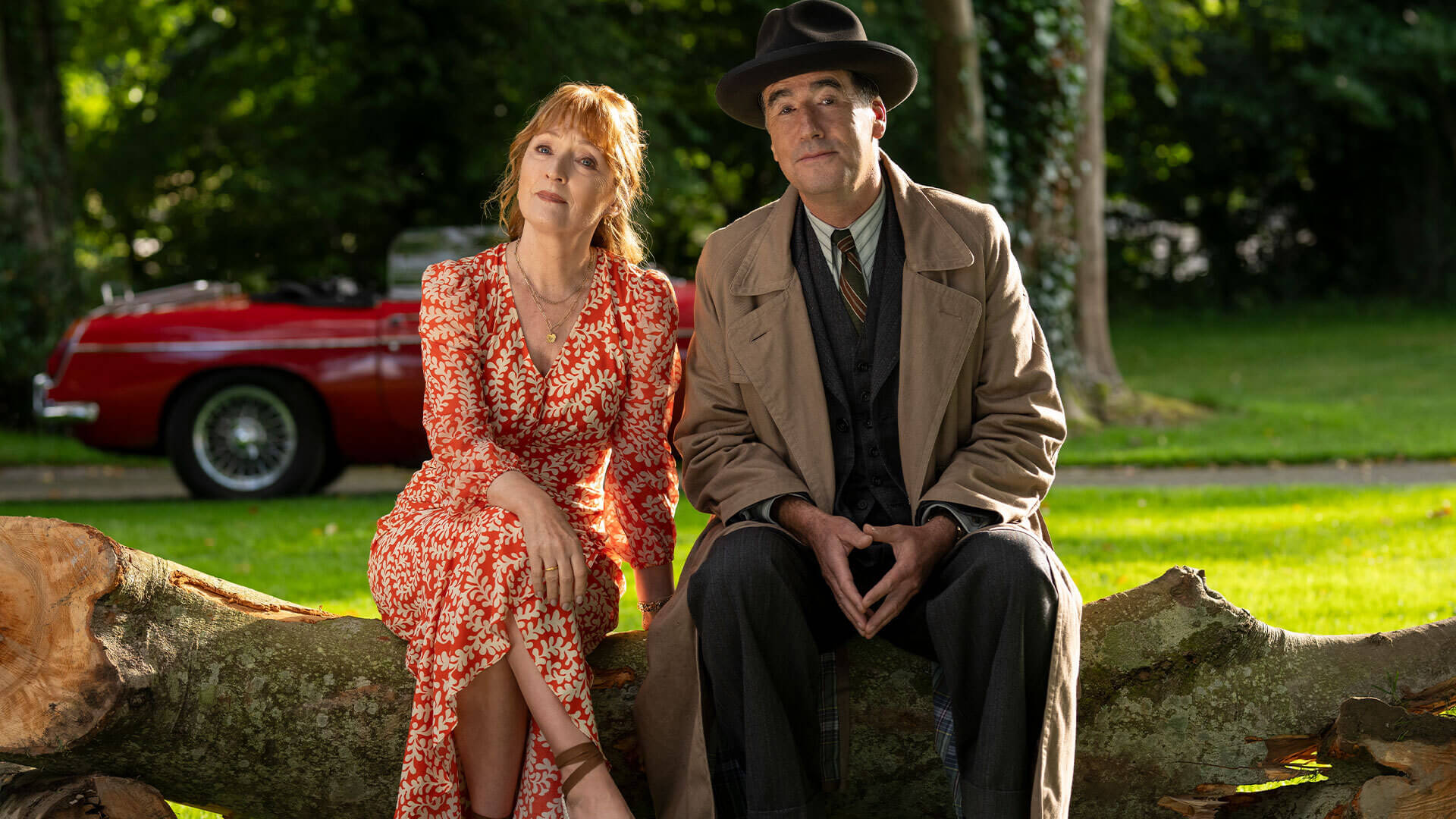


from PBS: Lesley Manville and Tim McMullan


One of the tags I used for this post is "page to screen," since according to PBS,  there will be a third (and final) installment in the Masterpiece series starring Lesley Manville as Susan Ryeland and Tim McMullan as Atticus Pünd.  The previous two have been extremely bingeworthy, so even though I didn't care for the book as much as I might have, I will be ready to watch when the series rolls around again. 


Friday, May 16, 2025

The Mouthless Dead, by Anthony Quinn


"It was a mask -- one that he wore so determinedly it became his other self." 


9780349146928
Abacus/Little, Brown Book Group, 2025
274 pp

hardcover 
(read in April) 

I don't remember how I happened upon this book, but I was hooked from the moment I read the blurb and knew I had to have it.  For one thing, it turns out to be a novel based on the brutal murder of Mrs. Julia Wallace that happened back in 1931, and I love historical crime, both fact and fiction.  The other thing that piqued my interest is that I had never heard of this case before, so while I was waiting for my book to arrive from the UK I spent quite a bit of time doing some research.  It was a case which Raymond Chandler regarded as "unbeatable. It will always be unbeatable" and about which he  also said that it was an "impossible murder because Wallace couldn't have done it and neither could anyone else."   So now I'm hooked and my book isn't even here yet.  By the time it actually arrived I was already primed, ready to dive in, and I was not disappointed.  

This post will be shorter than usual, because I don't really want to say too much  about what actually happens in this book  -- to tell too much is to completely ruin things, and I don't want to be responsible for that. 

  The murder of Julia Wallace took place at her Liverpool home one night while her husband William had gone to call on a potential client.  William worked for Prudential Insurance, and one night while at his chess club, he had received a message about a phone call from a Mr. Qualtrough, who had asked Wallace to meet him at his home.  The address was also left on the message, and William made his way from his home to the meeting.  He left his house and caught a tram to the area, but never actually got to the Qualtrough home -- it seems that the address was incorrect, and he spent quite a bit of time asking for help from a policeman and other people in the area, none of whom had heard of a Mr. Qualtrough.   Frustrated, he made his way home, only to find his wife dead.  There was no apparent motive, and yet despite what seems to have been an unshakeable alibi with witnesses and the assurances from neighbors that the Wallaces were quiet people who were not inclined to argue, the lead detective zoomed in on Wallace as the prime suspect.  He was arrested for the murder and sent to trial, where he was found guilty and sentenced to hang.  Not too long after the verdict however, the court of criminal appeals overturned the conviction and Wallace was set free, with the murder left unsolved.   By the way, none of this is spoiler material -- just a very brief outline of the actual case. 

The Mouthless Dead  begins some fifteen years later, and one of the former members of the Wallace investigation team, a now-retired Detective Inspector Key who had served as a Liverpool policeman for "nigh on thirty years,"  is on board an ocean liner sailing from England to New York.  He is in the process of putting together a memoir about his career, which would have been "quite unexceptional," except for the one case "that was, in its time, wildly notorious, and had become in the years since the material of legend."  He makes the acquaintance of two fellow passengers, Lydia Tarrant, "somewhat plain" and traveling with her mother, but interested in his stories, and Teddy Absolom, a younger man in his twenties, for whom "film had been his obsession since boyhood." Teddy hopes to look for work in the industry in New York, or maybe even Hollywood, where he's interested in writing and directing.  Lydia reveals to Teddy that Key is writing about the Wallace case in his memoir,  and Teddy admits to having been "obsessed with it as a schoolboy."  Teddy believes that "the hand of fate" must be at work here, because the case would make a great movie with "the lot" -- "a brutal killing, a police force baffled, a man condemned to hang."  Never mind that  there was "no ending"  -- according to Teddy, it wouldn't be a documentary, but a drama based on a real-life story, much like Hitchcock did with his movie "Rope."  And thus it begins, with Key holding Teddy and Lydia spellbound with his continuing story.   Key is only too happy to oblige helping Teddy, unable to resist showing off his insider knowledge.   


Julia and William Wallace, from The Julia Wallace Murder Foundation


 In the Acknowledgments section of the book, the author notes that he "owes this book to a conversation" he'd had that had "triggered" a childhood memory. He remembered his parents talking about it once,  likely because  his family had lived very close to Menlove Gardens, where Wallace was supposed to go to meet the mysterious Mr. Qualtrough.   As he says, "the story came out like a revenant from the darkness of forgetting, and I knew I had to retell it."   The author's done a great job here, bringing in the historical record of the Wallace case complete with police work and materials from the trials,  solidly landing the reader back in 1930s Liverpool.  However, the real genius at work here is that the retelling is offered to us via the fictional Key's perspective, suffusing the narrative with an unexpected intensity, so much so that I could not put this book down.  

The Mouthless Dead is both a gripping, engrossing tale and a keenly observed study of character, one that I can recommend very highly to readers who enjoy historical crime fiction or well-written, intelligent crime novels.  It's also a book I won't soon forget.  


Sunday, December 1, 2024

Ghosts of Society, by E. Phillips Oppenheim


9798886011203
Stark House Press, 2024
originally published 1908
235 pp

paperback

Ghosts of Society was originally published as The Distributors in 1908, coming at number thirty-two in author E. Phillips Oppenheim's (1866 - 1946) published novels, the first having been published in 1887.   He was incredibly prolific in his writing, publishing well over one hundred novels during his lifetime, along with several collections of short stories, a few autobiographical works, and as Daniel Paul Morrison notes in his extremely informative appendix at the end of this novel, "45 motion pictures."   Five of his novels, including this one, were written under the pseudonym of Anthony Partridge.  Ghosts of Society is my first novel by Oppenheim; I have a few more of his books on my shelves so it will very likely not be the last.  I had fun with this one, for sure.

The "Ghosts" are a group of seven people who are all welcomed within the higher rungs of London  society, right around the turn of the century.    Their leader is Lord Evelyn, but all decisions are made by consensus among the members.  In his introduction to this novel, Curtis Evans notes that they were a "fashionable set of Londoners,"  which 
"the postwar, Roaring Twenties generation would call denizens of "cafe society, and today in the democratic social media era we simply term influencers."
The "essential qualifications," as explained by one of their number to the young American woman Sophy Van Heldt are "birth, culture, and understanding," and "an earnest desire to acquire some interest in life apart from the purely mundane."    A more in-depth glimpse into the Ghosts is offered by another member much later in the story, who describes the group as people who 
"had gone at life with too much of a rush. Life, you know ... is made up of many chambers and a man or a woman cannot live in all of them. These people made the mistake of trying to do this. They rushed from room to room. They drank great gulps where they should have only sipped. They plunged head-foremost where they should have only paddled. Then, when they were still young, weariness came. They had tried everything. They were foolish enough to suppose that they had given everything a fair trial."
 Everyone knows that it is "considered a kind of bad form" to ask about them, and when Sophy makes the mistake of asking a certain Mr. Mallison directly about the group (not knowing that he is a member),  she is given a fairly firm and very rude snub, one she does not take kindly.  She makes up her mind that Mallison and "some of the others should suffer for it," which leads her to hire a private detective to get anything and everything he can find on the Ghosts.  What no one knows except the group (and their fence) is that when the Ghosts 
"come across a person whom we consider overburdened with this world's goods, and who shows no desire or design of doing anything else except spending his money upon himself and for his own gratification, we use our courage and our brains to make a pay a very legitimate fine."

In other words, they rob the wealthy of their jewels, using the proceeds of the sales to fund causes that benefit the poor, all anonymously of course.  In this story, one of their "victims" is a known tyrant in his own country, while the other two are more or less arriviste, all of whom have the wealth that allows them access to the company and house parties of Society.   The detective hired by Sophy just might turn out to be an issue, especially when things go very, very wrong during one such robbery. There are other forces at work as well among various individual members that may potentially threaten the group as a whole and certainly add uncertainty to the Ghosts' future. 

There is, of course, much more to this story. I found myself completely drawn to the whole  fin-de-siècle feel and the social observations of that particular era as expressed by the author, especially in terms of bored aristos craving change from what they see as their rather tedious, boring lives, and the desire to experience new sensations outside of the ordinary.   The plot is also pretty good, with the suspense slowly building as Sophy's detective moves closer to fulfilling his mission -- the last few pages are definitely page turners.  

My thanks to Stark House for my copy!  

Saturday, October 26, 2024

PPL #7: Murder in the Snow: A Cotswold Christmas Mystery, by Gladys Mitchell


9781784708320
Vintage/Penguin Random House, 2017
originally published as Groaning Spinney, 1950
220 pp

paperback

Last week we found ourselves at one of our favorite getaway spots north of here in a cabin in the woods where there is no internet and plenty of time for just sitting around and reading.  That is where I read this book, Murder in the Snow, the twenty-third installment of Gladys Mitchell's Mrs. Bradley series and book seven in my ongoing poison pen mystery reads.   Starting late in a series is sometimes but not often problematic for me, but definitely had an impact this time around.  It wasn't due to missing previous character development, but rather it was the fact that if I liked the books that came before,  having a clunker once in a while is okay if those preceding were pretty good.  In this case I had nothing by way of comparison, so I had no clue if this book was an example of one-off awfulness or if the entire series is this poorly written.  Obviously, I didn't care for Murder in the Snow all that much -- quite honestly, as the story progressed so too did my confusion and utter boredom.  

The novel opens during the Christmas holiday season, and Mrs. Beatrice Adela Lestrange Bradley has received two invitations from which to choose, one for a "conference of educational psychiatrists" in Sweden and the other from her "favorite nephew" Jonathan, who with his wfie had a home in the Cotwolds, once a "great estate" that had sold in two lots.  The larger part of the former estate had been taken by the Ministry of Education where there is a women's college for prospective educators, with Jonathan and his wife Deborah buying the smaller section, which contained the original manor house where they now live.    One of the features on Jonathan's property is a spinney with a gate, where, as he explains to his aunt Adela, a "ghost hangs out," supposedly that of a "local parson of about eighteen-fifty" who is known to hang over the gate.   To help take care of Jonathan's property, there is an estate agent known as Tiny, who does double duty for both Bradley and the college and lives with his cousin Bill, both bachelors who are taken care of by the housekeeper Mrs. Dalby Whittier.   There is also a gameskeeper, Will North, who has actually seen the Groaning Spinney spectre, so named because of the ghost that haunts the place.  Only a short chapter or two after the novel begins, Jonathan receives a letter concerning his wife and Tiny, who, unknown to Jonathan, had previously made a pass at Deborah and was seriously rebuffed.  Jonathan is all for going into Cheltenham to see if he can figure out who sent the letter as it contains "grounds for an action for slander," while Deborah suggests he take it to the vicar, "a sensible old darling" who may be able to figure out who might be responsible.  The action truly begins  as the snow begins to fall heavily, leaving the small village somewhat stranded, and Jonathan comes across a figure hanging over the gate.  It isn't the ghost, but rather Tiny's cousin Bill, who had been "dusted over into ghostliness by this last fall of the snow."   Things start to become very strange at this point as others, including the vicar, receive "vituperative notes," Bill's housekeeper goes missing and more deaths occur, all of which send Beatrice Adela Lestrange Bradley into investigative mode to discover exactly what's going on. 

from AbeBooks


All of the above is the perfect setup for a few hours of armchair detection, but I have to say that Murder in the Snow is actually one of the most murky and boggy mysteries I've ever encountered, so that by the time I got to the final denouement, I could have actually cared less, only happy that the book was over.  It is incredibly rare that this happens to me, but in this case my mantra became "oh please get on with it." To be up front about it,  I have no clue as to how Mrs. Bradley arrived at the solution she did given the meandering plot she offered her readers. As for the poison pen angle, that part started out strongly, with one major point connecting the letters to the overall murder plot, but it was still not enough to keep my interest strong. 

I have a few of Mitchell's books, so I'll give the first one in the series (Speedy Death, 1929) a go to see if perhaps Murder in the Snow was an anomaly in terms of plotting.  This one, sadly, I don't really believe I can recommend to anyone, even the hardest-core vintage crime readers.  

Monday, September 9, 2024

PPL #5: The Moving Finger, by Agatha Christie


"The Moving Finger writes; and having writ,
Moves on: nor all your Piety nor Wit
Shall lure it back to cancel half a Line,
Nor all your Tears wash out a Word of it."


9780062073626
William Morrow, 2011
originally published 1942
240 pp

paperback
read earlier in August

 The Moving Finger, is quite possibly the most well known of all of the poison-pen letter mystery novels from yesteryear (at least of the books I've collected)  and even though I've read it before and knew the who, it was still a fun read. 

Jerry Burton and his sister Joanna have come to the small village of Lymstock where he has come to recuperate after a "bad crash" while flying.  His doctor had told him that "everything was going to be all right," but he had to "go and live in the country" where he should have "absolute rest and quiet" for at least six months.  Obviously, as Jerry's looking back on things and telling the story that's about to unfold,  we get the sense that the complete opposite has occurred -- as he notes, "Rest and quiet! It seems funny to think of that now."  They hadn't been there too very long when they receive a "particularly foul anonymous letter" suggesting that Jerry and Joanna ("the fancy tart") are not really brother and sister.  Jerry wonders if their presence in the village is resented by someone, but he finds out that they're not the only people in Lymstock to have received one -- that "They've been going about" for a while now.   He also believes that "the best way to take it" is as "something utterly ridiculous," but his doctor, Owen Griffith, tells him that the problem is that "this sort of thing, once it starts, grows."  He also notes that "crude, childish spite though it is, sooner or later one of these letters will hit the mark. And then, God knows what may happen!"   The people of Lymstock are about to find out when one person commits suicide and there's a murder shortly after.  It seems that even in "such a peaceful  smiling happy countryside," there is "down underneath something evil."  

The village "looks the most innocent, sleepy, harmless little bit of England you can imagine," but as one character notes, it has "plenty of wrongdoing" and "any amount of shameful secrets."  Strangely though, the letter writer doesn't hit on any of those, sending out wild accusations instead.  At the same time it's enough to make people distrustful and leave them with a sense of fear wondering which of their neighbors is cruel enough to do such a thing.   Jerry does a bit of his own sleuthing and the police do their best, but it's only when Jane Marple, who "knows more about the different kinds of human wickedness..." is brought on the scene (rather late in the game here) by the vicar's wife that the case is finally solved.   


1942 edition; from Abebooks


My guess would be that anyone reading it for the first time would be hard pressed to figure out the identity of the letter writer; due to potential spoilers I won't say why, but trust me on this one.  I will say that the discovery of the culprit, along with the motive behind it all, came without much excitement, as Miss Marple unspools the answers quietly among a small group of people.  Otherwise, it's difficult to not get caught up leading to that point, since Christie lays out a compelling story with a clever plot that you won't want to put down.   Every time I read one of her books, I come away the sense that this author must have been much like her elderly detective, having a keen eye for human nature, and  The Moving Finger  is no exception.  Definitely a no-miss for Christie readers, for people interested in the poison pen in mystery novels and for vintage readers in general. 

There are two television adaptations that I know of (and that I've seen), one from 1985 with Joan Hickson as the erstwhile Jane Marple and the other from 2006 with Geraldine McEwan in the role.  I'm a huge fan of the older two-part episode because it's more like the novel,  but you'll have to watch both and decide for yourself. 

Friday, August 9, 2024

PPL#4: Murder Will Speak, by JJ Connington


9781616463922
Coachwhip Publications, 2016
originally published as For Murder Will Speak, 1938
287 pp

paperback

(read in July)

I have a stack of mystery/crime novels sitting here waiting for my thoughts and I am so behind.  Murder Will Speak is at the top of the stack, book number thirteen of eighteen in author J.J. Connington's series featuring Chief Constable Clinton Driffield.  It is my first outing with this author, even though I have three more Coachwhip publications by Connington sitting on my shelves at the moment.  After finishing this one, I bought two more, trying to line up as much of the series as possible for future reading in order.  

 The blurb on the back cover of this edition hints somewhat  cryptically at what the reader is about to encounter:

"A Poison Pen, ubiquitous, outspoken --
A murder (or was it suicide?) --
A suicide (or was it murder?) --
Who? -- Why? -- and Why? --"

The story begins with a bit of a shakeup at the brokerage firm owned by a certain Mr. Lockhurst, who is likely going to be away from the office for a few months after a diagnosis of coronary thrombosis.  His doctor, as discovered via telephone by his second in command, Oswald (Ossie) Hyson, has prescribed complete rest for twelve weeks, and Lockhurst is not to be "worried by business affairs."  That's certainly not a problem for Hyson, who figures that after all is said and done, Lockhurst's absence would likely be more along the lines of "possibly" five months, which would be "time to turn round in."  Right away you realize that something hinky is going on at the firm, especially when Hyson is only glad that the his employer "didn't peter out in that attack" because it would have meant auditors going through the company's books, and the fact that he had thought it a good idea to obtain a power of attorney from Lockhurst, even though it wasn't needed during the course of every day business.   As it turns out, there's not only hanky-panky on the financial side going on, but on the personal side as well with at least one typist in the office, maybe more.  

Away from the brokerage,  someone has been sending "the most awful anonymous letters" that say the "most dreadful things."  There has been so many in fact, that one character describes it as a "perfect epidemic," bad enough to have garnered the attention of the Investigation Branch (IB) of the General Post Office, under the supervision of a man named Duncannon.  According to him, the "poison-pen affair" has grown "to such major proportions" that it's time for "all hands to the pumps."  As he also notes, if the IB doesn't clear it up, "some really bad damage may be done."  As it turns out, he's completely right, but he has no clue of how "really bad" that damage may be.  


from Wikipedia


Sir Clinton is matched with a sort of partner (who is more like a sounding board providing the occasional hint to Driffield in this book -- since I haven't read any of the the others I have no clue if he ever takes a more active role) by the name of Wendover, whom Driffield refers to throughout as Squire.  It is he who brings Wendover into the conversation with Duncannon, and while the GPO  is running its  operation trying to find the poison-pen writer, the police find themselves in the thick of their own investigations after two deaths.  The first death is that of Nancy Telford, who along with her husband Jim were friends with Linda Hyson, wife of Ossie.  While Nancy was found dead in rural Scotland, the authorities there are hard pressed as to whether or not her death was suicide or murder, and have turned to Sir Clinton for help.  He in turn wonders if Nancy's demise was connected to the plague of poison pen letters, and gets Duncannon involved as well.   The second body in the case belongs to none other than Oswald Hyson, who is discovered with his head in the gas stove by the Hysons' maid upon her return home after her evening off.  The more he learns about Hyson, and while his death definitely looks like suicide, Sir Clinton isn't so sure and treats the matter as if it was a case of murder.  As he and his subordinate Inspector Craythorn begin to dive into the case, it becomes obvious that there may be a connection between the two deaths. 

I quite enjoyed this book, and even though Sir Clinton wasn't what I would call an exciting sleuth, he is extremely thorough in his methods, taking time to slowly layer what clues he has so that by the end, there is little room for doubt as to what happened, why, and by whom.  It was rather fun to watch this process; on the other hand,  I didn't find it too difficult to figure out the identity of the poison-pen author because it was just way too easy.  Unfortunately, figuring  out the solution to the murder here before the Chief Constable did wasn't too hard either.  There was actually one point where I page tabbed a brief bit of conversation that pretty much gave away the show and once that was stuck in my head, I started to have a bare inkling of how the killer was able to pull it off and then come up with what seems to be an air-tight alibi.   All of that was fine though, in comparison to how the author deals with the women in this story, with some pretty awful (and extremely dated) psychological hypotheses about what makes them tick.  While I won't go into detail here, some of these parts were  just cringeworthy, to be honest, but then again, the novel was published in 1938 so I'm not really all that surprised.  

As a whole, I can certainly recommend this book to readers of vintage crime/mystery and readers who enjoy a good story centered around the havoc that is wreaked when a twisted mind has little else to do but to disrupt the lives of others via the poison pen.  I love this stuff. 

By the way, do not miss Curtis Evans' most informative introduction to this edition -- while he goes into some great detail about the author, he doesn't give away too much about the mysteries in this book so it's perfect.  


Friday, June 28, 2024

PPL #3: Good By Stealth, by Henrietta Clandon


9781913054878
Dean Street Press, 2020
originally published 1936
211 pp

paperback


Although Good By Stealth was first published in 1936, in the realm of mystery/crime novels centered around poison pen letters it's something new and different.  One, we know who sent these letters  around the small village of Lush Mellish; two, we know that the perpetrator had served time behind bars for her crime, and three, it all comes out of the mind of a single person via a very long flashback.  It is, as author Henrietta Clandon* writes in the foreword, a "story told from the inside; a story which has already been told from the outside by the newspapers."  

The beginning of the novel has Miss Edna Alice out of prison now for  ten months, and writing "the story of the latter part of my life before malicious people and an absurd verdict, unjustly deprived me of my liberty."   As she also notes, she had found herself "in the same category as a mentally unsound woman who posts disgusting letters to her neighbors."  To hear her tell it,  she was a "victim of persecution, one born before her time," and the letters were meant as "constructive" criticisms, meant to help the receivers to do what was right and in the long run, become a better person.  It's not her fault if her letters caused turmoil among the population of Lush Mellis.   

Arriving in the village with her dog and a determination to be an active part of village life, she immediately finds fault with the several visitors who call on her.   The vet's wife she found "odd," the two doctors' wives she found to be  "a snob" and a gossip, but in the long run, she feels that her move to Lush Mellis was "a good one," and goes on to form and to join several circles in the community.   Before long, she finds and points out a number of problems within each group -- in her mind, she's just trying to offer helpful suggestions or to offer the benefit of her experience. Needless to say, neither her presence nor her help are appreciated, and eventually she begins to find it "strange" that her "efforts to help people, and give them a life, led to ingratitude and offensiveness."   She is never at fault, her dogs can do no wrong, and according to Miss Alice, it must be the case that there is a "campaign to wound and hurt" her, one to bring her name "down into the dust"  and get her to leave.   After some time, as a number of incidents involving Miss Alice pile up and she gets no satisfaction from the police or anyone else,  she begins her own campaign, secretly and anonymously, to  "morally and socially" rejuvenate Lush Mellish  doing her "good by stealth," and the letter writing begins. 

 How terrific it is that Dean Street Press brought this book from obscurity out into the light for modern readers!!  While there is a bit of investigating going on towards the end of the novel as the police try to discover just who the poisonous pen belongs to,  there really is not much of a mystery here at all, and that's okay. Good By Stealth is a most unusual and captivating character study capturing the workings of the mind of a woman whose world and her reaction to it exists in a singular, narrow point of view.  While it's impossible to discount that there just may be a kernel of truth in what she has to say about her fellow villagers, any sympathy I have for Miss Alice comes only in minute, tiny amounts, and that only in connection with her dogs.  On the other hand, the book made me laugh out loud here and there and roll my eyes often because of the sheer hypocrisy involved, and it was absolutely fun to read.  A unique perspective on the poison-pen-letter novel, this is one I can definitely recommend to readers of vintage crime/mystery fiction. 


------------------
*Henrietta Clandon was one of several pen names of John George Haslette Vahey (1881 - 1938), likely most known for writing under the name of Vernon Loder.  

Monday, June 24, 2024

Kiss the Blood off My Hands, by Gerald Butler


9798886010886
Stark House Press, 2024
originally published 1948
166 pp

paperback 

Just released this month, Kiss the Blood Off My Hands is the latest in the Noir Film Classics  series from Stark House Press.  I have a few of these books but this is the first I've read.  And since I love to see books I've read  sort of come alive on the screen, I bought a copy of the 1948 film based on this novel starring Burt Lancaster and Joan Fontaine and watched it as soon as I'd finished reading.  More on the movie later -- on to the book. 

The action begins in a pub when Bill Saunders, fresh off the boat in England,  kills a bouncer. He hadn't meant to, but the punch he'd landed on the man's face knocked him to the floor, stone cold dead. He doesn't care that the guy is dead; all he cares about is getting out of there.   Before anyone could call the police, Bill takes off running and so do a few others, chasing right behind him.  He notices a woman "going into a door," and takes advantage of the situation, forcing his way in.  Deciding to stay overnight, the next morning Bill discovers that the woman (Jane) has guts and doesn't seem afraid of him.  He realizes that she's different than the other women in his experience, and that  "There was something about her."  Eventually he leaves after she returns home from her job, but it won't be the last they see of each other. 

Bill is a certified tough guy, beating up and stealing money from taxi customers, robbing a sex worker, referring to women as bitches and tarts, and violence, which exists just beneath his surface,  is his way of dealing with most situations.  For him, people are just mugs, and as such, they're prey, ready to be taken advantage of.  He doesn't respond normally on an emotional level, but he is definitely attracted to Jane, showing up at her workplace,  but with Jane (whom he refers to as "the kid"), he's different.  He still hasn't told her that he'd actually killed the bouncer, and somehow he is able to persuade her to go out with him, at first to the races, then for tea based on the money she'd won from the track but when they're on a train and Bill tries the 3-card con on a fellow passenger, she sees his true colors when he turns violent when the fellow doesn't want to play any longer.  Then she lets him have it:
"I can't pretend that I didn't know you were a tough guy. I was fool enough to allow myself to be attracted by that. But I thought there was something decent underneath. Now I know there isn't. You're nothing but a cheap, bullying hooligan." 
Although she tells him she never wants to have anything to with him again, and that he's "rotten," it's that "something decent underneath" that Jane saw in him that eventually brings the two back together, with her believing that maybe a decent job would do him some good and give his life "a shape again."  Can she change this man  by taming what Curtis Evans refers to in his introduction as "his brutal impulses with the proverbial good woman's love?"  Is Bill at all redeemable and can he truly be rehabilitated?  In the meanwhile, in an horrific twist I didn't see coming, Jane finds herself in an unexpected dilemma that has the potential to bring everything crashing down around the two of them and tear down what the two have managed to build. 

The length of this book has nothing whatsoever to do with its complexity, and when an author can pack so much into such a short space, in my opinion, he's done a fine job.  Here that complexity is found not only in the character of Bill, or in the question of redemption, but more to the point, in the way that Butler maps out exactly how one random event sets everything else into motion, with unintended, and most certainly unexpected  consequences rippling down the line, definitely a true noir trait. 

It's so good that I couldn't put it down once I'd picked it up.   Solidly good reading and an absolute must for anyone who likes tough, gritty  twisty noir.  A giant thank you to Stark House for my copy!


And now the film -- I once did a mega Burt Lancaster moviefest in the comfort of my own home, but somehow I missed this one.  Kiss the Blood Off My Hands was released in 1948, with Lancaster starring alongside Joan Fontaine.  The opening chase sequence is just dynamite with Lancaster running through the dark, shadowed streets of London before climbing into Joan Fontaine's window.   All of the basics of the novel are there as a foundation, although there are quite a few changes, as expected.   Fontaine plays Jane, whose occupation changed between page and screen from a shopgirl  to a nurse.  I have to think that it's as a caregiver that movie Jane recognizes something damaged inside of Bill, and it is instinct that makes her want to help him.  It's also a good setup, because as part of Jane's ability to help him keep his violent tendencies in check and get Bill focused, she is able to get him a job as the driver for the clinic where she works; in one particular case, he is able to bring a young father the medicine his dying daughter desperately needs to survive.  Even though ignorance causes the dad to not want his child to have it, the scene affords a glimpse of something within Bill that truly cares about this little girl as he forces his past the father to make sure she gets what she needs.  And speaking of Bill, in the film he admits to having been a POW, where in the book, he doesn't really have too much backstory going on.   One of the biggest changes, however, has to do with a blackmailer played by actor Robert Newton, whose utter nastiness comes through on the screen enough to make you uncomfortable just looking at the guy.  I won't say what the differences are so as not to wreck things, but the changes vis-a-vis that particular portion of the plot  worked very nicely in the film, as the suspense ratchets slowly until a fateful moment, but it's clear that the story's not quite over yet.   Nicely done, although I did prefer the ending in the novel to the ending of the film, although I didn't jump for joy over either one.

So, both book and movie are a yes, both I can easily recommend. 


Tuesday, March 26, 2024

PPL#2: Gaudy Night, by Dorothy Sayers


9780062196538
Bourbon Street Books, 2012
originally published 1936
528 pp

paperback

I read this book earlier this month but as usual, it's hectic around here leaving very little me time for posting my thoughts.  Gaudy Night arrives late in Sayers' Lord Peter Wimsey mystery series, and because I'd forgotten what happens in nearly every book to this point, I've had to do a massive (and quick) reread of all that came before.  Well, not all actually; I skipped the short story collections and The Five Red Herrings after diving into it for a bit and got back on the track leading to Gaudy Night, promising myself I'd go back and pick them up another time, along with Busman's Honeymoon, the final original Wimsey novel.  If the length seems a bit on the daunting side, and while Gaudy Night could easily have been a bit shorter with nothing lost, I was surprised at how quickly the five hundred-plus pages went by.  

Anyone who has read the novels that came before will instantly recognize that this one is very different in comparison to the previous Wimsey novels.  While Harriet Vane, the main character in Gaudy Night, had earlier appeared in both Strong Poison (where she first meets Lord Peter while on trial for murder) and Have His Carcase (during which she comes across a body on a rock along the coast, beginning one of the strangest cases of the lot), here she takes center stage.  Since the events of Strong Poison, she'd become a writer of detective stories, had achieved a measure of financial success, and has been asked by Lord Peter to marry him several times, all of which she had turned down.  Now,  in a story that begins as she is invited to attend the Shrewsbury Gaudy (reunion) at Oxford, she's a bit nervous about going due to how she'll be received after all the notoriety she'd suffered through, but once there, she finds herself welcomed. Fears eased, she goes on to have a good time, leaving with the feeling that she had "broken the ice," and would be going back "from time to time."  It's during a stop for lunch on her way home that she discovers a particularly nasty note in the sleeve of her gown, "made up of letters cut apparently from the headlines of a newspaper," referring back to her earlier troubles.   Back in London,  she continues to receive "anonymous dirt" while trying to deal with her own "conflicting claims of heart and brain" as far as Wimsey goes.  Some time later, towards the end of Easter Term, a  letter from the Dean arrives, inviting her to the opening of the New Library Wing, along with an appeal for her "advice about a most unpleasant thing" that has been going on at Oxford.  It seems they have been "victimized by a cross between a Poltergeist and a Poison-Pen."  The letters are easy to ignore, but not the "wanton destruction of property," the "last outbreak" having been "so abominable that something really must be done about it."  It's obviously someone operating from within, so calling in the police is out of the question, and Harriet's own understanding of the way in which in this sort of thing would be viewed from the outside would make her most welcome to discreetly try to put an end to the situation.   Harriet's return to Shrewsbury is where the story begins in earnest, but there is much more to this novel besides the usual crime solving.  Set in 1935,  while women continue to enter the hallowed halls of Oxford as students and scholars,  Sayers (who went to Oxford herself) integrates into the crime story  her observations of the many problems faced by women in college, most notably the conflict between career and marriage as well as their place in the very male-dominated realm of academia.  While her commentary of the time is fascinating to read nearly ninety years later, it also fits directly into the mystery of the identity of the Shrewsbury poltergeist, since the perpetrator seems to be motivated by a "kind of blind malevolence, directed against everybody in College," rather than simply a "personal grudge."  This idea allows for a rather intense examination of personalities and psychological motivations among the characters (not all of them there for academic reasons)  that might be, as the Dean so nicely phrases it "at the back of it."  

Dorothy Sayers deserves a fair amount of praise here for giving Harriet the freedom to do most of the detecting independently while Wimsey is off doing work for the Foreign Office (signaling, perhaps, an awareness that the interwar years might be coming to a close in the near future) and while other avenues are unavailable (such as calling in the help offered by Miss Climpson -- one of my favorite characters in the earlier Wimsey novels, especially her role in Strong Poison).  It is only when Harriet realizes that the escalation from the college poltergeist is at its most dangerous point that she asks Lord Peter to step in.    Unfortunately, other than the length that could have been shaved with little detriment to the story and a comment about Sayers' obvious expectations that her readers were top-notch intellectuals who  understood each of the untranslated Latin phrases scattered throughout, I can't get into what I see as the downside of this novel without giving away the identity of  the Shrewsbury poltergeist, which I don't want to do. Not even a hint.  

I went into Gaudy Night for the poison pen letters and came out with something completely unexpected.   At the core of Gaudy Night, well beyond the mystery of the Shrewsbury poltergeist,  is Harriet's introspective look at herself on both the intellectual and personal fronts,  which made me think that Sayers had invested much of herself in her character, an idea I couldn't shake even after finishing the book.  So I looked online to see what others had thought. I found several people whose commentary was well worth reading, but maybe Lucy Worsley,  in an excerpt from her A Very British Murder summed it up for me best when she quotes Sayers as revealing that in writing Gaudy Night, she was finally able to say "the things, that, in a confused way, I had been wanting to say all my life."  

My advice: read the series up to that point, especially the other books with Harriet Vane, before you start this novel -- you'll definitely want the backstory and for the most part, they make for fun reading.  Gaudy Night was, as I mentioned, written in the 1930s with that sort of heavier style you often find in novels of the period, but once you get to the hub of this story you won't be able to put it down.    Gaudy Night is a definite standout among them all, and as I see it, it is definitely still relevant in so many ways.   Recommended.  


Monday, February 5, 2024

PPL#1: Fear Stalks the Village, by Ethel Lina White

"The moral is, padre, that human nature remains the same, everywhere, and dark places exist in every mind." 


9780712355308
British Library, 2024
originally published 1932
292 pp

paperback

Ahhhhh.  My reading has once again returned me to the tranquil English village of the interwar years, one of my favorite settings for British crime fiction.  This book features another personal favorite,  the dreaded poison pen letter.   In this case, it's not just one -- as the back-cover blurb info notes, there is a veritable "spate" of them going around the village.  

Prior to the circulation of these not-so-nice missives, the village, as the Rector notes, is a place where "There's no immorality ... and "no class hatred or modern unrest ... "  Those who live here "reflect the general tone of kindness and good breeding," and he has never known a place with so little scandal," which was as much a rarity "as a unicorn."   We are told that from an airplane it "resembled a black-and-white plaster model of a Tudor village, under a glass case," with no train station, no "floating population," with birth rates remaining "stagnant" and since "the natives resented the mere idea of dying in such a delightful place," Death did not visit very often.  "Everyone has a pedigree and a private income," while tennis and garden parties are part and parcel of the social life.   It is a place where "only the walls heard" what was going on behind the closed blinds, "and they kept their secret."  
   
But when the letters begin to intrude and to make their way through this idyllic setting, they slowly release their own form of poison, shattering the quiet village life and  throwing it more than a bit out of whack.   Fear, which is personified here in male form, makes its entry and begins to "stalk the village," as it becomes obvious that these letters are not coming from outside of this small haven. Some people start to silently ask about their neighbors "Is it you?" while others tragically turn to drastic measures to avoid the worst and most feared possibility of the exposure of  secrets they carry.  The letters (which some people deny even receiving although we know they did) are bad enough, yet the Squire's wife would prefer not to call in the police.  The Rector has the perfect solution in the form of a good friend by the name of Ignatius Brown who "rather fancies himself as Sherlock Holmes."  It will be up to him to try to root out the person who has caused all of this upheaval and the "death and disaster" that follows in the wake of "shadow and shame."  


Original cover, from Wikipedia (it looks like via Facsimile Dust Jackets)


What makes Fear Stalks the Village work well is in the way the author lays the foundation of  the harmony and more importantly,  the equilibrium defining this village prior to the introduction of both poison pen letters and Fear (the word capitalized throughout the novel).  Once things begin to happen, it is that highly-important baseline that directs reader focus to the threat of loss of this long-established order as it begins to crumble.    The core mystery is good, but it's the psychological aspects of this story that kept me turning pages, both individual and societal.  And then, of course, who couldn't love a dog by the name of Charles Dickens?  

Given the time in which this novel was written, it may seem a bit on the slow side as the author sets forth the atmosphere of the village (down to the flowers) and introduces us to the characters,  but once again, it's a matter of patient reading that will get you to the point of being completely wrapped up in things long before the end is in sight.   While this isn't my favorite novel of those I've read by Ethel Lina White (that one is her Wax from 1935), it's pretty darn good.  It's also a book I can definitely recommend for Golden Age mystery fans and readers who enjoy their crime set in an English village, as well as to those people (like myself) who are studious collectors of the British Library Crime Classics.  

Well done. 


Friday, January 12, 2024

The Long Shadow, by Celia Fremlin


9780571348107
Faber, 2023
originally published 1975
249 pp

paperback

I bought this novel to read over Christmas week, but as happens a lot around here, I had to put if off for a while, just finishing it this week.  Not a problem --  while the action in this story takes place during the Christmas season, The Long Shadow is a book that is good for reading any time of year. 

Just a few short months after death of her husband Ivor in a car accident,  Imogen Barnicott, who is still existing in a "grey capsule of bereavement" is awakened in the wee hours of the morning by a phone call.  On the other end of the line is a young man she had met at a neighbor's party, and after a bit of "idiotic conversation," the caller gets to the point.  He knows, he says, that Ivor's death wasn't accidental at all, and that she knows it too -- because it was Imogen who killed him.  She writes off the caller as a "nut-case" because she had been home at the time, some two hundred miles away from where Ivor had gone to speak at a conference.  But there's no time to think about that now -- her stepson Robin has arrived, and she needs to move Ivor's papers up to an attic room so that Robin can have the room where they are currently stored.  Soon the house begins to fill up with Ivor's other (uninvited) relatives -- his daughter Dot and her two young sons (husband Herbert will follow), and Cynthia, Ivor's second wife.  On top of family, Robin has brought in a young woman who goes by the name of Piggy as a tenant in Imogen's home, so she has a full house for Christmas.   Everyone had agreed on a "quiet Christmas," but it's that night when young Timmie announces that he's just seen his Grandpa in his study, "dressed up as Father Christmas."  Of course, there's no one there, but it marks the first of several "rather mysterious" and inexplicable events that occur over the holiday, added to which is the continuing menacing of Imogen about her supposed involvement in Ivor's death.   

The book jacket of this particular edition is a bit misleading, with drops of blood suggesting some sort of murderous activity to be found in this story.  While there are certainly a few mysteries to solve here, they are woven into and around Fremlin's examination of Imogen's new widowhood and her grief.  She undergoes "a sense of loss, total and irretrievable," but at the same time hasn't forgotten her deceased husband's "vast, irrepressible ego" that makes her pray that God doesn't let her "ever forget what a bastard he could be."  She loved and misses him but she's also a realist at heart, and as time goes on, she begins to truly realize just how thoroughly (and often dangerously)  Ivor's larger-than-life personality and his charisma had drawn people under the long shadow he cast while alive.  Fremlin offers a powerful character study here, putting family dynamics under the microscope while building and escalating an atmosphere of tension that lasts right up until the last moment.  At the same time, she injects enough humor to keep things lively and entertaining, no small feat given the intense subject matter.  

The Long Shadow was an unputdownable read for me, perfect for cold-weather, gray-skies reading (yes, we actually do have winter in South Florida) all snuggled up in a blanket with cup of hot tea in hand.  I've only read one other Fremlin novel, The Hours Before Dawn, which is also readworthy, enough in my case that I ended up putting it on my IRL book group's list a couple of years ago.  I will definitely be reading more of her work, and a shout out to Faber for putting The Long Shadow back into print.  

Recommended, with the caveat that it may not be a mystery novel for everyone; I actually prefer mysteries that delve into the psyche but I also know that many readers do not, preferring instead a  standard crime-solving story.  I'll read her books any time.  


Thursday, November 2, 2023

and now we come to the end -- The Four False Weapons, by John Dickson Carr


Berkley Books, 1957
originally published 1937
217 pp

mass market paperback
(read earlier in October)

It's truly a pity that the British Library Crime Classics series (as of right now)  doesn't include the final Bencolin mystery, because until they do, I'm sort of stuck with this cover, which was probably very cool in 1957 but doesn't hold a candle to the covers from the British Library.   This book lives in one of many baskets of old, beat-up, barely- read mass market paperbacks that I probably bought at yard sales or library sales over the last god knows how many years, while my British Library books live on their own shelves.  It will likely go back in its basket now, and hopefully the British Library will publish a new edition and I can add that one to the other four that came before.  I really hate when things are incomplete.  

In terms of tone, The Four False Weapons is absolutely unlike the other Bencolin novels.  Gone are the sort of grand guignol theatrics and the supernatural-ish/macabre elements Carr flirted with to give his books a different edge, and alas, gone too is Jeff Marle.   I have to say that I missed all of these things while reading Four False Weapons, just as I'll miss Bencolin now after having finished this book.  

The mystery doesn't present itself right away as in the previous books.  Instead, we meet Richard Curtis, who works as junior partner in a law firm whose "professional dealings" are mainly with "the more conservative families of Great Britain and certain English families abroad."  What he does isn't particularly exciting but more on the "humdrum" side, leaving him with the feeling that there has to be more out there and dreaming of something along the cloak-and-dagger lines.  He dreams of the day when his boss will tell him that he has a "mission for you to undertake," and as this novel begins, to his great surprise, today is that day.   As it happens, his boss is sending him off to Paris to meet and take care of Ralph Douglas, a wealthy client whose brother is in the Diplomatic Service, and whose fiancée is the daughter of a highly-esteemed head of a well-known travel bureau.  It seems that there is "something very, very fishy" going on at Ralph's home in the Forest of Marly, the Villa Marbre, that is connected to his former mistress, Rose Klonec (actually, the phrase Carr uses here is "poule-de-luxe" which translates out to something like "kept woman").   Before leaving,  Curtis gets advice from his boss to get in touch with Bencolin, whose might be "very useful" to the business at hand.    Once he meets with Douglas, his client tells him about "three queer incidents" starting with an offer to buy the Villa Marbre.  The second came about when Douglas had gone out to the now-empty villa (where he'd lived with Rose before they broke things off), and found things locked up, dusty and "undisturbed" as he'd expected, but with lights and water working, which he hadn't expected since he'd ordered them to be shut off.   And finally, while taking a look around, upstairs he'd discovered that in Rose's room there were pillows and new linens on the bed, followed by the discovery of a full refrigerator.  All of the above adds up in Ralph's eyes to "something damned funny going on," but there is absolutely nothing funny about the discovery of Rose's body and the maid's unbreakable insistence that Ralph had been there with Rose the night before when he swears he hadn't been near the place.  Enter Bencolin, who just happens to live nearby, and who finds too many clues that seem to have nothing whatsoever to do with Rose's death.    


the original 1937 Harper Sealed edition, from AbeBooks


I have to be honest here -- while it's another fun Bencolin entry, it falls heavily on the convoluted side when it comes to the French detective actually solving the case, in my opinion making the book longer and the ending more complicated than it needed to be.  There was one point where I'd thought the story was over, only to count the remaining pages and discover that it couldn't possibly end there.  And I was so right -- Bencolin had more than a few tricks left up his sleeve, none the least of which was an antiquated card game at a private gaming house.

I think this was my least favorite of the five books, yet despite the unnecessary over-complicatedness of it all, the twists and turns in the plot kept me engaged throughout.  More than anything, I was sad to see the end of the weirdness in the basic plots of the first four novels, but having said that, it's clear to me that those four Bencolin stories were the work of an author trying to find his footing; judging by what I've read by Carr outside of that series, The Four False Weapons is the closest in style to his later books.  

So, it's adieu to that series, but not to Carr -- I have every book the man has written, which will likely keep me going for some time.  As far as this novel, I'd recommend it in general to fans of this era of British mystery fiction, to hardcore Carr enthusiasts, and to those readers who must read and finish their mystery/crime series in order.    It's been a good series run. 


The Lost Gallows, by John Dickson Carr


9780712353632
British Library, 2020
256 pp

paperback

(read earlier)

In this installment of the Bencolin series, Carr offers up a bit of detective fun that blends British lore, a bit of  Egyptian flair and an intriguing mystery from the past, all of which together make for a crafty whodunit.   

Bencolin and Marle are in London to see a play, and there they are staying with one of Bencolin's old friends, Sir John Landervorne, the former assistant police commissioner of the Metropolitan police.  Landervorne lives at the Brimstone Club (which right away brought to mind the legendary Hellfire Club ) and our two friends are his guests there.   Over tea hanging becomes the topic of conversation, as Bencolin recalls a story about the "odd murder" of a man discovered by the Paris police  "dressed in the sandals and gold robes of an Egyptian  noble of four thousand years ago," who'd been shot in the head."   The sequel, Bencolin notes, was that while in a French prison, an "Englishman" had hanged himself, using the sheets of his bed."  From there, Landervorne launches into his own hanging story, about a man who recently had become involved in "some queer business" after having had one too many and getting lost in the fog.  It seems that the man had seen "the shadow of a gallows and a rope," and that "the shadow of Jack Ketch was walking up the steps to adjust the rope."  Sir John dismisses it  as a "cock-and-bull" story, but Bencolin wants to know more.  Just as Bencolin is remarking the strangeness of seeing a gibbet "under one's own window,"  Sir John calls his attention to a chair in the room, on which a model of one sits:

"no more than eight inches high ... made of cedar wood painted black. Thirteen steps led up to the platform, to a trap held in place by tiny hinges and a rod. From the crossbeam dangled a small noose of twine."  
The lounge steward identifies it as belonging to another resident of the Brimstone Club, a certain Nazem El Moulk,  who had received it earlier that day in the mail.   

The core mystery of this book actually begins after Bencolin, Marle and Landervorne leave the play and Marle is nearly run down by a limo driven by a dead man, whose throat had been cut "ear to ear."  Marle realizes that the limo belongs to El Moulk, and that his chaffeur is the unfortunate driver.  Back to the Brimstone they go, just in time to see the car come to a stop. Although Marle had seen El Moulk get into the car and be driven away, he is nowhere to be seen.   When the police arrive, the inspector reveals that earlier that evening, a call had come in reporting that "Nezam El Moulk has been hanged on the gallows in Ruination Street."   The problem is that there is no such place in the city -- so where is El Moulk?   As they head out into the dark city streets to try to find him, Bencolin and Marle find themselves in a race against time and a modern-day, would-be Jack Ketch intent on upping the body count.


1947 Pocket Books edition, from AbeBooks


As with the other books I've read in this short series,  The Lost Gallows narrowly skirts the supernatural without actually going there.   Carr does a great job of enticing the reader into the story pretty much right away, raising the tension and darkening the atmosphere little by little as the investigation goes on. There's also a bit of meta going on here, as the author delves into the subject of writing crime fiction and the pitfalls faced by writers in the genre when it comes to pleasing their audiences.   Once again, I didn't guess the who, which made me a very happy camper, but I did enjoy the journey, and spent quite a bit of time down the rabbit of hole of researching Jack Ketch and the history of British executions in general.   While modern readers may find these books a bit on the tedious side, I never get tired of them ... I've grown used to Carr's long-winded style by now, and quite honestly, I'm always impressed with the way in which he puts his mysteries together.   And, as I've said before about this series, the books are just plain fun and provide solid entertainment for a few hours when I need an escape.  

Recommended for diehard readers of mysteries of this period, as well as for fans of the British Library Crime Classics series, which is absolutely awesome.