Showing posts with label page to screen. Show all posts

Wednesday, June 18, 2025

Marble Hall Murders, by Anthony Horowitz


9780063305700
Harper Collins, 2025
582 pp

hardcover


We've just returned from a very long vacation which gave me the opportunity to read this book,  the third novel in this series featuring Susan Ryeland and yes, for series followers, Atticus Pünd is back as well.   While I won't be giving top much away here, I will mention that before the book even begins, there is a caveat to the reader that "the solution to Magpie Murders is revealed in this book," so to anyone considering Marble Hall Murders who hasn't yet read Magpie Murders and may be considering doing so, you've been warned.  

For those readers who are familiar with the previous two novels (the aforementioned Magpie Murders and Moonflower Murders), Susan Ryeland has returned to the UK after her time in Crete, where she and her partner Andreas came to the end of their road, each realizing that they were "no longer in love." As she came to realize, "My head was in London while my heart was no longer in Crete,"  so it's back home she goes, working as a freelance associate editor for Causton Books (nice little nod to Midsomer Murders there).   Her boss hands her the first thirty-thousand words of a manuscript which is and a  continuation novel featuring Atticus Pünd, which "follows on from Magpie Murders."  The author is Eliot Crace,  the title, Pünd's Last Case. Susan has reservations about the project from the beginning, but she feels she has no choice due to financial considerations plus the fact that Causton Books "was the one place in town" that just might take her on full time in a badly-needed senior position. Crace came from a wealthy family; his grandmother, Miriam Crace, had been the author of a series of well-loved children's books that had been "turned into graphic novels, a cartoon series on ITV, a hugely popular musical ..., three feature films, a ride at Universal Studios," not to mention the merchandise and an upcoming Netflix five-season deal.   As with the other two books in the series, as Susan begins reading the manuscript, we too delve into Pünd's Last Case, which, as the dustjacket blurb reveals, is
"set in the South of France and revolves around the mysterious death of Lady Margaret Chalfont, days before she was about to change her will. But when it is revealed that Lady Margaret was poisoned, alarm bells begin to ring."
 Susan picks up on a few things in the manuscript that lead her to believe that Eliot may have based Pünd's Last Case on his own family, and hearkening back to the dustjacket blurb, "once again, the real and the fictional worlds have become dangerously entangled."  As readers of the previous two books in this series know, that is precisely how those stories have played out, but the stakes become a bit higher now as the body count rises and Susan finds herself at the center of it all.  

It sounds like it should be a great story, right?, and most readers on Goodreads believe it is, garnering an average and staggering 4.38-star review score.  I'm very likely the outlier here, because I didn't find this book nearly as enjoyable as I did the other two that came before. The usual book-within-a-book was quite honestly, underwhelming.  Normally I care more for the Atticus Pünd stories than for what's happening in Susan's present, but that didn't happen here.  Worse, I figured out the who in the Pünd story long before the actual reveal because it was beyond obvious.  Like, HELLO!!!   My other major issue is that the author only decides it's time to bring out the major twist in the Susan Ryeland story way too close to the final part of the book,  giving a really rushed feel to the novel's ending. There are more niggly things, but this post is getting a bit long.   On the other hand, I have to admit that it entertained me for well over two days, so that can't be a bad thing.  When all is said and done,  it just wasn't as entertaining or satisfying as its two predecessors, so for me it was a bit of a letdown.  But as I said, people are raving about Marble Hall Murders so if you're following the series, you may likely want to read it. 
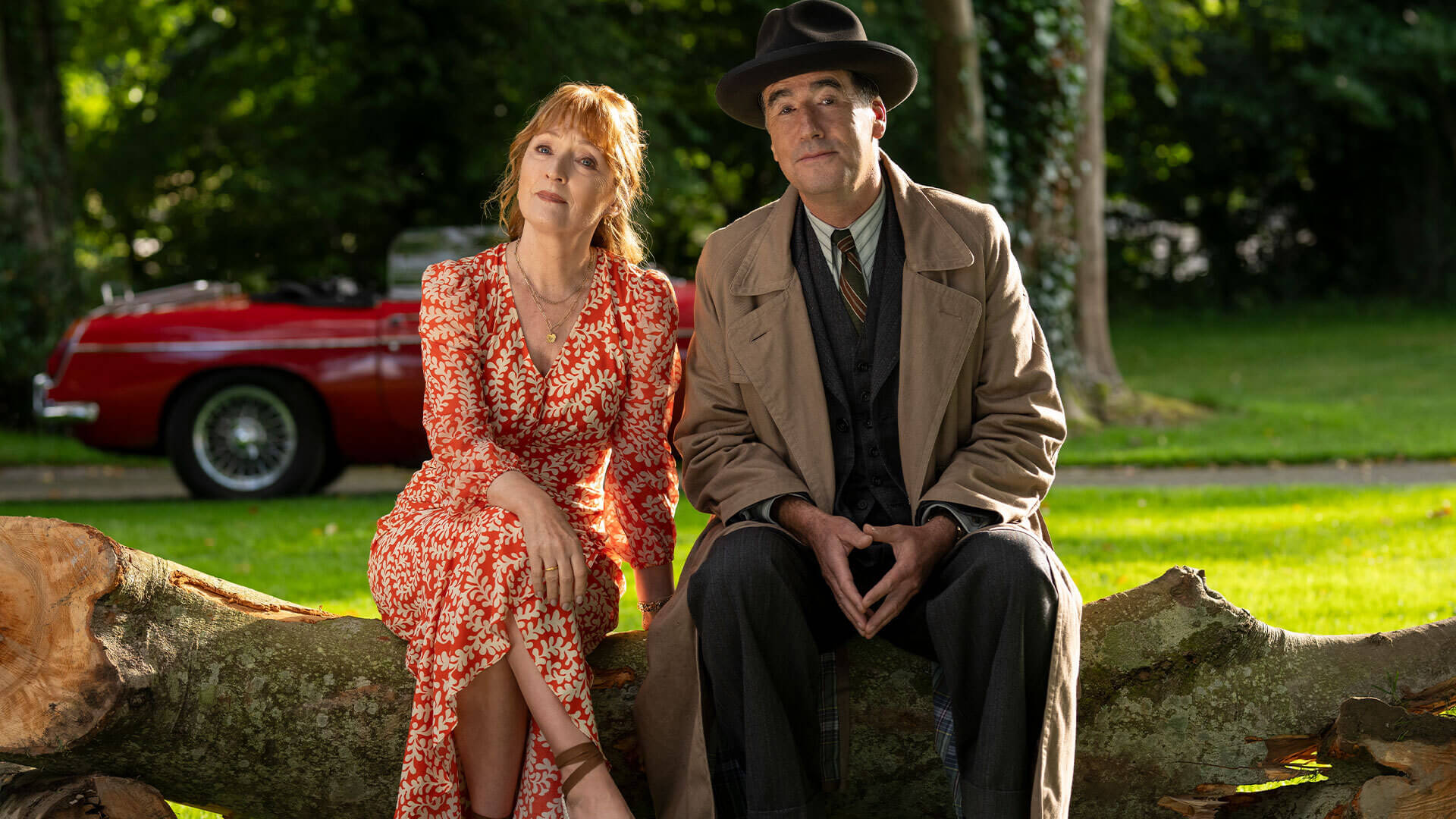


from PBS: Lesley Manville and Tim McMullan


One of the tags I used for this post is "page to screen," since according to PBS,  there will be a third (and final) installment in the Masterpiece series starring Lesley Manville as Susan Ryeland and Tim McMullan as Atticus Pünd.  The previous two have been extremely bingeworthy, so even though I didn't care for the book as much as I might have, I will be ready to watch when the series rolls around again. 


Sunday, May 18, 2025

Night Cry, by William L. Stuart


9798886011531
Stark House Press, 2025
originally published 1948
162 pp

paperback
(read in April)


A few weeks ago I turned on my television and an ad/small clip for the 1950 movie Where the Sidewalk Ends popped up on the home page for Amazon Fire TV (I know, but I really hate cable).   I clicked on the "add to my list" button, thinking it looked like a good noir film to hold on to for a late night insomnia viewing.  So, imagine my surprise when this book arrived the next day with its photo of Dana Andrews on the cover.   I took it as kismet and read the novel right away.    And before I get into this post, my many thanks to the Stark House Press people -- they are just terrific. 

Lieutenant Mark Deglin is still angry over missing out on a promotion he thought he'd had in the bag.   He believes that he's "one of the best detectives on the force," but as his captain notes, "he doesn't do things by the book all the time" while on the job.  He's still carrying that chip on his shoulders the night he is called out to a gambling club to investigate a murder.  The victim had been in a fight earlier that evening with another gambler by the name of Kendall Paine, a war-weary, decorated  vet who had since been thrown out of the club, so he quickly becomes the prime suspect.   Deglin goes to Paine's apartment where he starts asking questions, but the situation changes for the worse when the two men get into a physical fight and Paine falls down dead.   When Deglin calls in, he learns that the murder has been solved and that Paine wasn't the killer.  Instead of copping to the truth of what happened, he goes into cover-up mode, ditching the body while leaving clues that suggest that Paine had left town.  Things might have worked out at this point, but the real complications set in when Deglin is told that  although he's no longer wanted for murder, the DA really needs Paine as a witness in the murder case, and Deglin's captain assigns him the task of finding him. Deglin's web of deceit becomes even more tangled when Paine's girlfriend, Morgan Taylor, refuses to believe that Paine would just up and leave and a reporter named Smith offers to help her find him.  To add yet another twist to the knife, some secrets refuse to stay buried, backing Deglin into a tight  corner while the walls close in. 


first edition, Dial, 1948 (from Abebooks)


Aside from the taut story here, Night Cry is a compelling psychological portrait of a man battling his inner demons as the weight of his actions comes down on him. It also asks the question of what happens when the badge becomes worthless and a cop is left to ponder what's left. It is a truly fine crime novel, with darkness gripping the narrative tightly, and with noir vibes seeping deep into all facets of this book. It is gritty, moody and emotionally charged, and I give the author a lot of credit for building this story in well under two hundred pages.  From the outset, the author crafted an atmosphere that not only doesn't quit, but stays with you long after you've finished reading.    I can most highly recommend this book, especially to readers of vintage noir, and to crime aficionados who don't mind the darkness.


from posteritati


The novel is the latest in Stark House's Film Noir Classics series, so after the book comes the film viewing.  The  1950 film, scripted by Ben Hecht and directed by Otto Preminger, is gripping in its own right and well worth the watch, although I have to admit my preference for the novel.   In the movie Deglin becomes Mark Dixon;  Dana Andrews really throws himself into the role, slipping into Dixon's skin and taking on the moral weight that drags this man down as he finds himself ever so slowly hemmed in by his actions.  Gene Tierney's Morgan Taylor changes in the movie novel from a socialite to the daughter of a cabbie who models designer gowns for a living.  The story goes well during  the first half of the film, pacing and plot on point, but starts to lose its intensity as Dixon and Taylor find themselves falling in love.   And while the novel's ending wasn't exactly the best, the film's ending was just disappointing.   But as I say, it's still well worth watching. 

Bottom line: loved the book, movie was good but not a) great or b) as well done as the novel. 

Monday, January 13, 2025

The LIttle Sparrow Murders, by Seishi Yokomizo

 
9781782278870
Pushkin Vertigo, 2024
originally published as Akuma no temari uta (悪魔の手毬唄serialized 1957-1959; published in book form in 1971, Kadakowa Shoten)
translated by Bryan Karetnyk
311 pp

paperback
read in December

It is no secret how much I have come to love these books. I'd had this one preordered for months once I learned it was going to be published; I already have the next Pushkin Vertigo translation, Murder at the Black Cat Cafe, due out in the fall of this year, on my radar and in my sights.   The Little Sparrow Murders is number 49 of 77  in  Yokomizo's Kosuke Kindaichi detective series and is the sixth of this author's books to have been published in translation by Pushkin Vertigo.  I was also lucky enough to have latched on to a dvd of the film made in 1977, which was not quite as good as the novel, but then again, I expected that.  

It's July, 1955 and Kindaichi Kosuke is taking a much-needed rest and decides that he should go Okayama Prefecture where he'd "developed a fondness for the local people and their ways" after spending time there during a few of his crime-solving adventures.  First he stops in to visit with an old friend, Inspector Isokawa in Okayama, who gives him the address of an inn in Onikobe Village, owned by a woman who Isokawa once knew. Evidently, she's had "her fair share of sorrow," since her husband had been murdered some twenty years earlier, and the crime had never been solved.   While Kindaichi insists he only wants to rest for a while, he agrees to listen to the inspector about this case, which seems to mean so very much to him.   Once in the village, Kindaichi holes up at the Turtle Spring Inn, where he "could quite happily give himself over to idleness without being disturbed by anybody." As he notes, he didn't "feel any particular sense of obligation" to the inspector, but at the same time, he kept his eyes and ears open while "lazing around idly like a cat."   Kindaichi's plans for R&R are interrupted, however, with the disappearance (and perhaps murder?) of the elderly Hoan Tatara,  a self-described "recluse" and local historian.  Not long before Tatara disappeared, Kindaichi  had gone to his home and had written a letter to a former ex-wife for him, asking her to come live with him now that they're both old, a proposal that had been accepted.  In fact,  Kindaichi had run into an elderly woman with a large furoshiki on her back who had introduced herself as O-Rin, this particular ex-wife of Tatara's, who was on her way to his place.   Now, however, there is no sign of either of them, and Isokawa, who has come to Onikobe, wonders if perhaps Tatara's disappearance might have something to do with the unsolved crime of twenty years earlier.  It seems though that Tatara's disappearance is not the only strange happening in the village; it isn't long until a young woman is discovered murdered, her body and the scene staged in a bizarre fashion.  She isn't the only one to die, however -- the guests at her wake will soon be attending another one.   Kindaichi must figure out what connects all of these occurrences in order to stop these murders, and  discovers a slender thread of a clue that just might tie them all together. 


ryokan in Onikobe Village, from Trip Advisor


While my favorite of the Kindaichi mysteries so far continues to be The Inugami Clan (it's bizarre beyond belief and firmly in my strange-reading wheelhouse), The Little Sparrow Murders follows closely in second place.    The novel is also much more reader friendly than the previous ones, and Bryan Karetnyk's translation made the story flow.  I will say that I flipped back and forth between the text and the map that is provided at the beginning of the book any number of times before I finally took a photo and kept it up on my iPad screen to refer to.    The provided list of characters soon becames vital as well,  because the family relationships are beyond critical to the story. 

The Little Sparrow Murders delivers a super murder mystery, while also examining how the past has a powerful impact on the present and delving into social divisions, ritual, customs and the importance of history in this village.  It is also  a solid puzzle that armchair detectives will appreciate, making for a particularly good whodunit, and I am most happy to admit that  I did not guess or even come close to guessing the who here.   High marks to this one, and definitely recommended to readers of Japanese crime fiction or to fans of Yokomizo's detective Kindaichi Kosuke.  Now I'm not so patiently waiting for the next book.  


film poster for 1977 film, Akuma no temari-uta. From IMDB


Akuma no temari-uta was directed by Kon Ichikawa, as were thirteen other films featuring our erstwhile and somewhat scruffy detective Kindaichi.   There are other films with different directors, but the Ichikawa films are by and large my favorites, and Kindaichi's adventures were also revisited on Japanese television and in manga.   The story changes just a bit in the movie based on this novel but the main thrust of the book carries through the film.   In the book you have the list of characters complete with family relationships to draw on, but here the introduction to these people happens within the first half hour or so, making it a big on the draggy side.  But after that, I was completely engaged in what was happening on screen, especially the murders, which were portrayed in a way that even horror-film watchers would have appreciated, yet still kept close to the descriptions in the novel.  One trademark of Ichikawa's work is that he is experimental in style -- in Akuma no temari-uta there are quick cuts, flashbacks that often are revealed in grainy black-and-white and other moves that definitely kept me on my movie-watching toes.   One of these involves a scene from the 1930 movie Morocco that is so eerie in the watching, yet necessary to the overall character study.   There's also a sprinkling of Kindaichi's dandruff I could have done without, but that same thing happens in all of the Ichikawa movies in some form.   The end comes with some pretty over-the-top dramatics, but then again, I'm a long-time watcher of Japanese films where emotional scenes tend to bring this sort of thing out in the actor.  I am lucky enough to understand the language but I'm sure there must be copies of this movie on dvd with English subtitles. As usual, the bottom line is this: film good, book much better.  

Monday, September 9, 2024

PPL #5: The Moving Finger, by Agatha Christie


"The Moving Finger writes; and having writ,
Moves on: nor all your Piety nor Wit
Shall lure it back to cancel half a Line,
Nor all your Tears wash out a Word of it."


9780062073626
William Morrow, 2011
originally published 1942
240 pp

paperback
read earlier in August

 The Moving Finger, is quite possibly the most well known of all of the poison-pen letter mystery novels from yesteryear (at least of the books I've collected)  and even though I've read it before and knew the who, it was still a fun read. 

Jerry Burton and his sister Joanna have come to the small village of Lymstock where he has come to recuperate after a "bad crash" while flying.  His doctor had told him that "everything was going to be all right," but he had to "go and live in the country" where he should have "absolute rest and quiet" for at least six months.  Obviously, as Jerry's looking back on things and telling the story that's about to unfold,  we get the sense that the complete opposite has occurred -- as he notes, "Rest and quiet! It seems funny to think of that now."  They hadn't been there too very long when they receive a "particularly foul anonymous letter" suggesting that Jerry and Joanna ("the fancy tart") are not really brother and sister.  Jerry wonders if their presence in the village is resented by someone, but he finds out that they're not the only people in Lymstock to have received one -- that "They've been going about" for a while now.   He also believes that "the best way to take it" is as "something utterly ridiculous," but his doctor, Owen Griffith, tells him that the problem is that "this sort of thing, once it starts, grows."  He also notes that "crude, childish spite though it is, sooner or later one of these letters will hit the mark. And then, God knows what may happen!"   The people of Lymstock are about to find out when one person commits suicide and there's a murder shortly after.  It seems that even in "such a peaceful  smiling happy countryside," there is "down underneath something evil."  

The village "looks the most innocent, sleepy, harmless little bit of England you can imagine," but as one character notes, it has "plenty of wrongdoing" and "any amount of shameful secrets."  Strangely though, the letter writer doesn't hit on any of those, sending out wild accusations instead.  At the same time it's enough to make people distrustful and leave them with a sense of fear wondering which of their neighbors is cruel enough to do such a thing.   Jerry does a bit of his own sleuthing and the police do their best, but it's only when Jane Marple, who "knows more about the different kinds of human wickedness..." is brought on the scene (rather late in the game here) by the vicar's wife that the case is finally solved.   


1942 edition; from Abebooks


My guess would be that anyone reading it for the first time would be hard pressed to figure out the identity of the letter writer; due to potential spoilers I won't say why, but trust me on this one.  I will say that the discovery of the culprit, along with the motive behind it all, came without much excitement, as Miss Marple unspools the answers quietly among a small group of people.  Otherwise, it's difficult to not get caught up leading to that point, since Christie lays out a compelling story with a clever plot that you won't want to put down.   Every time I read one of her books, I come away the sense that this author must have been much like her elderly detective, having a keen eye for human nature, and  The Moving Finger  is no exception.  Definitely a no-miss for Christie readers, for people interested in the poison pen in mystery novels and for vintage readers in general. 

There are two television adaptations that I know of (and that I've seen), one from 1985 with Joan Hickson as the erstwhile Jane Marple and the other from 2006 with Geraldine McEwan in the role.  I'm a huge fan of the older two-part episode because it's more like the novel,  but you'll have to watch both and decide for yourself. 

Monday, June 24, 2024

Kiss the Blood off My Hands, by Gerald Butler


9798886010886
Stark House Press, 2024
originally published 1948
166 pp

paperback 

Just released this month, Kiss the Blood Off My Hands is the latest in the Noir Film Classics  series from Stark House Press.  I have a few of these books but this is the first I've read.  And since I love to see books I've read  sort of come alive on the screen, I bought a copy of the 1948 film based on this novel starring Burt Lancaster and Joan Fontaine and watched it as soon as I'd finished reading.  More on the movie later -- on to the book. 

The action begins in a pub when Bill Saunders, fresh off the boat in England,  kills a bouncer. He hadn't meant to, but the punch he'd landed on the man's face knocked him to the floor, stone cold dead. He doesn't care that the guy is dead; all he cares about is getting out of there.   Before anyone could call the police, Bill takes off running and so do a few others, chasing right behind him.  He notices a woman "going into a door," and takes advantage of the situation, forcing his way in.  Deciding to stay overnight, the next morning Bill discovers that the woman (Jane) has guts and doesn't seem afraid of him.  He realizes that she's different than the other women in his experience, and that  "There was something about her."  Eventually he leaves after she returns home from her job, but it won't be the last they see of each other. 

Bill is a certified tough guy, beating up and stealing money from taxi customers, robbing a sex worker, referring to women as bitches and tarts, and violence, which exists just beneath his surface,  is his way of dealing with most situations.  For him, people are just mugs, and as such, they're prey, ready to be taken advantage of.  He doesn't respond normally on an emotional level, but he is definitely attracted to Jane, showing up at her workplace,  but with Jane (whom he refers to as "the kid"), he's different.  He still hasn't told her that he'd actually killed the bouncer, and somehow he is able to persuade her to go out with him, at first to the races, then for tea based on the money she'd won from the track but when they're on a train and Bill tries the 3-card con on a fellow passenger, she sees his true colors when he turns violent when the fellow doesn't want to play any longer.  Then she lets him have it:
"I can't pretend that I didn't know you were a tough guy. I was fool enough to allow myself to be attracted by that. But I thought there was something decent underneath. Now I know there isn't. You're nothing but a cheap, bullying hooligan." 
Although she tells him she never wants to have anything to with him again, and that he's "rotten," it's that "something decent underneath" that Jane saw in him that eventually brings the two back together, with her believing that maybe a decent job would do him some good and give his life "a shape again."  Can she change this man  by taming what Curtis Evans refers to in his introduction as "his brutal impulses with the proverbial good woman's love?"  Is Bill at all redeemable and can he truly be rehabilitated?  In the meanwhile, in an horrific twist I didn't see coming, Jane finds herself in an unexpected dilemma that has the potential to bring everything crashing down around the two of them and tear down what the two have managed to build. 

The length of this book has nothing whatsoever to do with its complexity, and when an author can pack so much into such a short space, in my opinion, he's done a fine job.  Here that complexity is found not only in the character of Bill, or in the question of redemption, but more to the point, in the way that Butler maps out exactly how one random event sets everything else into motion, with unintended, and most certainly unexpected  consequences rippling down the line, definitely a true noir trait. 

It's so good that I couldn't put it down once I'd picked it up.   Solidly good reading and an absolute must for anyone who likes tough, gritty  twisty noir.  A giant thank you to Stark House for my copy!


And now the film -- I once did a mega Burt Lancaster moviefest in the comfort of my own home, but somehow I missed this one.  Kiss the Blood Off My Hands was released in 1948, with Lancaster starring alongside Joan Fontaine.  The opening chase sequence is just dynamite with Lancaster running through the dark, shadowed streets of London before climbing into Joan Fontaine's window.   All of the basics of the novel are there as a foundation, although there are quite a few changes, as expected.   Fontaine plays Jane, whose occupation changed between page and screen from a shopgirl  to a nurse.  I have to think that it's as a caregiver that movie Jane recognizes something damaged inside of Bill, and it is instinct that makes her want to help him.  It's also a good setup, because as part of Jane's ability to help him keep his violent tendencies in check and get Bill focused, she is able to get him a job as the driver for the clinic where she works; in one particular case, he is able to bring a young father the medicine his dying daughter desperately needs to survive.  Even though ignorance causes the dad to not want his child to have it, the scene affords a glimpse of something within Bill that truly cares about this little girl as he forces his past the father to make sure she gets what she needs.  And speaking of Bill, in the film he admits to having been a POW, where in the book, he doesn't really have too much backstory going on.   One of the biggest changes, however, has to do with a blackmailer played by actor Robert Newton, whose utter nastiness comes through on the screen enough to make you uncomfortable just looking at the guy.  I won't say what the differences are so as not to wreck things, but the changes vis-a-vis that particular portion of the plot  worked very nicely in the film, as the suspense ratchets slowly until a fateful moment, but it's clear that the story's not quite over yet.   Nicely done, although I did prefer the ending in the novel to the ending of the film, although I didn't jump for joy over either one.

So, both book and movie are a yes, both I can easily recommend. 


Tuesday, April 9, 2024

Point Zero, by Seichō Matsumoto


9781913394936
Europa Editions, 2024
originally published as Zero no shoten, 1959
translated by Louise Heal Kawai
279 pp 

paperback

 I needed a short novel for late-night reading while family was here last week and Tokyo Express (apa Points and Lines) called out to me from my shelf, after which I found myself wanting to read more of Matsumoto's work.  I chose this one,  Point Zero, which, like Tokyo Express, is set against the backdrop of  postwar Japanese society.  I found myself unwilling to put it down at any time once I'd started reading, and I liked it so much that I took out my copy of the author's A Quiet Place (also from Europa) which I'm ready to start later this evening.  About Point Zero, it's best to say as little as possible so as not to give away too much, so my post will be a bit vague.  Personally, I think the back-cover blurb is too spoiler-ish but feel free to disagree. 

 Although Teiko Itane had received marriage proposals in the past, she'd turned them all down.  Her situation changes when she receives a proposal from a certain Kenichi Uhara via a matchmaker.  Uhara is the manager of the Hokuriku branch of a major advertising firm, spending twenty days a month at the office in Kanazawa City and ten days in Tokyo.  That arrangement is of particular concern to Teiko's mother, but it seems that the company has been trying to get him to move to Tokyo for a while and he's finally agreed, using the opportunity to finally get married as well.  Even though they hadn't spent any time alone together, Teiko decides to accept the proposal, and also believes that whatever life he'd had in the past should stay in the past.  This decision will come back to bite her later, but for the moment, aside from some sort of  unspoken "complexity" within Kenichi that she senses, the few early days of the marriage that they share aren't so bad for either of them.  She's made friends with Kenichi's brother's family (who live in the Aoyama neighborhood of Tokyo) and after the honeymoon, the plan is for Kenichi to make his final trip to Kanazawa to hand over the job to his successor, a certain Yoshio Honda, who will be accompanying him on the train journey.   As she watches the train pull out of the station, she has no clue that this will be "the last time Teiko ever saw her husband." 


The first hint that something is wrong comes when Kenichi sends a postcard saying that he'll be home on the twelfth and fails to show up.  After a few phone calls, Teiko learns that nobody in the company knows where he is; on the third day the section chief of Kenichi's company advises her that someone will be going to investigate his disappearance in Kanazawa.  He also asks if she would be willing to accompany that person.  Kenichi's brother Sotaro can't get away at that time, so she heads to Ueno station where she learns that Honda has already been in touch with police and is taking Kenichi's disappearance very seriously.  Once she arrives in Kanazawa, she learns a bit more about Kenichi's movements the day before he was to take the train home to Tokyo, the results taking both Honda and herself by surprise. But this information is just the opening salvo of many more surprises to come, including a series of unexpected deaths and a ruthless killer who is determined not to be caught.  The question that drives Teiko here is just how these deaths are connected. She also realizes that "Her husband had a secret. What was it?"   Beginning her quest with only two photos of two different houses that might possibly be some sort of clue,  finding the answers becomes for Teiko nearly a full-time occupation.  She also doesn't realize that she is up against a very powerful and determined opponent, someone who will do anything to prevent the past from catching up to the present, no matter the cost. 


1971 edition (in which the cover is much more relevant and given the story, downright creepy)  from Amazon


Aside from the twists and turns that this story takes, I was struck while reading Point Zero by two things.  The first is the sense of place that Matsumoto layers into this novel, whether it is in describing  various views captured within the neighborhoods of Tokyo or (and most especially), his incorporation  of the natural world away from the city.   The second is that the most forceful characters throughout the novel are women.  Anyone who goes into this novel with preconceived notions of docile Japanese women taking a back seat to the men in their orbits may be surprised at the strength the author affords to many of the females here.  While there are more than a few I could talk about, it starts with Teiko, who is strong, highly independent and more than determined to get to the root of Kenichi's disappearance.  She has no trouble trying to dig out information from people ranging from top company executives to the police to denizens of the neighborhoods her investigation takes her, and obviously she will not be satisfied until she knows everything there is to know, even if she has to rethink things now and again.  

The novel is utterly twisty, full of betrayals and secrets which eventually are unraveled to take the reader to another time and place entirely.  All of the above makes for  a solid mystery at the core of this novel, and I seriously had trouble putting it down once I'd started.  I have a great love for Japanese crime authors who use their writing to explore human nature and troubled psyches, and  Point Zero certainly appeals on that level as well.  What elevates it beyond ordinary is Matsumoto's ability to set the crime not only within historical context but in a changing social context as well.  This one I can certainly and highly recommend, especially to readers of vintage Japanese crime fiction.  I loved it. 


from blu-ray.com


I also watched the film adaptation of this novel made in 1961.  There is also a 2009 version that I would love to see, but I have to wait for a long while for my DVD to arrive.    For now, luckily I subscribe to the Criterion Channel and there it was (the 1961 film) along with other Japanese noir movies.  The beginning happens very quickly  with fast scene changes and seems a bit clunky;  later these quick cuts will be a bit more fleshed out via flashback. It's only when Teiko arrives in Kanazawa that the movie gets a bit more back on track, but I was definitely thankful I'd read the novel ahead of seeing the film or quite frankly I would have been shaking my head at the start wondering what the heck is happening here.   The powers that be did make a number of changes to the original source material, but even with those it is still well worth watching.  


Saturday, June 3, 2023

Green For Danger, by Christianna Brand


9781728267661
Poisoned Pen Press, in association with the British Library, 2023
originally published 1944
284 pp

paperback

I'm still working at restoring my mental mojo, but that doesn't mean I've been idle readingwise. I'm just very, very behind and now I've got a stack of like five books sitting here waiting for me to post about. Not to worry -- I'll get there.

Green for Danger is book number two in Christianna Brand's Inspector Cockrill series, preceded by the series opener, Heads You Lose (which I'm reading now).  I'm just thrilled that it is a part of the British Library Crime Classics collection, since the copy I have is an old mass market paperback in pretty beat-up condition.   I enjoyed Green for Danger so very much that I immediately bought the remaining books,  including preordering Death of Jezebel (also from British Library Crime Classics and arriving in August) -- that's how very good it is.  

World War II serves as the backdrop for this clever, closed-circle mystery, which takes place at a former sanitorium now serving as military hospital at Heron's Park just outside of Heronsford in Kent.  The seven main players have all been called to duty there, and they are introduced one by one  (along with a bit of each person's backstory) via their acceptance letters which are being delivered by  postman Joseph Higgins.  The male contingent consists of Dr. Gervase Eden, a surgeon from Harley Street, Mr. Moon, another surgeon hailing from Heronsford, and Dr. Barnes (Barney),  a local anesthetist; the women are   Jane Woods  (Woody), who has been called as a VAD nurse as have Esther Sanson and Frederica (Freddi) Linley, and finally Sister Marion Bates.  Offering the tiniest bit of a clue as to where this story is headed, as Higgins takes himself and his bicycle up the hill leading to Heron's Park, the author tells us that he "could not know that, just a year later, one of the writers would die, self-confessed a murderer."  

Within that year, the hospital working routine of these new arrivals has been established, romance and more than a bit of sexual tension hangs in the air, and air raids are regularly bringing in casualties.  One of these is Joseph Higgins himself, admitted with a fractured femur.   His surgery is routine, "only a little operation, hardly anything at all," so when he dies before the operation begins while the anesthesia is being administered, everyone is surprised.  After all, "the old boy was all right" physically, and no one can find anything wrong in the equipment or the procedure that might have caused him to die so unexpectedly.  Goodness knows things like this can happen "for no rhyme or reason," but the problem is that this wouldn't be the first time that Barnes had lost a patient while administering anesthesia.  Major Moon tells him that if anything comes of Higgins' death, he'd be happy to call in "the high ding-a-ding" Inspector Cockrill  to ensure that "there isn't a lot of undue fuss."   At first Cockrill (who often goes by the nickname Cockie) doesn't "see what all the fuss is about," but it isn't too long before he realizes that Higgins' death was definitely suspicious, and definitely a murder.  He also realizes that it's one of our seven main characters who is responsible, but as to motive, he has no idea.  It seems however, that the murderer isn't quite finished, as there is a second death, again in the operating theatre.  


 Original first edition cover, from Wikipedia


As a person who often figures out the who long before the big reveal comes, I have to say that I was extremely delighted not to have done so this time.  I actually had two different suspects in mind but Brand came along and pulled the rug right out from under me.  That's not too surprising, since the author sort of toys with her readers by planting doubts (and thereby possible motives) about each of the seven suspects. In hindsight, all of the clues were definitely there, and it was like a "how did I miss that?"  kind of moment when Brand actually unmasked the killer.  Add to this the very realistic and credible sense of place and the atmosphere that the author delivers pretty much from the start, all making Green For Danger a pitch-perfect mystery. 


from Cinema Sojourns

I have the old black-and-white film (1946, Pinewood Studios) on DVD as part of my Criterion Collection movies, so I watched it right after finishing the novel.  While it deviates a bit from the book I could have cared less.  Alastair Sim definitely steals the show here in the role of Inspector Cockrill, often playing his scenes for laughs, which at times given the dark and actually somewhat sinister atmosphere underlying this film, can be a welcome relief.  He is eccentric, but underneath his quirkiness there is definitely a sense that he is a wise detective with a keen sense of justice.  The supporting cast, including Trevor Howard, also does a great job.  I would definitely recommend both book and movie, in that order.  

Thursday, July 28, 2022

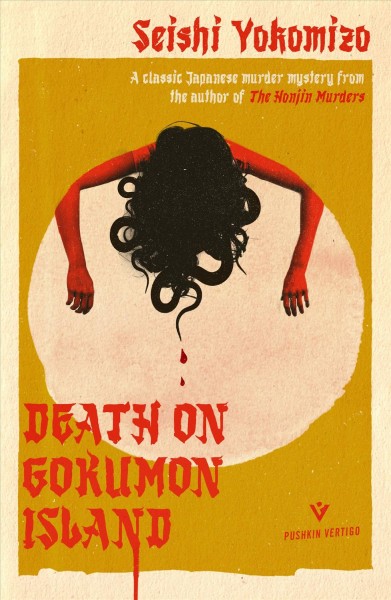
Death on Gokumon Island, by Seishi Yokomizo


9781782277415
Pushkin Vertigo, 2022
originally published as Gokumon-To, originally serialized 1947-1948
translated by Louise Heal Kawai
310 pp

paperback

Completely overjoyed when I learned last year that this book was going to be published by Pushkin Vertigo, I hit the preorder button at lightning speed.  At the same time, I bought a dvd of the 1977 film made from this novel, directed by Kon Ichikawa, which I watched last night after finishing Death on Gokumon Island.  More on that later.    

It's September, 1946 and as the novel opens, a ferry is making its way to a few different islands in Japan's  Seto Inland Sea.   It drops its passengers until there are only three left, all heading for a small island, Gokumon-to, which translates to Hell's Gate Island.  One of these people is Kosuke Kindaichi, who overhears a conversation between the other two -- a priest who had gone to pick up the once-confiscated, now-returned bell belonging to Senkoji Temple, and another man who informs the priest that someone named Hitoshi was "supposed to be coming home soon."  He had heard the news from a soldier in Hitoshi's regiment who had come to the island a few days earlier, when the guy had turned up to tell the family that Hitoshi had sent him to let them know not only that he would be returning, but also that he hadn't been injured in the war.  The priest then asks about someone named Chimata, which captures Kindaichi's attention, sparking a conversation among the three men.  It turns out that Kindaichi, a friend of Chimata, had come to Gokumon-to let the Kito family know of his death aboard a transport ship just a month earlier. 

Kindaichi, "like every other young man in Japan," had been drafted into the army, where he had spent two years in China before being deployed "between different islands to the south." His last stop had been in Wewak, New Guinea, where his division had been defeated, causing them to retreat; his division had joined others and it was then that Kindaichi had met and befriended Chimata-san,  helping him through his bouts of a very bad case of malaria and spending time together while the other soldiers "fell one after the other."   While they eventually made it out okay when the war ended,  each time Chimata fell ill Kindaichi noted that he suffered from "an extreme fear of death."  All was well, it seemed, until Chimata fell ill on board the repatriation ship; before he died he had told Kindaichi that he didn't want to die, and that he had to go home.  Otherwise, he said,  his "three sisters will be murdered."    Exactly why this might be is not explained until the end, but by then, it's too late -- it seems that Chimata had been right, and now our detective must try to discover who is behind these (quoting the back cover) "grotesquely staged" deaths that start not too long after he lands on the island. 


1971 cover from Mandarake


He will definitely have his work cut out for him, since the islanders tend to regard anyone not from there as suspicious; he is even arrested once by the local police sergeant who has no idea of his prowess as a "famed detective" and who views him as prime suspect in the case.  With the arrival of his old friend Inspector Isokawa (from The Honjin Murders) Kindaichi is released (to the sergeant's great  chagrin, I might add), but even then it will not be smooth sailing because, as he says to Isokawa, "everyone here on Gokumon Island is crazy. They're all out of their minds."   Perhaps, but while the Inspector makes note of the insanity behind the murders, Kindaichi eventually realizes that there is most certainly a method behind the madness on the part of whoever is responsible.  

What is done very well is the description of the longstanding power structure on the island and then there's the novel's  immediate postwar setting which captures the  demobilizations that are still ongoing, the families who continue to wait for their loved ones to return home and sit by the radio to hear the latest repatriation news, and a real sense of how the war has interrupted the flow of life for most people such as Isokawa, whose career had basically stalled during World War II and remains unsettled at the moment.   At the same time, the real payoff  in reading Death on Gokumon Island must wait for the end.  I was actually becoming a bit frustrated partway through because the story becomes more than a bit muddled and clunky at times; to be fair to the author, he does toss out clues here and there but they are on the impossible side of figuring out until all is revealed and things fall into place.  Trust me -- even the most seasoned armchair detectives will not be able to figure this one out.  Word to the wise: pay attention to the list of characters offered up front; I found myself returning to it several times.

 So far, Pushkin Vertigo has published four of the books in Seishi Yokomizo's Kosuke Kindaichi series:  The Honjin Murders, The Inugami Curse, The Village of Eight Graves and now this one.  According to Thrilling Detective, there are seventy-seven books featuring Kindaichi, so with any luck (crossing fingers) we may be seeing more in translation.   As I've noted before, my favorite is The Inugami Curse apa The Inugami Clan, but with another seventy-three left, who knows what little gems are yet to be uncovered in this series!  Despite my reading reservations at times,  Gokumon Island ends up being not only clever, but the author injects more than a twisted sense of destiny as well as a sort of tragic irony into this story once all is said and done.  Recommended for fans of the series and for Japanese crime fiction in general; it may be a bit slow in the telling but the reward is well worth waiting for. 


from TMDB

The Japanese film (1977) based on this novel (directed by Kon Ichikawa, whose The Burmese Harp I could watch on a continuous loop) starts with the same premise as the book, but for some reason I still can't fathom, the powers that be here then changed the storyline, including the identity of the killer.  Also unexpected and producing a very loud "wtf"  was a decapitation scene, and I have to say that I actually cringed every time Kindaichi scratched his head releasing clouds of very visible dandruff. Ick.  On the other hand, it streamlines the rather convoluted story making it easier to follow, but I'm glad I read the novel before viewing the movie.   All in all a fun experience but in my humble opinion, not quite as well done as the movie based on Yokomizo's Inugami Clan, also done in the 70s but miles better than this one.  


Sunday, June 19, 2022

A Taste for Honey, by H.F. Heard


 9781613161210
Penzler Publishers, American Mystery Classics, 2019
originally published 1941
197  pp

paperback

Still following the séptimo circulo list, up next after Night Over Fitch's Pond comes H.F. Heard's A Taste for Honey (#25),  published in 1941 and reprinted in 2019 via Penzler Publishers' American Mystery Classics series.    The book was made into a 1966 film called The Deadly Bees, but more on that later.  

Last week my insomnia flared up again and I grabbed this book  hoping I'd read until drifting off.  The complete opposite happened -- once I started it I couldn't stop.  It wasn't because it's a great book, but more because what happens here was so far out of the range of most mystery/crime novels of the period and so completely unexpected that I knew there would be no sleep that night.    The story is related by Mr. Sydney Silchester, a reclusive  sort of fellow who had come to a small village in the countryside for peace and quiet. He lives under a self-made rule of "keeping myself to myself," wanting to be "left alone, at peace," preferring his own company to that of others.   Evidently something has happened to shatter his solitude and he feels the need to "set it all down" so that his record (narrated retrospectively), will let people know that he had very little blame in the matter, the whole thing having been "forced" upon him.  What follows is not exactly a mystery but a sort of bizarre story that borders on pulpy horror (not the supernatural type but more like a sort of mad-scientist adventure caper), and while there is some  detection involved here,  this is by no means a whodunit.   And it all begins with Silchester's fondness for honey, which he buys regularly from a certain Mr. Heregrove, the local village apiarist.   At one point Silchester discovers that he's running low on the stuff, and while considering his next visit to the Heregrove's farm, he learns from his house cleaner that Mrs. Heregrove had met an untimely end after being stung to death by her husband's bees.  Though the coroner's inquest arrives at a verdict of accidental death, Heregrove has been ordered to destroy his hives, which leaves Silchester without a supplier.  Not keen on asking around the village due to his "dread of business dealings" that might lead to "social entanglements," he finds himself in luck one day while out on a long walk, when he happens upon a sign advertising "a certain amount of honey" for sale.   Happy to find a new supplier,   he goes on to meet the man who posted it, a certain Mr. Mycroft, who, along with the honey, also provides him with an interesting theory.   As the back-cover blurb says, Mr. Mycroft "senses the bloody hand of murder,"  meaning that he believes that Mrs. Heregrove's death was not an accident at all.   That will be it for plot, I'm afraid, because there is no way that I'm going to ruin the show for potential readers.  

Despite some testing of my patience with Silchester and Mycroft because of their often lengthy expositions on various topics,  I had great fun with this novel.   I have to seriously offer a tip of my hat to the author on even coming up with this crazy plot, which had it not been for Mycroft's habit to  (and pardon the pun) drone on and on, might have made for better reading.  On the other hand, the nature of the villainy revealed here allows for the author to discourse about the limitations of the law which, in this case, leaves these two men no alternative but to handle things themselves.    As Mycroft notes,
"The law protects us from the sudden, unpremeditated violence of the untamed blackguard. It is helpless against the calculating malice of a man who patiently and deliberately studies to get around its limitations  When you have really faced up to the fact ... that the law, the magistrate and the village policeman are helpless to protect you, then you will be free to consider the unavoidability of step two of doing what we can do."
The situation comes down to a battle of the minds, with uncountable lives at stake if things go wrong.

 I should warn potential readers to leave the introduction for last as Otto Penzler reveals "one of the surprises in this book" in his assumption that "the secret has been revealed often enough that few readers will be astounded."  I suppose he never thought that perhaps there are still some readers like me who have neither read this book nor discussed it with anyone before, so that's certainly a big oopsie on his part.   And as to that secret, well, it's not hard to figure it out pretty much right away with all of the clues offered by the author. Trust me, that's the least concern in this novel.  Also, if you are one of those readers who must find something likeable or relatable about the characters, it's very likely you won't find it here.  All in all it was a fun read, not perfect by any means, but still very much worth the time.  


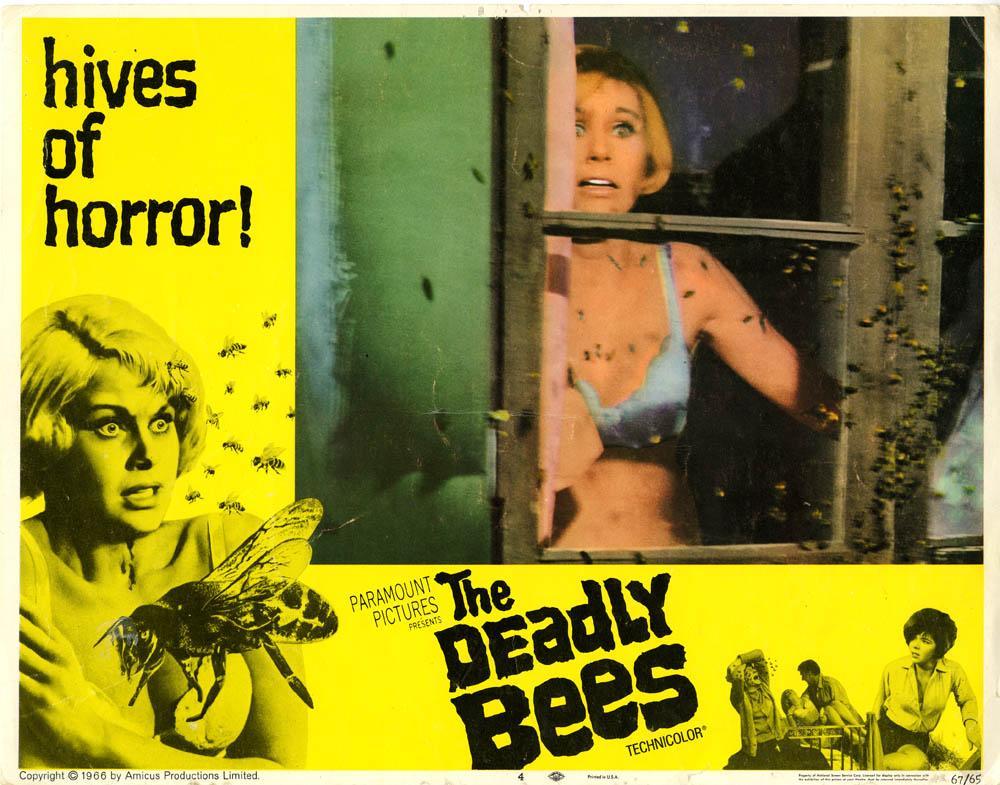
movie poster, from filmaffinity


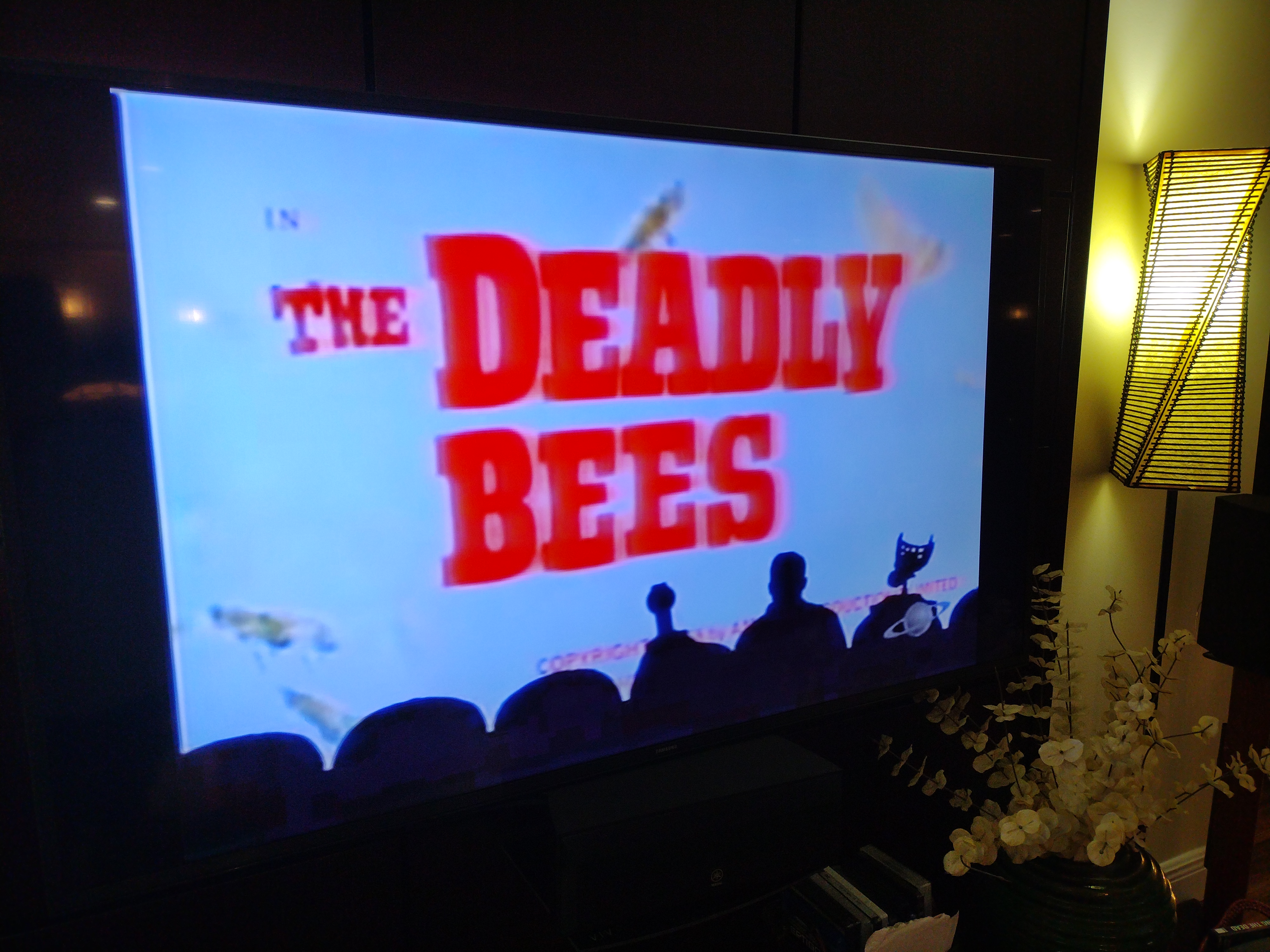
As to that movie (an Amicus production) I mentioned earlier, the original screenplay was written by Robert Bloch,  but the director of the film, Freddie Francis, evidently didn't like it and along with Anthony Marriott, decided to change it.  That's a shame really, and according to the B&S About Movies blog, Bloch never saw the film but did say that Deadly Bees "buzzed off into critical oblivion, unwept, unhonoured and unstung."   It would probably appeal only to true-blue diehard connoisseurs of old horror films because it was pretty bad, with the plot centering around a pop singer who has gone to Heregrove's farm for a rest after fainting from exhaustion during a television performance.  The roles are actually flipped in this film, with Mr. Mycroft (still painfully expository) as the bad guy.    I couldn't actually lay hands on a copy to watch but I did find an MST3K (of which I've been a huge fan for eons) episode on youtube which didn't actually quite deaden the pain; even the sarcastic bot banter couldn't save the experience. 


MST3K version, my photo


I  also watched an episode of the Elgin Hour, "Sting of Death" (1955), which stars Boris Karloff and hews much closer to the novel than the later 1966 film.  This one is worth the watch, although  the scope is rather limited, I suppose,  due to the allotted television time. It also won the Edgar Award for best TV episode in a series in 1956.  


Boris Karloff as Mr. Mycroft


Bottom line: book fun, movie bad; book recommended just because it's so very different and strange, movie is definitely skippable unless you are a masochist.  


Saturday, April 10, 2021

Laura, by Vera Caspary

 read in March

9780743400107
ibooks, 2000
236 pp


paperback

I meant to post about this novel some time ago, but in between my reading of the book and now, there's literally been an avalanche of things going on here that have required my focus elsewhere.  I also had  to really consider how to talk about this novel,  sort of mentally pulling my hair out over how not to give too much away, which is no easy feat.   Let's face it -- if you've seen the movie then you're already aware of the surprises in store,  but I am going to try to  avoid mentioning any spoilers here just in case. As a result, this will be reading journal post light. I hadn't seen the film until I'd finished reading the novel (just standard operating procedure), and while I enjoyed the movie very much, for me reading the book is the better experience by far.  

Like most crime/mystery fiction I enjoy reading, Laura is a complex,  twisty and suspenseful story that moves beyond the realm of standard whodunits into the more literary zone where human nature is put under a microscope.  And oh my -- the range of psyches in this book definitely merit close examination.   At the center of this story is Laura Hunt and the people in her immediate orbit, and then there's the detective on the case who discovers her only after she's been murdered. 

In telling this story, Caspary uses a series of first-person narratives, utilizing, as A.B. Emrys reveals in her essay "All My Lives: Vera Caspary's Life, Times, and Fiction" (which does not appear in my edition, but as an afterword in my Feminist Press edition of Caspary's Bedelia, 198), "the Wilkie Collins method of multiple narrators."*   These begin on a Sunday with the account of  well-to-do (and quite snobbish) columnist, collector and aesthete Waldo Lydecker,  as he finds himself grieving over the "sudden and violent" death of his friend Laura Hunt the previous Friday night. Violent death  indeed -- Laura  had been shot at close range on Friday night in her apartment, the buckshot also severely damaging her face.  On that last day of her life, she  had announced to her fiancé Shelby Carpenter (to whom she was supposed to have been married the next Thursday)  that she would need  "four or five days of loneliness" before the honeymoon, especially after having launched her latest successful advertising campaign.   She still planned on having her weekly dinner with  Lydecker that evening, after which she would catch a train to Connecticut where she had a house, returning on Wednesday.  But for some unknown reason, Laura  had canceled her dinner date;  evidently she had changed her mind at the last minute.   Assigned to the case of Laura's murder is Detective Mark McPherson, the second narrator, who had learned from Lydecker that if he wants "to solve the puzzle of her death," he must first "resolve the mystery of Laura's life."   

In attempting to do so, McPherson listens to what the other men in her life have to say about her, but he also develops a personal interest in Laura as well. He comes into the case viewing her as "just a dame" until his interest grows slowly into obsession, taking his time, for example, to go through her apartment, touching her clothes and possessions as a way to understand her.  It is mainly through the gaze of each of the men in this novel that we see Laura, but the author has also included a narrative in which we discover her true nature, that of a "modern" and fiercely independent person concerned about being her own woman, having "given so much of everything else," but always withholding herself, with too much to lose otherwise.  While the story does eventually reveal the "who," in my opinion, it is the question of why that is much more pertinent:  what exactly was it that made Laura a target for murder? 


original 1943 cover from Wikipedia


I did say that I would not post any spoilers, but the truth is that I could seriously go on forever about this book because there is so much to tell.   Unfortunately, that would involve spilling much more about the characters, about the story and about the twists involved throughout, and that's not going to happen here.   I did feel that the author sort of tipped her hand in one very telling scene making it easy to figure out the who far ahead of the actual solution, which was a bit disappointing, but in the long run Laura is a definite no-miss, and not just because of the crime element -- it is much more a study in character that brings out a number of issues that remain pertinent today.   

Don't miss the film, although quite honestly the book is so much better.

As I said, reading journal post light. 


*9781558615076
Feminist Press, 2005


Friday, October 2, 2020

L.A. Confidential, by James Ellroy


-- read earlier

"It was a once-in-a-lifetime case and the price for clearing it was very, very high."


I'm one of those weirdos who actually preferred the novel to the film adaptation, and I think it's because it had been so long since I'd seen the movie that it I'd forgotten about it.   I recently watched the film again after finishing the novel and was a bit thrown off -- not only had the story been cut, which due to its complexity I'd expected, but parts of the plot were changed as well, even down to who was killed in the Nite Owl Coffee Shop.   James Ellroy himself said about the film that it was "about as deep as a tortilla." 

Luckily that's not the case with the novel. There is nothing shallow about  LA Confidential, which goes straight for the jugular and doesn't let go.   

As was the case in The Big Nowhere, three police officers are at the center of the story. Sgt. Jack Vincennes  has fifteen years on the force, yet he is not well respected by his superiors.  He was given a fitness rating of D+ by his own supervisor who also remarked that he is "barely adequate."  Jack has a side gig as technical advisor to a TV cop show (think Jack Webb and Dragnet) and also provides celebrity fodder for Sid Hughes' tabloid Hush-Hush, giving Sid the heads up when an arrest is about to be made allowing the magazine a leg up on press scoops. He also wants to leave Ad Vice and return to Narco before he retires,  and is told that if he can "make a major case," in a "Picture-book smut" investigation he'll get his wish.  Like many of Ellroy's tormented characters, Jack has a secret from his past which if uncovered would cost him everything.  Wendell "Bud" White has no use for men who beat women; as a boy he witnessed his mother's murder at the hands of his father.  Lieutenant Ed Exley, former war hero,  lives in the shadow of his father, a retired legendary cop now construction bigwig who is currently bringing a Disneyland-type park and a freeway to Los Angeles.  Exley "works poorly with partners and well by himself;" he is also regarded as a "coward" because he does not use violence against suspects.  Aside from his inner rivalry with his father, he too harbors a secret that he would prefer to keep hidden, and after he rats out the culprit in a jail beatdown by cops during a drunken Christmas Eve party, everyone hates him.  

The main case at the novel's  heart is the shooting at the Nite Owl Coffee Shop, "The first all-Bureau call-in in history."  Six people died when at 3 a.m. three men entered and shot the place up. The police have one hot lead on the case: over the previous two weeks, three men had been seen "discharging shotguns" into the air at Griffith Park.  They had been seen driving a purple Mercury coupe at the time and it was a purple Mercury coupe that a witness had seen parked across from the coffee shop at the same time the massacre went down.  But since this is James Ellroy we're talking about there, this case will quickly unfurl well beyond its center and as it spins, it will drag the three cops along with it, catching up to them in ways no one could predict.   And that's an understatement.  

LA Confidential has been criticized by readers for its rather labyrinthine complexity involving numerous subplots, but I didn't have an issue with it and frankly, could care less, since after having read its predecessors The Black Dahlia and The Big Nowhere, I've become used to Ellroy's penchant for grandiose, and I was caught up in each and every turn taken by this story.  What I really want to say is that it's a firecracker of a  read that sucked me so far down the rabbit hole of Ellroy's 1950s Los Angeles that is was a relief when I finally got out.   Again, not perfect, but pretty damn close.  

It's another book that is uberbleak, not for the squeamish, should come with warning labels, and yes, it's long in the reading, but I enjoyed every second of it.  Every nanosecond of it.