Showing posts with label 1980s. Show all posts

Tuesday, June 27, 2023

The Mill House Murders, by Yukito Ayatsuji


9781782278337
Pushkin Vertigo, 2023
originally published as Suishakan no Satsujin Shinsou Kateiban, 1988
translated by Ho-Ling Wong
253 pp

paperback

The Mill House Murders is apparently the second of several books by this author in what Wikipedia refers to as the "Bizarre House/Mansion Murders" series. I've previously read his The Decagon House Murders (also published by Pushkin Vertigo),  the first in the series and a really good mystery that cinched the deal when it came to preordering this book. And while I had the inklings of a solution to this mystery vaguely floating on the periphery of my brain, The Mill House Murders still managed to seriously stump me as I couldn't figure out either the who or more importantly, the how.  

The novel begins at 5:50 a.m., September 29, 1985, within a prologue in which we learn that it is nearly dawn, and the group of people staying at the home of Fujinuma Kiichi have had a very bad September 28th night. While a typhoon raged outside, things inside the Mill House had taken a horrific turn -- a woman had fallen from the tower room,  a painting had vanished, and one of the guests had simply  disappeared.  As if that's not bad enough, things are about to get worse, with the discovery of a dead man in the incinerator, "cut up in pieces and burnt."  It was, to quote Fujinuma, "a blood-soaked night."   Flash forward exactly one year later, and once again a major storm is making its way to the area, and once again guests are expected at the Mill House. Aside from a caretaker and a housekeeper,  Kiichi lives in the house along with Yurie, whose father's dying request was that Kiichi take her in.  Not too long after he had done so, Kiichi had been involved in a car accident that had left his limbs damaged along with his face, leaving him with the desire to withdraw from the world. He had Mill House built, and he and Yurie spent a rather solitary existence, with Yurie spending most of her life in the house's tower room until the two eventually married.  The Mill House is named for its three water wheels that provide the house with its electricity; as one of the guests remarks about them, they
"...  almost look like they are turning against the flow of time, keeping the house and everything in this valley frozen in a never-ending moment." 

It seems as though this is precisely what the reclusive Kiichi desires, but as idyllic as it sounds, it is evidently not meant to be.  

It seems that every year on September 28th,  a small group of Kiichi's acquaintances make their way to his home to view his collection of his famous-artist father's paintings, which he kept only for himself and not for public consumption in an exhibition.  It seems that these well-known paintings have strange effects on the viewer, often to the point of producing a hallucinatory reaction, but there is one that Kiichi will allow no one to look at known as "The Phantom Cluster," making his guests want to see it all the more.    This year there will be an extra, uninvited guest by the name of Shimada Kiyoshi who is not only interested in the events of September 28th of the previous year, but also a friend of the man who had disappeared at the time, who was thought to have been responsible for the theft of the painting and most likely for the death of the incinerated man.  As Shimada says to his host, "something about the case bothers me. There's something not right ..."   And yes indeedy, there is something very wrong in this house, beginning with the first death, bringing back fresh memories of that night a year earlier, as well as the question of  whether history might be repeating itself once again.  


2008 Japanese cover (which I must say beats PV's cover by a mile) from Amazon Japan


Shimada's theory is that the police investigation of the 1985 events was flawed, and he is there to try to find out "with my own eyes and ears" what had happened.   He is not there in any official capacity, nor is he there to catch the killer; his mission is to simply discover the truth.   As they say in Japan, 頑張ってね, -- ganbatte ne -- good luck.  He'll need it.  As he notes at one point, 
"... solving a problem is a lot like solving a jigsaw puzzle. However, in this case we don't have a picture of the completed puzzle, nor do we know how many pieces there are in total. And of course, the pieces of our mystery might not be flat, but three-dimensional, or perhaps they even have four or five dimensions. So depending on who is putting the pieces together, we could all end up with completely different pictures, or perhaps I should say 'shapes.'
 Given what's going on at the Mill House, solving this particular puzzle is  definitely not going to be easy. 

There is seriously nothing like reading a book that takes place during a major storm while in real life there's thunder and lightning at play all around you, making The Mill House Murders atmospheric and a bit creepy at the same time.   This story begins in the past, moves into the present, and continues in this way throughout the novel. At most points both timelines are set as a mirror of the other, as Shimada's questioning goes on and he gains more information and more clues as to what had happened in 1985.  That is not to say that 1986 doesn't have a few surprises in store; as I said at the beginning of this post,  I thought I had at least a sort of outline of the solution in my mind (I actually sort of did in a vague way guess a small part of it) but by the end, the various twists and turns taken throughout this story brought things to a level at which I would never have guessed.   The truth is that I'm always so happy to end a book with a with a huge gasp when all is revealed; this is twice now that it's happened with this author.  

At Pushkin's website, there is a short bio blurb that says that Ayatsuji is a 
"Japanese writer of mystery and horror novels and one of the founding members of the Honkaku Mystery Writers Club of Japan, dedicated to the writing of fair-play mysteries inspired by the Golden Age Greats. He started writing as a member of the Kyoto University Mystery Club, which has nurtured many of Japan's greatest crime writers."

I do hope that Pushkin Vertigo will go on to publish at least a few (if not all) of the remaining Bizarre House/Mansion Murders books by this author -- for me The Mill House Murders was very well done, highly satisfying and really quite ingenious.  I happen to love these sort of mysteries;  they aren't always for everyone but I thrive on puzzle solving of any sort and these books are definitely puzzlers, in a very good way. 

 Recommended to regular readers of Japanese crime fiction/mysteries.  

Monday, January 10, 2022

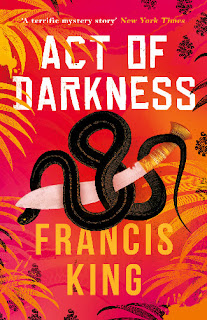
Act of Darkness, by Francis King


9781948405997
Valancourt Books, 2021
originally published 1983
305 pp

hardcover


I'm actually on the fence about labeling this book as crime fiction, because really, there's so much more to it.  I mean,  there is a crime (quite a heinous one in fact), there is a bit of an investigation and a number of possible suspects who might have been responsible.  At the same time, it ventures well into the literary zone, as the author delves into and  unravels human souls, exposing people for who they really are, and it works on a metaphorical level as well.   The bottom line, however, is that it's quite good, very dark, highly atmospheric and well, anything but typical.  


Just very briefly and excruciatingly barebones so as not to spoil things for anyone who may want to read this novel, Act of Darkness is structured in five parts, and it is in the first of these, the appropriately-entitled "Omens,"  that we meet the Thompson family.   Set in India in the 1930s, they are at home  in the hill-station villa where they've gone to escape the hot summer weather of the plains.   Toby Thompson is the head of this family, although business and other matters interest him far more than his home life.  He is married to second wife Isabel, now pregnant, and they have a young six-year old son named Peter who can often be annoying and definitely curious.  Toby's daughter from his first marriage, Helen, a sort of cold young woman who feels out of place and somewhat resentful,  has recently returned from boarding school in England, and  also living in the home is Clare, Peter's governess, who likes things simple, unmessy and uncomplicated. These characters are introduced from his or her own perspective; by doing it this way King allows the reader to glean an understanding of the complexities and the tensions within their interactions with each other, and most importantly, careful readers will be able to pick out the "omens" of what's to come. 

The central "Act" of this novel is a horrific murder that happens in the middle of one night, but it's the aftereffects that are at the heart of this story.  As the author writes,
"A slow, expected death has a way of irresistibly sucking the members of a family together down its dark funnel. This death, as violent and unexpected as the explosion following the detonation of a bomb, had the opposite effect of blowing the members of the Thompson family in separate directions, however much they struggled to cling to each other." 

The murder also lays bare some of  the pent-up frustrations, jealousies and suspicions that have been simmering and chipped away at under the surface within this household.  The author absolutely excels here as he traces the effects of this crime on those left behind over the years that follow,  offering more than one or two surprising twists as he comes down to its solution.

I loved this book -- King has created an atmosphere seething with dark, sometimes violent  undercurrents running below the surface both within this family and also in India under British rule; that tension, once picked up on in the reading, just doesn't go away.  I will say that not too far after the murder, I had this sense that I already knew this story, and rifling through my brain it hit me where I'd previously experienced it.  I won't give away any hints as to what it reminded me of  (just in case), except that it was a particular and sensational crime that had occurred in England during the Victorian era.   Once it dawned on me, I was a bit upset,  thinking "well, I already know how this turns out," but as it happens, I wasn't at all prepared once the truth was revealed.  I can certainly and highly recommend this book, especially to readers who are more into the why behind  things rather than just the who.  It is a memorable story that I still see flashes of in my head  even though I finished reading it a few days ago; it's also a book that I absolutely could not put down.  


Friday, September 17, 2021

A James Ellroy Double Feature: Brown's Requiem and Clandestine


9780593312209
Vintage, 2021
originally published 1981
321 pp

paperback 
(read earlier)

I hadn't really intended to read more of Ellroy at the moment, but back around mid-August I read his My Dark Places and there he was, back in my head and under my skin again. The only way to exorcise his presence was to read more Ellroy, and I decided to start with his earliest work.  Brown's Requiem is his first novel, followed by Clandestine, and I read both.   

 In the introduction to this edition of Brown's Requiem, Ellroy notes from the outset that he was "determined to write an autobiographical epic second to none," but he also realized that his life was "essentially an inward journey that would not lend itself all that well to fiction," which, based on his life as described in My Dark Places,  is probably true.  His response:

 "I then ladled a big load of violent intrigue into my already simmering, tres personal plot -- and the result is the novel you are about to read."

This book is much more a PI novel than anything else he wrote (at least of the books I've read), a fact he makes known in his introduction where he says that this book is "heavily beholden" to  Raymond Chandler.  He also notes that he owes Chandler a "two-fold debt" -- for getting him going and showing him "that imitating him was a dead-end street on GenreHack Boulevard." The Chandler influence shows.   Fritz Brown is an ex-cop, now private investigator whose main source of income as the novel opens is repossessing cars.  The PI business is slow; before making money from the "repo racket" he'd handled "a few cases," but now his office is more like his reading room; the business much more a tax front than an active concern.   Enter Freddy "Fat Dog" Baker, a caddy with a pocket full of bills, who comes to Brown with concerns about his sister.  It seems that 28 year-old Jane has been staying with an older "rich guy," who evidently wants Jane to have nothing to do with her brother.  There's "no sex stuff" going on -- "it ain't like that," but Fat Dog feels that the man is "not right somehow," and that he is "using my sister for something."  He wants Brown to tail the guy, to see what he's into because "he's fucking her around somehow," and Fat Dog wants to know what's going on.  Brown likes the idea of a "surveillance job," one he can work around the repo schedule, so he agrees.   On his first sight of the older man, Sol Kupferman, Brown recognizes him, and his mind goes back to the Club Utopia,"a sleazy neighborhood cocktail lounge"  that had been firebombed in 1968, causing the deaths of six people.  Three culprits were caught, owned up to what they'd done, but had named a "fourth man" as the mastermind, a story that  the cops never believed.  While on the force, Brown hadn't been involved with that case (he was a rookie at the time), but he had been to the Club Utopia with his patrol buddies before it had gone up in flames, and had seen Sol Kupferman there at the time.  As the face of his investigation begins to change,  his finds his own past becoming inextricably intertwined with the case at hand.  


While my description doesn't do this novel the justice it deserves (and of course, there are plots, subplots and characters that I haven't gone into because of time), it's easy to see the first inklings of what to expect in Ellroy's future writings, especially Ellroy's penchant for writing novels that are dark with a capital D.    In Brown's Requiem the prose is more tame, less zippy than in his LA Quartet, but given that it's his first novel, you can see still detect faint strains of the originality of yet to come.  It's interesting to go back and reread Ellroy from the start, especially knowing that  the first book of his excellent LA Quartet  would be published only six years later.    Recommended for those so inclined, mainly people who've enjoyed Ellroy's books and know what to expect. 


Avon, 1999
originally published 1982
paperback, 328 pp


With  Clandestine Ellroy gets more personal, more autobiographical than in Brown's Requiem, tackling his mother's 1958 murder, albeit in fictional form.  It's so very easy to spot, of course, having read this novel after reading Ellroy's My Dark Places, but he also admits to it in a 1996 interview with Laura Miller at Salon where he says that Clandestine was a "chronologically-altered, greatly fictionalized account" of her murder.  Unlike real life though, in Clandestine he also "solved the case."  My Dark Places also allowed for recognizing a fictional young James Ellroy in this book who under a different name, makes an appearance here as well.  

In 1951 Fred Underhill is a young policeman working Wilshire Patrol. When not on the job, he "played a lot of golf and sought out the company of lonely women for one-night stands."   On the job, after roll call one morning, he and his partner were out warning the owner of a small butcher shop/market about a two-man stickup team hitting small markets and a liquor store, and while there they was called to the horrific scene of Underhill's  first murder, a woman identified as Leona Jensen.  Not too much after that, his partner is killed, and later Underhill was sent to the "tragic sinkhole" of the Seventy-seventh Street Division, Watts.   News of a second murder reaches him, that of Maggie Cadwallader, a woman with whom he'd once had a one-night stand after meeting her in a bar called The Silver Star.  It strikes him as more than coincidence that he'd found a matchbook from the Silver Star at the scene of Leona Jensen's death; as he noted, "it was slight, but enough."  Eventually he tracks down the man he believes might be the perpetrator, and thinking about his case, his suspect, his revenge, his collar, his "glory and gravy train," reports his findings to his Captain, only to be slapped down as a "supremely arrogant young man," for whom justice is certainly not a motivation.  Rather than being suspended from duty, however, the Captain sets up a meeting with a certain Lieutenant Dudley Smith, who will be in charge of deciding "the course of this investigation."   And here is where the story actually begins, in my opinion, as Underhill's ambition gets the better of him, making decisions for which the outcome will bring serious repercussions both personally and professionally.    It isn't until he sees the story of the "dead nurse" that he realizes he may have a shot at justice for the dead, as well as for his own personal redemption.

In Clandestine, Ellroy introduces a number of characters (and themes as well) that will reappear in later work, most notably Dudley Smith, a truly bad guy even here, with more than enough hints of what will happen to anyone who crosses him.  This certainly book is more future Ellroy than its predecessor, reading very much like a prequel to the LA Quartet; it would be a great place to start for anyone who's considering Ellroy's work.  Beware: it's good, but it  ain't pretty.  


Wednesday, December 16, 2020

The Decagon House Murders, by Yukito Ayatsuji


9781782276340
Pushkin Vertigo, 2020
originally published as Jukkakukan no Satsujin  (十角館の殺人),  1987
translated by Ho-Ling Wong
284 pp

paperback


"We're just the poor insects that flew into the trap called the Decagon House"


Had I been eating something when the big reveal of this story came along, I probably would have choked because of the huge gasp that involuntarily came out of me.  As soon as that cleared, the first words out of my mouth were "holy sh*t."  I don't have that reaction very often;  even though there have been many times I've been truly surprised at the unmasking of the who, this one absolutely takes the cake.  

It began as a "little adventure" for seven members of their university's Mystery Club, who'd decided to make the island of Tsunojima the destination of their club trip.   They'd gone there looking forward to 
"Freedom on an uninhabited island. A cold case to pick over. A bit of a thrill."
They had arrived on the island on March 26th, having been taken there via fishing boat.  Tsunojima, located about five kilometers off the coast of Kyushu's Oita Prefecture, had been the site of a still-unsolved "mysterious quadruple murder" six months earlier, resulting in the deaths of Nakamura Seiji (last name first), his wife Kazue, and the "servant couple who worked for them.  Nakamura's gardener was thought to have been the killer, but it was never proven since he'd disappeared and never been seen again.  The murder culminated in a fire which had completely destroyed the main house, the Blue Mansion; the "annex building" known as the Decagon House was left intact.  Decagon House was to be their home away from home for the next few days; together, each of the seven members -- Ellery, Carr, Leroux, Poe, Van (short for Van Dine),  Agatha and Orczy -- comprised "the core writing group" of the club.  For the upcomng April club magazine, they were each asked  while on the island to write one story based on the magazine's title, Dead Island the name of the "first Japanese translation of Dame Agatha's masterpiece" known to everyone today as And Then There Were None. 


from Goodreads


Oh no, I thought, I don't want to spend my reading time going through a Christie ripoff, and as luck would have it,  aside from a few nods in homage to And Then There Were None, it turned out to be anything but.  

The novel moves back and forth between what's happening on the island and what's going on back on the mainland, where a former member of the University Mystery Club, Kawaminami Taka'aka, receives a mysterious letter containing only one sentence:
"My daughter Chiori was murdered by all of you."

Kawaminami is floored when he realizes the letter is from none other than Nakamura Seiji -- and that he's received an  "accusation made by a dead man."  What's more, he discovers right away that at least one other member of the club, now on the island,  has received the same correspondence.  Along with two other acquaintances,  he begins to delve into the matter of the strange letter, which leads them to also investigate the case of the quadruple murders of the previous September on Tsunojima.  In the meantime, the weirdness begins back at the island with the discovery of seven "milky white plates," on which red characters had been printed, 


quickly followed by the mysterious death of one of the seven and the first of the plates having been tacked to the dead person's door.  With no possibility of leaving the island, and as more deaths follow, as the back cover blurb notes, "the survivors grow desperate and paranoid, turning on each other." 

As I've always said about this genre that really stands on its own within the genre of crime/mystery fiction,  these stories are less character oriented and more about how the deed was done.   It's no surprise to me on reading several reader reviews  of this book that noted the lack of character development, because that's pretty standard with this sort of thing, something I've come to expect after reading so many of them.  Taking that aspect away, focusing on the who and the how, The Decagon House Murders becomes an intense puzzle, the solution of which I would never have guessed.  I will say that I'm a bit frustrated at not being able to share my experience with the identity of the who, but to do so would be giving away the show.  I do think I would like to take a look at the original though, because I'm not sure I would have translated some things in this book the same way, for example, in having one character refer to the group as "y'all."  I mean, come on. Seriously? 

I had great fun with this novel, and I certainly would recommend it to regular fans of this sort of puzzler, or to fans of Japanese crime fiction in general.  The ending alone was well worth the price I paid for the book.  


Friday, July 5, 2019

Murder in the Crooked House, by Soji Shimada

9781782274568\
Pushkin Vertigo, 2019
originally published as Naname Yashiki no Hanzai, 1982
translated by Louise Heal Kawai
paperback

345 pp

A few years ago I read and loved Shimada's The Tokyo Zodiac Murders so it was a no-brainer as to whether or not to buy his newest, Murder in the Crooked House.  As in The Tokyo Zodiac Murders,  at one point in the action, everything comes to a full stop as the author throws out a challenge to his readers, letting us know that at this point in the game we have everything that we know to solve the mystery.   The question is "Can you solve this case?"  The answer:  no, not I.  I did manage to figure out the who but not the why and not the how, and even that  small victory came only after making my way through a wriggling school of red herrings thrown in throughout the story.  To those of you who solved it by the time the "challenge to the reader" is thrown down,  I would love to have your brains, because I was kept in the dark pretty much throughout.


And small wonder.  I don't know how anyone could have possibly solved this while reading because the solution is so farfetched and so out there, well beyond the norm of many of the locked-room crime novels I've read.  In fact, whenever reading in this subgenre, I flip the switch in my brain to "suspend disbelief" mode so that I'm prepared when the denouement comes.  On the other hand, once I knew how Shimada made it all happen, I found myself going back to the diagrams scattered throughout the novel trying to put things together and doing the inner "aha" as I saw how it could have been pulled off (sort of).     I have to admire the author's creativity here, and  I have to wonder how many hours he must have given to setting up the entire story, not to mention how much fun he must have had in doing so.


from CDJapan
In the long run, this is a book where it is best to know next to nothing about the story.  What little I'm willing to spill here is that the action takes place in a house somewhat like the one pictured here on the Japanese cover.  As we learn,
"At the top of Japan's northernmost island, Hokkaido, on the very tip of Cape Soya, there's a high plain that overlooks the Okhotsk Sea. On this plain stands a peculiar-looking structure known by the locals as 'The Crooked House.' " 
At present it sits empty, on the market for many years, and "will probably stay that way."  One might think that it's because of its remote location, but in reality,
"it's far more likely the murder that keeps buyers away."
The house's actual name is the Ice Floe Mansion, built and owned by Kozaburo Hamamato, a somewhat eccentric industrialist who, at the time of the events that took place here, was in his late 60s.  He occupies the tower, which bears more than a passing resemblance to the leaning one in Pisa; his eccentricity even includes a drawbridge that connects with the rest of the house.  Hamamoto refers to it as "this old man's whimsical mansion," because, as the back blurb notes, it is a
"maze of sloping floors and strange staircases, full of bloodcurdling masks and uncanny dolls."
His daughter Eiko and three household staff also occupy the "crooked house," and as the story begins, the Hamamotos have opened their house to a number of guests for the Christmas holidays, 1983.  The first night of the guests' stay turns out to be anything but normal, but things become even more off-the-wall weird once daylight brings the discovery of a most bizarre murder.    Going back to the blurb once more, the victim has been "found murdered in seemingly impossible circumstances," in a locked room which is accessible only from the outside, the murderer having left no footprints in the snow either coming or going.  While a few of the houseguests take on the puzzle the killer has left behind, the local police are called in and do their best to try to put the limited (and strange) clues together to form a picture of what had happened.  When another death occurs, in circumstances that are perhaps even stranger than the first murder, they have their hands full and call to Tokyo for help, bringing Kiyoshi Mitarai and his friend/sidekick Kazumi Ishioka to Ice Floe Mansion.  But even then ....

[as an aside, Mitarai and Ishioka are names readers will recognize from Shimada's The Tokyo Zodiac Murders; I actually did a double take when I came across them here for the first time on recognition since I had no idea that this was their second adventure. ]

To say more would be to spoil and I don't want to do that at all because it would be wrong to take away someone's fun in trying to piece together exactly how these crimes were committed.  What I will say is that the use of masks in this story  is most appropriate as  it seems that most of the people staying in this house over the holidays have things they desire to keep hidden, each masking his or her inner self behind a very different public persona while in the company of others.   I could go on here, but it would also be a spoiler to do so.

I loved the eerieness of the setting  in this book, which added an atmospheric quality to the novel.  Combining such a remote location, the howling winds during a blizzard, the greyness of the sea during the winter with the fact that the people in the house are all pretty much trapped there until the mystery is solved gives the story a claustrophobic feel that only heightens the strange events that take place.

  In comparing Shimada's earlier book with the present one,  I have to say that Murder in the Crooked House is much more reader friendly, moving much more quickly through to the solution than was the case in Tokyo Zodiac Murders; I also felt that this time around, as I said earlier, I had to keep myself in the state of suspension of disbelief a bit longer than while reading the first book. When all is said and done, I had a lot of fun with this novel and certainly recommend it, most especially to people who find pleasure in reading locked-room/impossible crime novels, which are in many ways a very different breed than your average crime/mystery novel and may take a bit of getting used to.

 Once again, hats off and major applause to anyone who solved this crime before the answers were made known.  I was left completely in the dark. And that's okay.


Tuesday, May 22, 2018

I dare you to come out of these unscathed: The Factory series, by Derek Raymond

"The black novel ... describes men and women whose circumstances have pushed too far, people whom existence has bent and deformed.  It deals with the question of turning a small, frightened battle with oneself into a much greater struggle -- the universal human struggle against the general contract, whose terms are unfillable, and where defeat is certain." 
            -- Derek Raymond, The Hidden Files, as quoted by James Sallis in the introduction to He Died With His Eyes Open (x).


note:  My editions, with the exception of Dead Man Upright are all from Serpent's Tail (bought eons ago), but Melville House has them all as part of their International Crime Series.

This is going to be a long post since it's going to be about five books. There are no spoilers at all, beyond what's already on the cover blurbs.  And since I don't really write reviews, I'll point you to people who know what they're doing and who are good at it:

Derek Raymond's Factory Novels, by Jeff VanderMeer
Doors Closing Slowly: Derek Raymond's Factory Novels, by Patrick Millikin
The Visionary Detective, by Joyce Carol Oates

Ah, to have the talents of these writers, but such is not my lot, so on with my own take on these dark, unflinchingly raw, heartbreaking and excellent novels.


These five books are collectively referred to as the Factory series, based on the fact that their main character works out of a police station on Poland Street nicknamed "The Factory."  This detective sergeant has no name (becoming "the nameless one" in my head),  and works in A14, Unexplained Deaths.  It is "by far the most unpopular and shunned branch of the service," and the nameless one explains in He Died With His Open he and his colleagues there work on
"obscure, unimportant, apparently irrelevant deaths of people who don't matter and who never did."
At Unexplained Deaths, "no murder is casual, no murder is unimportant," and our detective sergeant prefers to work on his own without interference from the higher ups.  He refuses promotion, and in The Devil's Home on Leave, the point is addressed from the detective's end as to why, after one of his superiors tells him that if he remains a sergeant, he'll "always get the shitty end of the stick."  His answer:  "Maybe ...,  but I think that's the end where the truth is."  He knows he is not "inspector material, or Branch material, but just Unexplained Deaths material," and he is completely okay with it.  (29; 123)  The people at A14 "didn't see death" like others did, and certainly not in any kind of "civilised prepared way:
"We saw it without the church, without the priest, without the funeral parlour; no hymns, just the dead body stiffening, sometimes in one, sometimes in more than one piece; we saw death suddenly, when we had a hangover, called out to the raw dank place where death was when we weren't in the mood, like a cabbie picking up a client obliterated by the dark on an empty road." (Dead Man Upright, 24). 

Reading through these books we also come to realize that Raymond has given us an ongoing commentary about contemporary British society and politics.  As Paul Oliver reveals over at the Mobylives blog, 
"Raymond was a writer of great complexity, who wrote with a nearly unmanning combination of fury and compassion as he chronicled the austerity of Margaret Thatcher's England." 
His work here in the Factory series, as whoever writes the back-cover blurbs for Melville House says, is  an "unrelenting investigation into the black soul of Thatcher's England," but really, it's not difficult to see in these novels that Thatcher's England has become pretty much soulless; it's not just the buildings that are in decay and left to rot, but also the souls of some of its inhabitants.

That "fury and compassion" is alive and well here, transferred into the form of Raymond's detective, whose  work at A14 often takes him into the "sad, narrow streets" in which live
 "the desperate last fugitives of a beaten, abandoned army, their dignity, rights and occupations gone (or never known), their hope gone, tomorrow gone."
He often encounters those "made invisible in their misery by the frozen night," for whom he could not get any justice "until they were dead" (How The Dead Live, 25-26); and as the series progresses, we learn why justice is so important to him and what it is that motivates him to solve these cases that are sent his way. 


In the first book of this series, He Died With His Eyes Open, the nameless one takes on the case of a man found dead in "a ghastly lonely area," laying there with his eyes open, severely battered; it looks like the work of two people.  The dead man has been identified as Charles Staniland, 51, and the sergeant's superior from Serious Crimes, Bowman, calls it a "derelict death," but when the detective begins his investigation, he realizes pretty early on that the "cheap suit" on the body belied someone "educated, reflective, intelligent."   After he listens to a number of cassettes and reads papers left behind by the dead man,  our nameless detective realizes that he had "started to think, dream, almost be Staniland by proxy."  In short, he has established a connection with this man who, while living, had suffered a tragedy leaving his life to take a turn for the worse, sending him as well as his  hopes and dreams into a downward spiral.  And now he wants justice:
"Though Staniland had died at the age of fifty-one, he still had the innocence of a child of six. The naive courage, too -- the desire to understand everything, whatever the cost...The fragile sweetness at the core of people -- if we allowed that to be kicked, smashed and splintered, then we had no society at all of the kind I had to uphold... I knew I had to nail the killers...Not just know them. Nail them."

 It is the detective's ability to establish this connection between his victims and himself that is at the heart of these five novels; it is also this particular quality which makes these books so emotionally taxing to the reader, since as the detective uncovers what it is that has brought these people to where they are now,  we simultaneously learn more about what it is about him that has brought this man to do what he does.   We also come to understand just how much the past continues to haunt the present, another idea that runs throughout this series.


The Devil's Home on Leave takes a bit of a different path, since at the beginning of his investigation of a most brutal, grisly crime, the killer's MO narrows down the identity of the suspect.  What's left in this case is for the detective to gather proof against the perpetrator, which is going to be challenging since this man has no conscience, no fear, and nothing to lose.   And while I didn't particularly care for the direction that this story ultimately took,  we learn much more about the detective's heartbreaking past and how it is that he has come to "understand murder" so well.


By the time I'd finished book three,  How the Dead Live, and book four, I Was Dora Suarez,  I was sort of wishing I hadn't read all four in a row.  I felt much like I did the time I binge watched the TV version of David Peace's Red Riding Quartet, after which I was like completely gutted. (Do NOT make that mistake; trust me on this one).    There is the deepest sort of pain to be found in both of these books; different, but pain all the same, and there's so much here that it takes its toll.   In How the Dead Live our detective is sent to look into the case of a missing woman, a doctor's wife whose absence had gone unreported.  His efforts are stymied as he  runs into a wall of silence from just about everyone in the small village of Thornhill, but when he finally learns the truth, it's his compassion that takes over in an extremely sad and tragic situation.  Meanwhile, his uncomprehending and unwanted superiors, sensing the headlines to be made over the case,  decide to bulldoze their way in, and the nameless one goes to great lengths to see the right sort of justice through, even at the potential cost to his career.


 While looking for reviews about these books, I came across an article in  The Australian mentioning that  crime novelist Ian Rankin once called Raymond's  I Was Dora Suarez "`English crime fiction's equivalent to Edvard Munch's The Scream."   I'd say that's about right.  He also notes in that article that Raymond's books are not only novels, "but also reports from a front line of casual cruelty in a world lacking empathy," again, spot on, and while that idea is apparent in each and every book in this series, it is especially true here.  Not only does the title character, Dora Suarez, live in a "world lacking empathy," she also inhabits a world where  the sickest, lowest, and meanest people lack any sort of conscience.

 Once  that book was over, not only had I had enough of  Derek Raymond for the moment, but I had to sit and regroup for two days before I could move on to the last book, the first night with sizeable portions of bourbon in hand.   James Sallis, in his intro to He Died With His Eyes Open, referred to I Was Dora Suarez as a book that sends electric shocks through your system (see below), which it did -- it is so powerful in fact, that I don't want to say too much about it.    It is not only tragic because of the horrid death of Dora Suarez and of  her older housemate but reading further into it, it's also a case that will drive the nameless detective further than ever in his quest for justice.   And how sad is it really, when a lonely, haunted man finds the woman of his dreams only after she's dead?   There's much much more indeed, but let's leave it there.  Of all of the books in this series, this one is best experienced cold, with not much known about it ahead of time.  What I will say is that in my opinion, in I Was Dora Suarez we find everything Raymond has written about in the previous novels fully realized in a way they hadn't been before to this point, and perhaps that's why I found it to be the most powerful of all of the Factory books.


And finally we come to the end, with Dead Man Upright, which is a bit of a departure from the rest of the series in some ways, but in others, not really.  For just one thing, there isn't a specific crime that brings the nameless one into the case, but rather a potential crime.  In a pub and drinking beer with a friend, our detective  hears from his old police buddy about the strange behavior of an older man, a certain Henry Cross,  in his building, whose dealings with different women have captured the interest of the detective's friend.  As he puts it, "there's something that smells dead off about it."  Once the nameless one assures his friend he'll look into it, he searches the older man's apartment, and finds some pretty chilling signs that his friend's intuition was right, and that the man most likely dangerous and needs to be off the streets.   But what he doesn't find is a body or any sort of evidence at all that points to a specific crime -- all he can do is warn the potential victim while he tries to catch what he believes to be a serial killer before it's too late.   But she's having none of it, since for her, he's her only chance at happiness in an otherwise dreary life.  And while I won't give away the rest, Dead Man Upright delves into one of the darkest places there can be -- directly into the mind of a psychopath. It is my least favorite of the five, but still very, very much worth the read.


As James Sallis says in his introduction to He Died With His Eyes Open,
"Five or six times in a life you come across a book that sends electric shocks skittering and scorching through the whole of you and radically alters the way in which you perceive the world." (vii)
 After finishing the entire Factory series  I can certainly attest to the "electric shocks skittering and scorching" that not only went through the whole of me, but also sort of imprinted themselves into my brain in their wake,  probably to leave a mark forever as to how I approach and engage with crime writing.   They are, as the back cover blurb from He Died With His Eyes Open notes (again quoting Sallis), "literature written from the edge of human experience," and they indeed seem to exceed the "limits of the crime novel and of literature itself."   The fact that the main character is a detective working for the police in London might make anyone believe that Raymond's novels are yet just another series of police procedurals, but that is absolutely not the case and reading them as such is just plain folly.    These books  are among the darkest of the dark in the realm of crime fiction,  and are not for everyone, and for those who do read them, beware the toll they take on your wellbeing for the duration.

I loved these books and there will never be anything like them again, I'm sure.