Showing posts with label mystery series opener. Show all posts

Tuesday, September 10, 2024

PPL#6: The Voice of the Corpse, by Max Murray


9781915530318
Galileo Publishers, 2024
originally published 1947
218 pp

paperback
(read in August)

Although The Voice of the Corpse is set in the UK,  Max Murray was actually born in Australia.   A very quick scan through online resources shows very little in the way of biographical information, but the back-cover blurb reveals that:

"The author, Max Murray (1901-1956) began life in Australia as a bush boy. His first job was that of a reporter on a Sydney paper but after a year he set out to work his way round the world. During WW2 he wrote scripts for the BBC Overseas Programme. After the war, with intervals for travel, he devoted himself primarily to writing fiction. He published 12 novels during his life, most of which had the word 'Corpse' in the title." 
 He is also an author who is new to me, so I'm getting in on the ground floor with this guy's work.  I've already bought the next book (also from Galileo), The King and the Corpse, and I'll keep buying the series if more are published.   

Set in the small village of Inching Round, this story begins with the death of Angela Pewsey, a forty-nine year old woman who evidently never married, waiting for someone to return from Ceylon.  She's been expecting him for fifteen years, ever since their meeting on a boat where he had asked her to wait for his next visit home "on leave from the plantation."  Up to the moment of her death, she'd been  singing "appropriate folk songs" while sitting at her spinning wheel, working on a sweater made from the hair of her Chow, so she never heard her attacker come up on her.  Angela, it seems, has made it her business to know everything about everybody in Inching Round, and she didn't shy away from letting people know, in her own way, that she knew.  As we learn, "the method of these revelations was in itself enough to make most most reasonable people feel capable of murdering her," so right away there is a village filled with victims turned suspects.  The time of death was "half past three," when one of her neighbors realized that Angela was no longer singing as the church clock noted the half hour.   The local police are called in, and come to the conclusion that the deed was done by a tramp. 

However, Inching Round isn't just the site of a murder -- it seems that someone has been sending the inhabitants of the village poison pen letters, causing not only a stir but distrust and fear.  As Celia Sim says in conversation with her friend and family solicitor Firth Prentice on a train journey to Inching Round,
"There's something in the atmosphere. There's something furtive about it: the way they look at each other as if they were wondering, suspecting; and then their eyes slide away as if they were ashamed of their thoughts. It is pretty awful."
 Once off the train though, the two hear about the murder, and Firth believes he knows the identity of the person yielding the poison pen:
"When somebody is writing anonymous letters and somebody is murdered, it's not hard to guess who was the author of the anonymous letters, is it?"
 He doesn't, however, believe in the mysterious tramp as Angela's killer, leaving, as Celia so aptly notes, "someone in the village ... one of us."  And when there are so many people who've suffered at her hands, it's not surprising that they're not only happy about her demise but also have a possible motive for getting rid of her.    Celia's mother wants Firth to investigate Angela's murder, but when Inspector Fowler from Scotland Yard enters the case, she is not at all forthcoming, explaining  to him that "the pain you will cause to so many of us will be out of all proportion to the good you do."  And, as it turns out ...


from Abebooks, 1947 First Edition 


While there is an intriguing whodunit at play here, the author also engages in a bit of romance,  humor and the scattering of some pretty good red herrings throughout the story.   There are two little boys who completely steal the show for a while,  offering Firth information they've obtained using their strange skills, including the recognition of the sounds of footsteps made by various people in the village.  I couldn't help it -- these kids were funny and they made me laugh out loud.     The Voice of the Corpse isn't as strong on the detection front as it might have been, but there's a huge twist (or two) that I did not see coming at all that made reading this book on the whole more than satisfying.  It was a fine introduction to the work of Max Murray, whose remaining mystery/crime stories I'll be very much looking forward to exploring.   I also can't believe my good fortune in this book being published while I've been engaged in reading as many poison-pen stories as I can in 2024! 

I can  recommend this novel to readers of vintage crime and to readers who are interested in fictional poison-pen phenomena but want something just a wee  bit different.    It's a bit off the beaten path and definitely not same-old same-old, which makes it majorly attractive for me.  


Friday, October 6, 2023

It Walks by Night, by John Dickson Carr

I read this novel some time back, but I seem to be continuously playing catch up with posts.  Better late than never, I guess.  I have a large tote bag filled with finished books, so before I start reading any more, the plan is to whittle down that pile. 


9780712352642
British Library, 2019
259 pp

paperback
(read in September)


Published in 1930, It Walks by Night is the first novel in the series featuring Carr's French detective M. Henri Bencolin, "juge d'instruction, the adviser of the courts, and the director of the police."  As revealed by Martin Edwards in his excellent introduction,  it had started out life as a novella entitled "Grand Guignol," anonymously published in 1929 in an issue of The Haverfordian, "Haverford's first literary magazine."  Carr went on to rework his novella into a novel called With Blood Defiled, which Harper & Brothers wanted to publish, changing the title to It Walks by Night for its 1930 publication.   While the title may have changed, there is a sort of Grand Guignol vibe to this book; as a brief paragraph in The Paris Review notes, when ownership of the original Grand Guignol chapel was taken over by Max Maurey in 1897,  he saw it as the perfect venue for "straight-up horror."  Under his leadership, the plays appearing there "began focusing on tales of insanity, hallucination, and above all terror."  Given that bit of history, and after finishing this book, Carr's original title actually makes more than a bit of sense, but renaming it as It Walks by Night was definitely a good move.  

The story here is narrated by Jeff Marle, a young man who has known Bencolin his entire life, since the detective was Marle's father's best friend, having met during college in America.  Marle, who serves in the role of Bencolin's partner in crime solving (akin to Holmes' Watson)  describes Bencolin as having a "thin and aquiline nose,"  a "small moustache and  pointed black beard," and greying black hair, "parted in the middle and twirled up like horns."   As an aside here, just for fun I did an image search on Bencolin and found this one, and I'll be damned if it doesn't fit Marle's description to a T.  


from Biblio.com


Marle has come to Paris from Nice after receiving a wire from Bencolin, which said that "there was danger ahead," and asking if Marle was interested.   Even though Jeff has no clue as to what's going on, he sends a telegram back saying only "yes."   Once he meets up with Bencolin, he is told that there's a man "in the greatest danger of his life," who has appealed personally to the detective to "oversee his protection."  Naming a certain  Raoul de Saligny, "the athlete, the beau sabreur, the popular idol," at first there is very little conversation except for a strange "reference to danger from werewolves."  As it happens, the reader has already been introduced to the idea of werewolves in a passage from a 15th-century book (opening Chapter One) that  Bencolin had sent Marle describing 
"a certain shape of evil hue which by day may not be recognized, inasmuch as it may be a man of favored looks, or a fair and smiling woman; but by night becomes a misshapen beast with blood-bedabbled claws"

and I have to admit to wondering from the outset if perhaps we were going to be in for a bit o' the  supernatural here, an idea that later seemed to be cemented by more than one mention of Poe, and of course, werewolves. 

From dinner the two move on to the popular Fenelli's, a tourist hotspot featuring dining, dancing and, by invitation only, gambling, while the more covert activities going on there conjures up the era of French decadence.   It is there that Bencolin and Marle position themselves so that they can keep an eye on the Duc de Saligny, who on that very day had married the former Louise Laurent.  Her former husband, Alexandre, had attacked her with a knife and shortly thereafter had been committed to an asylum for the criminally insane.  Unfortunately, after making his escape, he had moved on to Vienna where he'd undergone plastic surgery; after killing the surgeon and cutting off his head, he vanished. His escape, it seems, had coincided with the announcement of his ex-wife's marriage, which she had postponed until such time that Laurent could be captured, but de Saligny did not wish to wait.  As Bencolin relates to Marle, just two days earlier the Duc had  received a letter from Laurent, telling him not to marry Louise, and even creepier, that he is watching and that he has put himself close to de Saligny.  Laurent's plastic surgery may have completely altered his appearance making that possible, but even worse, Laurent is obviously in Paris, and now de Saligny feels his best chance is in "public places" until the police can finally lay their hands on his nemesis.   That may take a while, especially after the bridegroom is discovered not only dead, but decapitated in a room at Fenelli's that was being guarded at the time by one of Bencolin's men.   The crime is definitely one that can be labeled as  "impossible" -- as Bencolin notes after examining the murder scene, 
"... there are no secret entrances; the murderer was not hiding anywhere in the room; he did not go out by the window; he did not go out the salon door under my watching, nor the hall door under François' -- but he was not there when we entered.  Yet a murderer had beheaded his victim there; we know in this case above all others that the dead man did not kill himself." 
 It's difficult enough for  Bencolin and Marle to try to wrap their collective heads around this murder, and when more ghastly crimes follow, Bencolin comes to the realization that they are facing
"a murderer who is utterly cold-blooded and cynical, and who firmly believes that these acts are done justifiably, to avenge wrongs.  The crimes are the means of venting on the world a spite too deep for ordinary expression." 
The armchair detective in me did not solve this crime (did not get anywhere even close), and if there is anyone out there who actually figured out the entire solution ahead of the big reveal, my hat is off to you.  Carr's biographer Douglas G. Greene  said (as quoted in the introduction) that there were "many clues to the solution,"  but evidently I missed a few; I think my jaw dropped down to the floor when all was made known.   Still, as with the best mysteries, it's the getting there that counts, and I did not put this book down until the journey was over.  

I read this book in September, but thematically it also fits into October reading with its emphasis on damaged psyches, the darker side of human nature and of course,  more than one grisly crime.   I've already read books number two and three (Castle Skull -- my thoughts coming soon on that one --  and The Corpse In the Waxworks ) both of which share with this book, as Douglas H. Greene stated, "the art of the magician."   Bencolin (and Carr) can certainly go on and on in some cases so you will need a bit of patience, but I can most certainly recommend It Walks by Night for readers who enjoy impossible crimes and the concomitant piecing together of the puzzle.  


Tuesday, March 8, 2022

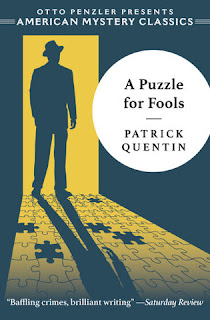
A Puzzle for Fools, by Patrick Quentin


 9781613161258
American Mystery Classics, Penzler Publishers
originally published 1936
237 pp

paperback


"It had been a puzzle for fools..."


A Puzzle for Fools is #21 on the Borges/Bioy Séptimo Círculo list, and it's a good one.  It is also the mystery series opener for the nine books featuring Peter Duluth, Broadway producer, ranging datewise from 1936 to 1954.    

Peter Duluth has known his share of tragedy.  His wife Magdalene had died in a fire in the theater, and as a result his life started to hit the skids.  After "drinking to an eight-hour-a-day schedule" over the last couple of years,  and not "particularly reluctant" to drink himself to death, he decided that some time in a sanitarium might be a good idea.  Detoxing was pretty tough at first, but he made it through the worst and now, under the care of a trusted psychiatrist, he seems to be doing pretty well.  His "spells of depression" are less frequent and his physical self was also improving.  As this story begins though, he's not sure sure of himself -- it seems that in the dark of his room, he hears his own voice whispering to him he must get away, and that "There will be murder."  He knows he's not saying these things, and his fright overtakes him until he speaks to his psychiatrist, Dr. Lenz,  who lets him know that "this is not the first disturbing thing which has been reported recently," and that whatever he sees or hears "out of the ordinary, that thing is real and has its basis in fact."   The doctor also feels that there is a "subversive influence" at work in his sanitarium, causing him to worry about the patients and asks Peter for his help. While patients might not reveal things to him that upset them, they might say something to a "fellow inmate."   

It isn't long until he learns about the strange things that are happening among the other patients, including a few who, like Peter,  have also heard themselves talking when they know they weren't.   More talk of murder follows, and it isn't too long until talk gives way to action and someone is actually killed in a way that leaves no traces of violence.  It's a bizarre crime on the impossible side, and while Peter has been allowed to keep up with the police and their investigation in confidence,  he has some ideas of his own as to how to discover who among them is a killer.   However, before he can make any real progress, the strange occurrences continue to plague the patients, and then there's another death. 

After my less than great experience with A Puzzle for Players I was more than a bit  reluctant to once again wade into this series, but  I was surprised at how very much I enjoyed this one.  For one thing, the atmosphere is set at the beginning and doesn't let up over the course of the story.  There's just something compelling about the scene of the crime being inside of a sanitarium with its darkened corridors, locked doors and secrets; even better, this story really is a puzzle -- the author offers any number of clues to put together to get to the heart of this mystery, and his characters are so nicely drawn that at some point I realized that nearly every person in the sanitarium was a potential candidate for suspect, and that ultimately in this story, you can't really trust anyone.   

Don't miss the introduction by Otto Penzler; while I don't quite agree with Penzler's assessment of Puzzle for Fools as a "suspense thriller in the Alfred Hitchcock mode," it still makes for a good few hours of fun and unputdownable reading.    Recommended to those readers who enjoy these older mysteries.  The armchair detective in me was highly satisfied -- I never guessed the who and so I was completely taken by surprise when all was revealed.  I call that a win. 


Wednesday, May 27, 2020

Inspector Stoddard is on the case: The Man With the Dark Beard and The Crime at Tattenham Corner, by Annie Haynes

Back in April I read the first of the series by Annie Haynes featuring as her detective a certain Inspector Stoddart of the Yard.  The Man With the Dark Beard was published in 1928; the three remaining books in this series were published in 1929 and in 1930.   Book number three, Who Killed Charmian Karslake? (1929) was published posthumously, while the fourth, The Crystal Beads Murder, was completed by someone else before it was published in 1930, although Haynes had already been working on it prior to her death.  For the complete story you can read Lizzie Hayes' post about Annie Haynes on her informative blog, Promoting Crime Fiction


9781910570746
Dean Street Press, 2015
originally published 1928
185 pp

paperback

This is is tricky book to post about,  because any minor hints past the basic murder plot and subsequent investigation will absolutely give away the show here.  As it was, I had it pretty much sussed  before page 60,  but I do believe that's because it leans way more toward Victorian sensation fiction than a typical golden age mystery, and as I am a huge fan of sensation fiction, the plot was easy to figure out.  On the other hand, it is definitely a murder mystery, one which introduces Inspector Stoddart of the Yard, who will find himself investigating two murders before all is said and done.

It seems that Dr. John Bastow has something rather heavy on his mind when he asks his friend Sir Felix Skrine the following question:
"Suppose that in the course of a man's professional career he found a crime had been committed, had never been discovered, never even suspected, what would you say such a man ought to do?"
 He goes on to up the curiousity ante by asking what if the "hypothetical man" had "kept silence -- at the time," leaving the criminal to go on to having "made good." What then?  Skrine answers that Bastow ought to know his "duty to the community," when they are interrupted by the ringing of Bastow's surgery bell, and they agree to meet later to talk more about Bastow's dilemma.  Unfortunately, the ringing of the bell is not the only interruption that Skrine will have to contend with, because before the two can continue their chat, Bastow is found dead in his locked office, having been shot in the head.  Enter Inspector William Stoddart from the Yard.  There are very few clues onsite, except for the fact that Bastow had been writing a letter to Skrine about their prior conversation, in which he revealed that the "proofs" were in his Chinese box, which seems to have gone missing.  Also near the corpse is a scrap of paper which reads "It was the man with the dark beard."  What is also known is that Dr. Bastow disapproved of his twenty year-old daughter Hilary's plans to marry young Basil Wilton, Bastow's assistant, who just happens to have been the last person known to have seen Bastow alive, and who just happens to have been dismissed from the doctor's service shortly before the discovery of the body.

The concerned Skrine, who is "one of the greatest -- some said the greatest -- criminal lawyers of his day," also stands in loco parentis to Hilary until she comes of age, and to her disabled brother Fee as well. He offers them a cottage near his country house, taking them both away from the city.  As their father's executor, he also means to continue Dr. Bastow's wishes against Hilary marrying Basil, and eventually makes Hilary an offer that she will struggle against yet find it's one she really can't refuse.  In the meantime, Basil has his own issues, not the least of them the fact that he's found himself a suspect in yet another murder.  As Stoddart moves into the investigation of this second unnatural death, he has no clue that time is actually running out and that it's not only Basil's fate he holds in his hands.

 While I have to be honest here and say that The Man The Dark Beard was not as good as it could have been, because of too much focus on the sensation-fiction plot.  However, giving credit to the author, she obviously spent a lot of time in plotting what  turns out to be a truly nefarious crime, as that part of the novel came face to face with the detection in the case.   I had to look at the book from that particular vantage point, otherwise what's left is an all too-easy-to-solve mystery that offers very little challenge to the reader.

That is not at all the case in the next book, The Crime at Tattenham Corner, which I did not want to stop reading once I'd started it.  Again, some nice plotting from Haynes here, but this time the


9781910570760
Dean Street Press, 2015
originally published 1929
236 pp
paperback


actual mystery carries a lot more heft than her first Stoddart novel.  Stoddart and his "most trusted subordinate," Alfred Harbord, are called to Hughlin's Wood, "not a great many miles from Epsom," where a body has been discovered, face down in a foot of water in a ditch.  All that is known is that it is "a man of middle age" and  "evidently of the better class." It seems that the man has been shot in the head, and that a card in his pocket bears the name of a "man high in the financial world." Based on the name on the card, the monogram on the man's watch and a letter in his pocket, it seems that their dead man may be Sir John Burslem of Porthwick Square.  Burslem's valet is sent for, and on arrival, instantly makes the corrorborating identification.   The police immediately begin to wonder if perhaps his death on Derby Day has any significance, since his horse, Peep O'Day, was set to run and was odds-on the favorite for the win.  As it turns out, "an owner's death renders void all his horses' nominations and entries," leaving Peep O'Day's rival, Perlyon, set up to take the prize.  The owner of Perlyon is a Sir Charles Stanyard, who by some weird twist here, was once engaged to Burslem's widow Sophie, his second wife.   Stanyard takes the lead on the suspect list, but there is quite possibly another motive aside from the Derby.  It seems that on the night before his death, Sir John had inexplicably and quite hurriedly changed his will so that Sophie would inherit all, leaving out Sir John's daughter Pamela, "the apple of his eye," completely, followed by the strange disappearance of Ellerby, Sir John's valet, who was witness to the new will.   Before it's over, Stoddart and Harbord will find themselves deep in a convoluted web of mysteries that they must solve before they can solve the bigger mystery of Sir John's murder.

The Crime at Tattenham Corner is truly ingenious, allaying all of my fears about continuing the series after reading the previous book, and it is genuinely satisfying as well.   This time around I was almost finished before I cottoned to the author's scheme, but only a small part of it; the clever twists (and there are more than one) in the plot did not make it at all easy.  Haynes has quite a few tricks up her sleeve this time around, offering a mystery that will keep armchair detectives both  guessing and entertained.  Around the murder investigation there are strange happenings including a séance or two, hosted at her home by the very strange Mrs. Jimmy Burslem, Sir John's sister-in-law, whose husband is known to be trapising around Tibet looking at old ruins, while widow Sophie who never had a head for business, makes plans to run her husband's financial empire.  The main attraction, though, is most certainly Stoddart and his investigation.  He truly is a policeman who never gives up, no matter what it takes.  Wink wink.

So bottom line: The Man With the Dark Beard is okay, but for readers who have familiarity with the often-convoluted plots found in Victorian sensation novels, may be a bit on the easy side to figure out, while The Crime at Tattenham Corner is a definite yes, making me eager to get on to book three, Who Killed Charmian Karslake? asap.

Don't miss the excellent introduction in each book by Curtis Evans, whose crime fiction knowledge knows absolutely no bounds.


Monday, November 4, 2019

back to the 20s and my happy place again: Inspector French's Greatest Case, by Freeman Wills Crofts

9780008190583
Collins Crime Club/Harper Collins, 2016
originally published 1924
297 pp

paperback

With the sun beginning to set earlier now, there is nothing like curling up with a good cup of tea and a mystery that  delivers a bit of a one-two punch of a twist before all is said and done.  The hero of the day is Inspector Joseph French, referred to (behind his back, of course) by his colleagues at the Yard as "Soapy Joe," a moniker based on his reputation as being "quite a good fellow at heart."   In an introduction to this particular edition in which we "Meet Chief-Inspector French" written by the author in 1935 (and also found here at Classic Crime Fiction) we also learn that "Politeness is an obsession with him," and that
"He's decent and he's as kindly as his job will allow.  He believes that if you treat people decently -- you'll be able to get more out of them; and he acts on his belief."  
As far as this particular case being his "greatest," well, I'll admit that I have no clue there, since there will be twenty-nine more cases for the Inspector to solve, the last published in 1957.  In this book, the series opener and the first French mystery I've read, he is brought in to solve the case of a murder of a Mr. Gething, the head clerk of diamond merchants Duke and Peabody.  The firm's safe is open, "three-and-thirty thousand pounds" worth of diamonds are gone, along with a thousand pounds in notes.  Despite a number of clues and a number of suspects, the case is anything but open and shut, and "days slipped by" without any progress, causing the Inspector no end of frustration.  It is a bafflement that will continue to dog French as the case takes him on a series of travels beginning in Switzerland, leading him eventually to a ship on its way to Brazil; he always seems to be close but at each step, just as he feels he's getting somewhere, he hits the proverbial wall as events transpire to put barriers between himself and a solution. 


original British cover, 1924, from The Passing Tramp


In Crofts' introduction he states that
"Anyone about to perpetrate a detective novel must first decide whether his detective is to be brilliant and a 'character' or a mere ordinary humdrum personality."
Speaking of "humdrum," in 1972, Julian Symons would write in his Bloody Murder: From the Detective Story to the Crime Novel that Crofts was
"not just a typical, but also the best, representative of what may be called the Humdrum school of detective novelists..."
of whom "most came late to writing fiction, and few had much talent for it."   His feeling was that they
"had some skill in constructing puzzles, nothing more, and ironically they fulfilled much better than Van Dine and his dictum that the detective story properly belonged in the category of riddles and crossword puzzles."  (118)
As Curt Evans explains in his book Masters of the "Humdrum"Mystery,   Symons was referring to a group of writers who "placed far greater emphasis on puzzle construction and adherence to fair play detection than on characterization and stylish writing," which he notes is "fair enough."   However,  Evans also notes that in his view, "Symons insufficiently values the great technical sophistication of the plots in the best works of these authors,"  and that
"this school of mystery fiction has been unjustly disparaged by Julian Symons and the many critics who have adopted his views."  (2012, Location 191).  
French may not be the most brilliant detective ever (and Crofts reveals in the introduction that "many people call him dull"), but he never lets go, remains completely methodical and detail oriented throughout, and he is not averse to listening to his wife's flashes of insight when she comes up with an idea that sparks the light bulb over his head that will move him another step along in his investigation.  "Thoroughness and perseverance" are qualities that the author has given his detective, and admittedly, French does not "leap to his conclusions by brilliant intuition."   In short, he's a regular guy, he gets things wrong, and keeps trying until he gets it right.   Personally, I found myself rooting for Inspector French along the way and actually feeling sorry for him as things continued to go wrong.  If you want dazzling detective, you won't find that here; Inspector French's Greatest Case has much more in common with police procedurals and Crofts had obviously spent a great deal of time meticulously plotting each step of this mystery. 

As far as the twist, I had actually figured this bit out but it was not too long before French himself did, so the experience was unlike when I read detective novels in which I guess things early on, which is a plus.  And "humdrum" or not, I quite enjoyed Inspector French and I quite enjoyed the book, enough so that  I've been slowly stockpiling these Harper editions so that I can look forward to more of Soapy Joe's cases in the future.

Thursday, September 12, 2019

The Long Call, by Ann Cleeves

9781250204448
Minotaur/St. Martin's Press
375 pp

hardcover


"We all need secrets, just to keep sane, to feel that the world doesn't own us." 


Let me just say this:  I did not particularly care for the one book I've read by this author, Raven Black, and I never went on to read any of her other novels,  but for some weird reason when I first heard about The Long Call, I preordered it.  To this day I can't think why, but as it turns out, it was a good call.  I spent all of yesterday reading it, unable to put it down.


"... the cry of a herring gull, ... the long call, which always sounded to him like an inarticulate howl of pain."


 And indeed, the long call sounds throughout this novel, which takes place in a  small town in North Devon, centering on the murder of a man with an albatross tattooed on his neck. Given the nature of the tattoo, I immediately figured out that this must have been a person suffering under the weight of some heavy burdens, and as things begin to unfold, it turns out that I was right.   Investigating the crime is Detective Matthew Venn, who had once lived in the area and had broken from a particular religious group to which he and his family had belonged, estranging him from his parents.   Working with his colleagues Jen Rafferty and Ross May, he discovers that the victim is one Simon Walden, a man whose past had left him completely broken.  Walden had been living at the home of Caroline Preece, where he had rented a room along with Caroline's friend Gaby Henry; he had also been  involved as a volunteer at the Day Centre at the Woodyard, a sort of artistic safe place for people with learning and other disabilities, managed by Venn's husband Jonathan.  When a woman with Downs Syndrome goes missing from the Woodyard, Venn begins to surmise that the two cases are somehow connected, and that there is something just a bit off -- there  is "too much coincidence. Too many people circling round each other, without quite touching."   He also realizes that it is  quite possibly the Woodyard itself that is the connection,  putting him in the uncomfortable position of having to decide whether or not to withdraw himself from the case because of his personal ties. Before he can make that decision however, little by little the investigation begins to uncover hidden secrets from the past that just may have a direct bearing on the present.   To say any more would be to spoil, but the story revolves around unraveling those secrets to get to a solution.

And what a solution it is, a complete surprise (for the most part),  but it is the getting there that really matters.  The Long Call is refreshingly free of gratuitous violence or sex, affords the armchair detective  a solid mystery, and the author spends quite a lot of time on the main characters in terms of thoughts and backstories.   She also manages to weave in a number of social issues without being in your face about it, and above all, takes her time in allowing the story to unfold, allowing the questions and the suspense to accumulate  on the way to solving the mysteries in this novel.  As I looked through reader reviews after finishing it, I noticed a lot of people found it too slow (??)  but for me it was absolutely on point.  My only negative is that most of an entire chapter  could have been left out here (chapter 29, in which Caroline and her father do a bit of emotional sparring and then come to terms with each other)  that to me added nothing whatsoever to this story.

This book begins another series, evidently, given the blurb on the front that says "Introducing Detective Matthew Venn."  I was so impressed with The Long Call that I will be definitely be in line to buy Venn's next adventure.    I'm still not sure what prompted me to preorder this book (Twilight Zone music playing in my head here), but I'm happy I did.

A bit dark for cozy readers, and not quite as edgy a story that might be enjoyed by noir fans, I can recommend it for those who enjoy a good mystery without the clutter that is all too often included in a lot of modern crime fiction these days. 


Monday, July 29, 2019

Whose Body? by Dorothy Sayers

9780062307545
Bourbon Street Books, 2014
originally published 1923
213 pp

paperback

"Enter Sherlock Holmes disguised as a walking gentleman."

As much as I prefer the less unsung mystery/detective story/crime novels of the past, there comes that time when I just can't pass up the more well-known novels of this particular era, especially when the author's name is so familiar to nearly everyone, mystery reader or no.  And while I wouldn't call Whose Body the best in the series (that will come down the road a bit later), it is most certainly worth reading as it introduces one of the best-known characters of mystery's golden age, Lord Peter Wimsey. 

Just a wee bit about Sayers' creation before moving into the novel itself.  In his work on Sayers,  James Brabazon,  author of Dorothy L. Sayers: A Biography (Charles Scribner and Sons, 1981) picks up a quotation of hers from  "How I Came to Invent the Character of Lord Peter," from Harcourt Brace News (Vol. I, July 15 1936: 1-2) where she reveals in a sort of tongue-in-cheek fashion that she had been "thinking about writing a detective story," when in walked Lord Peter:
"complete with spats, and applied in an airy don't-care if-I-get-it way for the job of hero." (120)
 Martin Edwards, writing in The Golden Age of Murder (Harper Collins, 2015), says that Sayers "reasoned" that
"A detective who was not a professional police officer ... needed to be rich ... and to have plenty of leisure time to devote to solving mysteries.  She conceived Wimsey as a caricature of the gifted amateur sleuth, and found it amusing to soak herself in the lifestyle of someone for whom money was no object..."
She also
"endowed Wimsey with criminology, bibliophily, music and cricket as a favourite recreations. He is a Balliol man, equipped with a magnifying glass disguised as a monocle, a habit of literary quotation and an engaging, if often frivolous, demeanour." (19)
We also learn in Whose Body? that he  is also someone whose "young mind had been warped in its young growth by 'Raffles' and 'Sherlock Holmes'," and whose "career as a private detective"  was "hampered" by a public-school education. But there is much more to this "frivolous" man which doesn't crop up here until well into the story, when, as I remarked somewhere after finishing this novel, just as he's really getting on your nerves there comes that one moment when you suddenly realize just how very human Lord Peter Wimsey actually is. 


from OUPblog
A call from his mother, the Dowager Duchess of Denver,  alerts Lord Peter to a most unusual crime.  A dead man, wearing nothing but a pair of pince-nez, was discovered in the bathtub of the mild-mannered architect Thipps of Battersea.  Later, after having a look at the flat in Queen Caroline Mansions and incurring the wrath of Inspector Sugg,  Wimsey returns home and is called upon by his friend and Scotland Yard detective Charles Parker, who tells him a story of the disappearance of financier Sir Reuben Levy.   As it happens, Levy had gone missing on the day he was slated to attend "a most important financial meeting and do some deal involving millions."  Parker had taken his own look at the man in the bath, thinking it might be Sir Reuben; on discovering that indeed it was not, Parker remains puzzled at the man's disappearance.  He welcomes Lord Peter's interest in the case, and it is not too long before our hero comes to realize that perhaps the two just might be related.  First, though, he and his almost Jeeves-like valet Bunter must wade through what will turn out to be a mess of red herrings before the case(s) can come to a successful close.


What absolutely has to be my favorite cover:  1948 Avon paperback edition; artwork by Anne Cantor from Moment

Most unfortunately, once you reach a certain point, the identity of the criminal is way too easy to figure out, but I think you have to consider the fact that,  as Edwards notes, the author was generally "more interested in describing the culprit's methods of carrying out and concealing the crime."  In this sense, I was actually more interested in Lord Peter and Bunter to actually mind too much, and despite knowing ahead of time the who, the how, I felt, was rather ingenious.  And also under the heading of most unfortunately (and I would add uncomfortably), I'd forgotten exactly how demeaning Sayers' descriptions of  Jewish people were at the time.   Otherwise, I'm quite happy to have read it again, and as I have the entire series here, I'm sure Lord Peter and I will meet once again in the near future.


Sunday, September 23, 2018

*climbing back into my comfort zone: At the Villa Rose, by A.E.W Mason

9780755117390
House of Stratus, 2009
originally published 1910
258 pp

paperback

I'm back in my happy place (aka yesteryear) once more with this book, which is Albert Edward Woodley Mason's first installment of a series featuring Inspector Hanaud of the Sûreté.  I first came across this title while reading Martin Edwards' The Story of Classic Crime in 100 Books, where he describes how Mason got the idea of writing this book:
"On a visit to the then-renowned Star and Garter hotel at Richmond, A.E.W. Mason saw two names scratched on a window-pane by a diamond ring: 'One was of Madame Fougere, a wealthy elderly woman who a year before had been murdered in her villa at Aix-les-Bains, the second was that of her maid and companion, who had been discovered ... bound and chloroformed in her bed.'  The incident stuck in his mind, and visits to a provincial conjuring show, a murder trial at the Old Bailey, and a restaurant in Geneva supplied him with further material for the plot of a detective novel." (26)
Mason teamed his Hanaud with Mr. Julius Ricardo who wasn't a detective but rather, as Edwards describes him, "a fastidious dillettante who had made a fortune in the city of London."  In fact, as we meet Ricardo, he is in Aix-les-Bains in the second week of August where he normally spent "five or six weeks" as part of his "habit" at that time of year.  More specifically, he is at the Villa des Fleurs on a Monday evening,  where instead of gambling, he prefers to watch  "the spectacle of the battle which was waged night after night between raw nature and good manners." It is at the baccarat table where Ricardo lays eyes on Harry Wethermill, an "Englishman," and young Celia Harland, who is there with an elderly woman.  He watches them for a while, and the following night Ricardo and Wethermill walk back together to the Hotel Majestic where they're both staying, chatting about nothing.  On Wednesday morning, Wethermill bursts into Ricardo's rooms with a newspaper that carries the story of "an appalling murder" that was "committed at the Villa Rose."  The dead woman was the wealthy Mme. Camille Dauvray; her maid had been chloroformed and her hands tied behind her back.  The newspaper also reports the disappearance of Mme. Dauvray's companion,  a "young Englishwoman," whom Ricardo guesses was Celia, the woman with whom he'd seen Wethermill on Monday at the Villa des Fleurs.  The newspaper suggests that it was she who was responsible for Mme. Dauvray's murder; Wethermill suggests getting in touch with M. Hanaud, "the cleverest of the French detectives," since Hanaud just happens to be in Aix-les-Bains on holiday.    Hanaud warns both men that "the case is dark," but agrees to take it on.

the 1940 movie poster, with Kenneth Kent as M. Hanaud,  from WikiVisually
This really could have been a fine book, except for the fact that Mason decided to reveal the "who" way too early, and  then combined witness testimony and different narratives relating to the crime into one account to explain it all.  Gah! How disappointing!  Edwards refers to this as "lop-sided story structure," and I'm afraid he's spot on with that description.  Had the author put it all together in a different way, there's a hell of a story in there -- a fake medium with a conscience, rivalry, and a rather sadistic set of villains who, in at least one scene, find a sinister joy in causing pain to their victim.  All of the elements are there to have made the book a fun reading experience but they come too late -- by then the shock/suspense value is sort of lost.

I've been looking at what readers say about this book, all of whom noted the crappy structure that ruins the surprise, a point with which I agree, but what I don't agree with is the idea that these characters are, as one person said, "one dimensional."  As someone who pays close attention to the people who populate the books I read, there's a lot going on with the characters in this novel that is well worth reading.  If you're in this just for the usual crime, investigation, and solution, you miss a lot of the interactions between the evildoers and their victims, especially when it comes down to the motivations behind their actions.  The human interest is not just limited to the villains of this piece, either, but I can't say more without giving everything away here.

I will be revisiting Hanaud starting in 2019 when I creep into the Golden Age with my crime novel reading; I'd say that even though you now know  that things are going to be a bit "lop-sided" in the storytelling, it's still a good book and that there is a lot happening here to make it readworthy.  Read it slowly, don't devour it, and now, armed with knowledge of how it's going to be, sit back and relax, paying attention to the unfolding of the plot.

Recommended, certainly for readers  interested in twentieth century,  pre-World War I crime writing.  Frustrating it may be, but there's a good story within the lopsidedness.

Monday, March 26, 2018

Babylon Berlin, by Volker Kutscher

9781250187048
Picador, 2018
originally published as
  Der Nasse Fisch. Gereon Rath erster Fall, 2007
translated by Niall Seller
423 pp

paperback

Read earlier this month.  Actually, Babylon Berlin is a book I didn't even know existed until I watched the Netflix series with this title a few weeks back.  When I saw that it came from a book, I knew I had to read it.  I also have the second one, The Silent Death, sitting here but it will have to wait until I return from vacation.  Speaking of the Netflix series, anyone planning to read this book should know right up front that the book is not the series -- they are two very different entities, so a word of warning:  don't expect the novel to be a mirror to the television show.

If you don't make comparisons in your head as you go along, giving the book a chance to speak for itself,  this first installment of the series featuring Gereon Rath makes for a pretty darn good read.  It is set in 1929 Berlin, during the waning years of the rather decadent Weimar period, and is our introduction to Inspector Gereon Rath, who has come to Berlin from Cologne and has been assigned to the Vice division, thanks to his father pulling the right strings after he suffers a major disgrace in his home town.  While Rath is busy keeping down porn and making his way through the city's underground nightclubs, the Homicide Division is struggling with the case they've nicknamed "Aquarius." It's a case that is driving the division crazy; they have very little to go on aside from the fact that their victim was tortured before he died of a heroin overdose and the car he was in was sent purposefully into a canal.

 In the meantime, a tangle in his lodging-house room one night with a Russian man sets Rath on the trail of the prior tenant, who has dealings with underworld gangs and anti-Stalinist communists.  It's then that he hears the strange story of smuggled Russian gold, but more importantly, his own secret investigation, plus info he gets from Charlotte, a young Homicide department stenographer, gives him what he feels might be the upper hand in the Aquarius case -- a  "nasse fisch," (wet fish) --  now a case "put on ice."   Solving the case on his own is especially important to Rath for his own reasons -- he can't stand the "arrogant homicide detective" running Aquarius, and with his knowledge that he keeps to himself, he "looked forward to the day when he could show him up..."  But he's also carried a lot of baggage from Cologne to Berlin, which has some personal bearing on the importance of solving this case.

 Everything is looking great for this young and ambitious Inspector, right up until the time when things go horribly wrong, putting both his career and his life in serious jeopardy.


Inspector Gideon Rath, from the TV series -- Nordic Drama

Political struggles on the streets, seedy underground nightspots run by rival gangs, rival Communist factions, all pale in comparison to the real story here, which is the corruption that permeates all levels of this city.  For Gideon, who's still getting used to how things work in Berlin, trying to figure out who exactly he can trust also becomes a major issue. He's in an unusual spot of being both insider and outsider; he has no interest in politics, and in a very big way he comes across as being rather naive.

First novels in a series are generally the weakest, but this one is actually quite good.  I mean, the reality is that there is a book two and beyond so we know things are going to work out, but I swear, I was on pins and needles throughout,  wondering how Rath was going to fare.  But there's also the element of the here and now in this city that captured my attention; there are brief mentions of Hitler and of Nazis but this is a very "in this moment" sort of book that doesn't really give any clue as to where Germany will go in the next few years. 

One reader noted that this book reminded her of the novels of Marek Krajewski, but I'm not sure I agree with that assessment -- Krajewski's work gets down into the deepest decadence of this period in ways that this book and author never do.  I've also seen more than one comparison of Babylon Berlin to the work of Philip Kerr, but again, I don't think that's exactly accurate either. And to those readers who found this book "too long" and "tedious," well, there's also a graphic novel available.

If you can divorce yourself  while reading this book from the stunning Netflix series, it turns into a very good read.  Otherwise, you may be setting yourself up for disappointment since aside from people and a couple of plot elements that carry from page to screen, the two are very, very different.  Do not miss the series though; unexpected twists in every episode will keep you glued and wanting to binge.

On to book two.


Friday, October 13, 2017

The Wine of Angels, by Phil Rickman

0330342681
Pan Books, 1999
629 pp

paperback

"It was the depressing side of country life; they all seemed to know their Pattern and the Pattern didn't change."  -- 326

 This old 1999 copy has been with me through several  moves (along with many of the other books in this series), and has sat quietly on its shelf since the last move eleven years ago.  Recently, though, The Wine of Angels came up in an online group discussion and I figured it was time to brush off the accumulated dust and give it another read.  It's also in keeping with the season -- not just Fall, mind you, but that spooky time of year leading up to Halloween.  Not that this book is overpowered by what I call the woo-woo factor, but there are plenty of mystical moments that helped me decide to read it as part of the Halloween book list. It is set in a small British village, but there's nothing at all cozy about this one. Other than the secrets that are hidden behind closed village doors, it's about as far from St. Mary Mead as one can get.

Wine of Angels is the series opener featuring Merrily Watkins, who has just received her first real assignment as a newly-ordained Anglican vicar.  While visiting the village of Ledwardine, Herefordshire,  deciding whether or not to "go for it," she arrives just in time to witness a strange ritual under an old apple tree known as "The Apple Tree Man."  It is supposed to be a traditional "wassailing," but one of the villagers (an "incomer," there only about a year and a half)  takes it upon herself to add rifles to the mix, citing a reference in a book about collected folk customs.  One of the long-time villagers contests that decision, saying that since it's not a local tradition, what they're doing may end up causing "offence" to the orchard itself, but rifles are fired anyway and Merrily stands by as one of the men blows off his own head.  If that's not an attention-worthy opening to a novel, I don't know what is. 

That event will return to the story later, but in the meantime, the struggle between modern and traditional takes center stage in this mystery.  Merrily ends up accepting the job in Ledwardine, but not everyone is happy about her presence there.  Her male predecessor had been there for decades, so it's not surprising that some of the villagers would be unhappy about her appointment.  But that's not the worst of it -- it seems that there is to be a Ledwardine cider festival, and one of the residents decides he's going to put on a play to solve the mystery of the centuries-old death of a local vicar, Wil Williams, who was accused of practicing witchcraft.  There are some in the village who do not want things to come out in the open, and Merrily gets stuck in the middle of a growing controversy.  In the meantime, perhaps the incomers should have paid more attention to Lucy Devenish and her warning about causing "offence" to the orchard, especially when a local girl goes missing after last being seen there.


from Tudor Stuff


Since The Wine of Angels is the first in a series, the author spends a lot of time on the people who live in Ledwardine, most especially  Merrily and her fifteen year-old daughter Jane. And while there is a lot going on in the mystical sphere here, in his review at  The Agony Column  Rick Kleffel  notes that  the interaction between  Jane and Merrily  "grounds the novel in the real world," and I'd say that's a perfect way to describe it:  not only does Merrily have to concern herself with the doubts involved in her own belief, the antagonism of some of the villagers toward her position, and a recurrent nightmare that adds to her stress, but she also worries about Jane, who is trying to find her own way after yet another move in her life.   And, like most mystery novels that are set in small villages, there are secrets that remain hidden until something forces them to float to the surface, which happens more than once in this book, leading to as Kleffel says, a story with "layers" that are peeled away to uncover "something more mysterious." 

It's fun, it's intelligent, and it's not just another point A to point B mystery story with a tired plot that's been done over and over again; combined with the people in this book  and the struggle between modernity and tradition, The Wine of Angels  makes for a very, very good read.  I'd forgotten just how much I enjoyed this novel and I went scurrying back to the shelf to grab the next one, Midwinter of the Spirit for more.  Recommended, for sure.


Wednesday, August 9, 2017

Pietr the Latvian, by Georges Simenon -- the very first Maigret novel and it's a good one.

9780141392738
Penguin Classics, 2013
first published in serial as Pietr-le-Letton, 1930
translated by David Bellos
162 pp

paperback

"Inside every wrong-doer and crook there lives a human being."

Due to the nature of his job, my husband travels a lot, and that's the time I watch foreign television.  Normally at my house TV comes on about 7:30 pm and goes off about 10:30, but when the spouse is away, viewing time has been known to start much earlier and sometimes last until the sun comes up the next day.  Over the last few weeks of his intermittently being gone, I've slowly been watching the French-language production of Maigret on MHz, starring Bruno Cremer in the title role; on  arriving at season two, I decided that I really need to read these books.

I'm no stranger to Simenon's work, but the Maigret books have just been sitting here gathering dust for eons. Most of them are the old Penguin versions from way back when, but I'm slowly replacing those with the Penguin Classics editions for my home library.  


Bruno Cremer, who in my opinion is Maigret


Pietr the Latvian is the first of several (and I do mean several) books in this series, written over forty-plus years of Simenon's life.  As the novel opens, the Detective Chief Inspector has learned that an internationally-known, "Extremely clever and dangerous" criminal known as Pietr the Latvian is on his way to Paris on board the Étoile du Nord.  At the station as the passengers begin to depart, Maigret lies eyes on his quarry, whose physical traits he's memorized carefully.  At that moment, there's a flurry of excitement, and it turns out that there's been a body found  in Carriage 5 of the train. To Maigret's surprise, the body turns out to be that of  the man Maigret's been waiting for -- none other than Pietr the Latvian.  Or is it?   This is where the case begins, one that will become even more enigmatic before it is solved.

It's here that we begin to understand Maigret and his methods.  He is relentless to a fault as he dogs his quarry through the streets of Paris in the pouring rain, and he employs all the current tools of the profession.  But there's more to police methodology at play here -- Maigret also uses his head.  He's developed what he calls his "theory of the crack in the wall:"
"Inside every wrong-doer and crook there lives a human being. In addition, of course, there is an opponent in a game, and it's the player that the police are inclined to see. As a rule, that's what they go after." 
But Maigret has learned to bide his time, because
"...what he sought, what he waited and watched out for, was the crack in the wall. In other words, the instant when the human being comes out from behind the opponent."
In this case, that patience and particular ability will serve him well, but along the way to that "instant" he will undergo a lot of inner turmoil as things get to the point where it becomes, as Maigret says, "between them and me."

While being an armchair detective is fun here because of the puzzler Simenon gives us, more importantly my attention was drawn to the final chapters where all is unraveled.  Even then, it's not so much the solution -- instead I noticed that what comes out of these last few pages is the very stuff of his excellent romans durs, in which, as John Banville noted in the New York Review of Books in 2015:
"... a man who has spent his life in servitude to family, work, society, suddenly lays down his burden -- 'Lord, how tired he was now!' -- and determines to live for the moment, and for himself, in full acceptance of the existential peril his decision will expose him to."
What that "existential peril" is in this book I won't say.  However, while many readers may see Pietr the Latvian, or for that matter any of the Maigret mysteries as yet just another police procedural, it goes well beyond that into examining just what it is underneath someone's exterior self that leads him or her to do what they do. In short -- I get the feeling that as I travel through the Maigret mysteries, I'll find myself in the mind of a policeman  who genuinely understands human nature, and that's a place I want to be.

Once again, anyone considering reading this book should be aware of the times in which this book was written because there is some definite racial/ethnic stereotyping being done here, but I can definitely recommend the novel to crime readers of all sorts.


crime fiction from Belgium


Wednesday, January 11, 2017

.... but first, the last book from 2016: The Bone Readers, by Jacob Ross

9781845233358
Peepal Tree Press
270 pp

paperback

(read in December)

"My gift was reading bones." 

The Bone Readers is,  according to the back cover, the first book  in Ross' 4-book series the Camaho Quartet, so named for the small Caribbean island where this story takes place.   That's a good thing, and I'll be following this series as it's published.  The Bone Readers isn't your average crime novel, nor is the main character your average policeman, both of which are definite plusses in my book.

The star of this show is Michael Digson, aka "Digger," who, as the story opens, finds himself witness to a crime on the streets of San Andrews on the island of Camaho (think Grenada),  a situation that ultimately (and somewhat reluctantly) lands him a job in the small police department.  The biggest incentive he has for joining is that he would have access to information about his mother, who was killed in 1999.   She was a "servant girl" in the home of Digger's father the Police Commissioner, who got her pregnant; leaving Digger to grow up as his "outside" child. DS Chilman,  who'd "recruited" him hopes to put together a younger team, meant to be part of a "separate office from San Andrews Police Central, with its own staff and resources," a
"squad of men who could navigate the forests and valleys of Camaho blindfolded, with guns at their disposal."
As Chilman says, it is "Because is not nice what I see coming in a coupla years time."

Digger is sent to the UK for training in forensics, and on his return he dives right into several cases. Chilman retires, but before doing so, tasks Digger to look into a cold case involving the disappearance of a young man named Nathan, "the ghost that DS Chilman was chasing," who seems to have simply vanished. While Digger's adjusting to his police-department colleagues, Chilman sends in a woman to help him with the case. Enter Miss K. Stanislaus, a rather unorthodox choice since she's not really a police person, but she knows the people and the island inside out.  The novel follows Digger at first on a few official cases, but the story really focuses on Digger's work on the two cases, that of his mother's death and Nathan's disappearance. But there are forces on the island who don't want the truth revealed, and trying to solve these mysteries will not be easy, especially since a) secrets and lies abound and b) what may seem apparent from the outside of things doesn't always reflect the reality of things.

We love the Caribbean islands, and reading this book took me back there for a while.  For example, the description of the little rumshops (sort of ramshackle bars) there was one in particular
"a one-room shed with a single fly-spotted bulb dangling from the centre of the ceiling. The three wooden benches against the wall looked as if they were built by drunks. The wall itself served as a back rest,"
that brought me back to the many "rumshops" we visited on each island -- they are really as he describes them and I could just taste the Puncheon rum we drank in one or two of them  in Port of Spain, Trinidad.  At the same time,  it's not just the physical setting that is impressively and realistically  evoked here -- Ross also takes us behind the scenes, if you will,  to look at how things work politically, socially, and even at the family level on this island, and does so in a way that blends in nicely with Digger's investigations.  One more thing: that the two cold cases are the biggest draw for Digger is interesting, since it allows the author to hone in on a close-up look at victimization, loss, and grief, all of which permeate this story.  Keep your eyes on the women here -- they are the strongest characters in the entire novel.  Major applause.

Moving on to what many readers have had to say about this book, it seems that more than a few had issues with the accents of the characters.  It does take a little time to get into the rhythm of the language Ross uses here, but it soon gets to the point where it just starts being natural. What this novel has that a lot of books coming off the bigger presses at the moment do not is depth, a keen understanding of behavior and human nature, and frankly, an original story/plot that will hold a reader's attention right up until the very end. Then again, I've come to expect very good things from Peepal Tree Press, which specializes in Caribbean fiction as well as "Black British fiction," as noted on the back cover.  There is no question -- I'll be adding each book in this series to my library as it's published.  Definitely a book I can recommend, especially for people looking for something completely different.


Tuesday, August 9, 2016

and another badass mommy hits the streets. Sigh. Woman of the Dead, by Bernhard Aichner

9781476775616
Scribner, 2015
279 pp

hardcover


 The main character of this novel is truly one of a kind -- a young woman, happily married to a cop with two little daughters, who has a unique occupation: she's an undertaker, running the family business after the death of her parents some eight years prior to when this story begins.  But the fact that she's comfortable around dead people isn't what makes her stand out.

Blum is married to the love of her life, Mark and all is perfect in her world until one day her husband is killed in a hit-and-run accident. When she's finally able to start to pull herself together, she takes on the task of cleaning out Mark's stuff.  It's then that she runs across a series of conversations between Mark and a woman -- all professional, no hanky-panky -- but Blum's curiosity gets the better of her and she listens.  As the conversations get darker and more serious, she is convinced that the investigation  Mark was running had a major connection to his death.  She does what any normal person would do and runs to the police with her information, speaking with Mark's friend and trusted colleague, who assures her that the woman in the recordings is nothing but a liar. In short, he says there was nothing to any of this, and she should forget about it and go on with her life.  But Blum isn't convinced -- there's something about this mystery woman that catches her attention, and, of course, if this all has something to do with Mark's death, she wants to know. Eventually, she begins to realize that Mark was into something really ugly and really deep, and that his death was more likely a murder to keep him from getting too close to the truth.   So she decides to look into things herself, and ends up setting herself on a course of revenge.

When it comes down to it, this story has all of the elements of a typical badass heroine thriller, with a dark, actually psychotic twist involving her past that helps her do what she does once she has revenge in mind. But I do have to say that this book didn't set my heart racing as I think it was intended to do.    First of all, I figured out the BIG reveal quite early on so finishing this novel became a game of waiting to prove myself right.  Let's just say that guessing the who and the why has happened to me before, but when it happens so very early in the story, it actually wrecks things for me beyond repair.  And absolutely nothing after that point in this book made me question myself whatsoever.  Way too easy --  I think when someone is writing a crime novel, considering that his or her audience is probably full of seasoned crime-reading veterans, there should be the added bonus of an actual mystery going on.  Second, there is so much violence here that for me, at least, it was not at all a pleasure to read.  But those are minor issues compared to my third, which is that everything happens and falls into place so unrealistically easily that there was no challenge whatsoever in the reading.  I mean, seriously -- if you're going to write a thriller, shouldn't it be thrilling? Whoever wrote the dustjacket blurb saying this book is "Vivid, tense, and written with breakneck narration" probably needs to go back and read it again -- I didn't see any of this in here.

I feel absolutely awful when I don't like a book that I know someone has put so much effort into but I can't help it in this case.  On the other hand, a huge number of readers gave this book high marks and enthusiastic praise, so anyone considering this book should probably decide about it on his or her own. As for me, I'm just so done with badass mommies in a big way.


Tuesday, February 10, 2015

a new author for me: James Sallis -- The Long-Legged Fly

0802776205
Walker and Company, 2001
originally published 1992
200 pp

paperback

Well now here is something entirely different -- rather than having an entire series follow a main character's arc, James Sallis manages to put it into one book.  There are five books which follow this one in his Lew Griffin series which I haven't read, but The Long-Legged Fly covers a span of time from 1964 through 1990.

Set in New Orleans, each section of  The Long-Legged Fly centers around Griffin's search for someone who is lost.  Taken as a whole, one could argue that Griffin is also searching for himself in this book.  Who is this Lew Griffin exactly? When we first meet Griffin, he's hell-bent on vengeance and actually kills a man before he goes back to settle into his office where we discover he's a PI  who is friends with a local cop -- pretty much standard pulp-fiction fare.  Then another surprise -- he hits the skids and comes back as a collector for a loan outfit, spending time in a halfway house after weeks of detox for his alcohol problem.  At some point he becomes interested in writing and changes his life again, becoming the author of a Cajun detective series,  until there's a big twist at the end where just who is actually doing the narrating becomes a central question that forces the reader to completely re-evaluate everything he or she has just read.

As New Orleans changes over the years, so too does Lew Griffin.  According to the chronology, the book begins when he is twenty-four.  He is asked by a militant group to find a missing activist who got on a plane in New York and was never seen again. This part of the book has a lot of focus on racial identity, which is a theme carried throughout the novel, with references to early works of Chester Himes and George S. Schuyler (among others), and black heritage, including history and the blues which the author will later note was
"a way of letting you get outside -- outside the sixteen or eighteen 18 hours you had to work every day, outside where you lived and what your children had to look forward to, outside the way you just plain hurt all the time." 
 In the second part, Griffin (now age 30 but feeling "old and tired")  is tasked with finding the "shy" daughter of a couple from Mississipi, who had been gone for three weeks. New Orleans, her parents say, is where she'd been talking about going and that she was talking about staying with an actress with Willona.  It will be tough -- as Griffin tells them,
"...the city doesn't much care about any of us individually, let alone a sixteen year-old girl from Clarksdale." 
It's also in part two where we discover that Lew had served in the military as an MP and had a penchant for "busting heads."  1984 comes along and we find Griffin in a hospital doing detox after he had hit bottom -- committed by the court.  He is in the care of a British nurse with whom he falls in love; through her he feels "new worlds opening within him" that he knew were always there but he could never reach. While staying at a halfway house he meets someone whose life is cut short by gang violence in the inner city, but not before Griffin had agreed to find the man's missing sister.  Six years later, things have really turned around for Lew; he's become a successful detective novelist, a part-time teacher,  and life is good -- up until the day he gets a call about another missing person, this time someone he knows very well. Once more its time time to take stock -- and reflect.

Clearly, this is no ordinary man and Griffin is definitely not the stock PI of pulp fiction. There is a certain rich interplay of elements in this book that makes it unlike any other in this genre. First, there's New Orleans, a city that, like Lew, reinvents itself while keeping its history intact; there's also an abundance of literary references and references to local blues artists and their work.  Griffin has to work through a lifetime of pain and, as noted on the back-cover blurb, he fears "becoming as lost as the frail identities he is trying to recover."  I genuinely appreciate an author who allows his or her characters to discover themselves around a plotline rather than making the plot the central focus of a novel -- and since I prefer understanding people and why they do what they do in a given situation,  I've always felt a plot should be secondary with characters first.  Then again, not everyone reads like I do, so readers looking for a fast-action, pulpy PI novel will definitely not find it here. Readers who also prefer a strictly linear chronology may also not care for this one, but for me, The Long-Legged Fly  is something completely out of the ordinary.  Recommended with absolutely no qualms whatsoever, but mainly to readers who are much more into fullness of character rather than straight-up action.