Showing posts with label translated crime fiction. Show all posts

Thursday, November 20, 2025

Murder in the House of Omari, by Taku Ashibe


9781805335214
Pushkin Vertigo, 2025
original title Ōmarike Satsujin Jiken大鞠家殺人事件, 2021
translated by Bryan Karetnyk
375 pp

paperback


“On a certain street corner, one day in the near future—” construction is roaring through the Semba district of Osaka. The old storefronts are coming down, to be replaced by the shiny new developments that will soon erase the neighborhood’s past. A small noticeboard tries to offer a nod to history, mentioning that this was once the place where the image of the classic “Osaka merchant” was born. But its quiet attempt at remembrance doesn’t stand a chance against the jackhammers, excavators, compressors, and crushers that are making the area “disappear for good.”  Then something unexpected happens -- while digging, a work crew uncovers what looks like an old air-raid shelter. They pause for a bit, curious—it’s not empty, nor is it a typical shelter. Inside are bits of everyday life frozen in time: furniture, dishes, and even a stash of old mystery novels. One worker recognizes them immediately: a complete set of the Ryuko-Shoin world detective-fiction series, a  mix of Japanese, American, and British titles. There’s also a cloth decorated with a temari ball and an old-fashioned logo bearing the name Ōmari—a name none of them have ever heard. The hole is filled in, covered over, and forgotten. Whatever life once thrived there has vanished again, this time beneath concrete. And with it goes any trace of the "vibrant way of life and commerce that the House of Ōmari once brought to the area" —not to mention the numerous murders that happened there "during its final days."  

Luckily, we have the creative imagination of Taku Ashibe to relate that story, in this novel that ranges from 1906 in the Meiji Era through the end of World War II and beyond.  Ashibe is an incredibly prolific author and a member of the Honkaku Mystery Writers Club of Japan, nominated several times for the Honkaku Mystery Award for best fiction before winning it, along with the Mystery Writers of Japan Award in 2022, for Murder in the House of Ōmari.  


 Note the temari ...  from Amazon Japan


Before the story plunges into its unsettling run of murders, the author takes a moment to ground us in the company’s past and the people who built it. The House of Ōmari began as a modest “general-goods wholesaler” in South Kyuhoji-machi, but in 1894 the family made a savvy move into cosmetics—a decision that would define their future success. Over the years, one of the later heads expanded the enterprise even further, adding manufacturing to the mix while keeping the wholesale side alive and branching into over-the-counter medicines.  By 1906, the House of Ōmari is thriving. Sentarō, the family’s “young master” and heir apparent, decides to take a casual trip to the Panorama Museum near Namba Station. With only a company errand boy in tow, he heads out for what should have been an ordinary day—until he suddenly disappears, “like a puff of smoke.” His vanishing leaves the family without a male successor, throwing the Ōmari line of inheritance into disarray. To stabilize the future of the business, the family ultimately adopts their senior head clerk, who then marries their daughter Kiyoe and changes his name to Shigezo Ōmari.  The couple went on to have four children—two daughters (Tsukiko and Fumiko) and two sons (Taichiro and Shigehiko). But with Japan’s entry into World War II, the fortunes of the Ōmari family begin to shift. By 1943, the business is a shadow of what it once was; selling cosmetics is now considered unpatriotic, and to be "longing for" Euopean-style goods has to be kept under wraps. By 1945, the family is largely reduced to assembling care bags for soldiers, and their prosperity starts to unravel. Both sons are away serving in the military, leaving the two daughters and a daughter-in-law, Mineko, at home with their parents to keep the household and what remains of the business running.   It’s a dark night that same year when the police summon Dr. Namibuchi to the House of Ōmari for what they call a “police medical matter.” When he arrives, it turns out to be an attack on Tsukiko—but thankfully, she’s very much alive, and the blood is revealed to be fake. Yet the relief at her being alive doesn’t last long. Shortly after the police and the doctor finish their examination of the scene,   a real tragedy is uncovered: the body of Shigezo, the family patriarch, hanging in his bedroom. The police and Dr. Namibuchi quickly confirm what everyone fears—this was no suicide. Shigezo has been murdered.  As mentioned earlier, Shigezo’s death is only the first in a chilling string of murders. Add to that a peculiar detective and a series of bizarre happenings around the house, and the story quickly becomes stranger—and far more intriguing—than anyone could have imagined.

Sure, it takes a more than a little while before the first murder actually occurs, but it’s far from wasted time. As the fortunes of the House of Ōmari rise and fall, the author also captures the shifting landscapes of Osaka—and Japan as a whole—showing the transformations the country undergoes leading up to and during its militaristic period socially, culturally and economically.   It’s impressively done, working both as a well-plotted murder mystery and a vivid slice of history, with the two elements perfectly intertwined.  There is a bit of silliness here that might have been left out (a demon with red hair comes to mind), but otherwise, I have to admit to being completely caught up in the book, trying to figure out who is behind all of these horrific events.  Murder in the House of Ōmari had me tapping into my inner armchair detective, keeping me hooked from start to finish—while at the same time, the author’s rich historical backdrop had me completely absorbed in the history of a changing Japan as well as Osaka's merchant culture.  

This one’s definitely best for patient readers, but the payoff is well worth it—by the end, the story proves to be a truly satisfying read on many levels.   Definitely recommended. 


Monday, January 13, 2025

The LIttle Sparrow Murders, by Seishi Yokomizo

 
9781782278870
Pushkin Vertigo, 2024
originally published as Akuma no temari uta (悪魔の手毬唄serialized 1957-1959; published in book form in 1971, Kadakowa Shoten)
translated by Bryan Karetnyk
311 pp

paperback
read in December

It is no secret how much I have come to love these books. I'd had this one preordered for months once I learned it was going to be published; I already have the next Pushkin Vertigo translation, Murder at the Black Cat Cafe, due out in the fall of this year, on my radar and in my sights.   The Little Sparrow Murders is number 49 of 77  in  Yokomizo's Kosuke Kindaichi detective series and is the sixth of this author's books to have been published in translation by Pushkin Vertigo.  I was also lucky enough to have latched on to a dvd of the film made in 1977, which was not quite as good as the novel, but then again, I expected that.  

It's July, 1955 and Kindaichi Kosuke is taking a much-needed rest and decides that he should go Okayama Prefecture where he'd "developed a fondness for the local people and their ways" after spending time there during a few of his crime-solving adventures.  First he stops in to visit with an old friend, Inspector Isokawa in Okayama, who gives him the address of an inn in Onikobe Village, owned by a woman who Isokawa once knew. Evidently, she's had "her fair share of sorrow," since her husband had been murdered some twenty years earlier, and the crime had never been solved.   While Kindaichi insists he only wants to rest for a while, he agrees to listen to the inspector about this case, which seems to mean so very much to him.   Once in the village, Kindaichi holes up at the Turtle Spring Inn, where he "could quite happily give himself over to idleness without being disturbed by anybody." As he notes, he didn't "feel any particular sense of obligation" to the inspector, but at the same time, he kept his eyes and ears open while "lazing around idly like a cat."   Kindaichi's plans for R&R are interrupted, however, with the disappearance (and perhaps murder?) of the elderly Hoan Tatara,  a self-described "recluse" and local historian.  Not long before Tatara disappeared, Kindaichi  had gone to his home and had written a letter to a former ex-wife for him, asking her to come live with him now that they're both old, a proposal that had been accepted.  In fact,  Kindaichi had run into an elderly woman with a large furoshiki on her back who had introduced herself as O-Rin, this particular ex-wife of Tatara's, who was on her way to his place.   Now, however, there is no sign of either of them, and Isokawa, who has come to Onikobe, wonders if perhaps Tatara's disappearance might have something to do with the unsolved crime of twenty years earlier.  It seems though that Tatara's disappearance is not the only strange happening in the village; it isn't long until a young woman is discovered murdered, her body and the scene staged in a bizarre fashion.  She isn't the only one to die, however -- the guests at her wake will soon be attending another one.   Kindaichi must figure out what connects all of these occurrences in order to stop these murders, and  discovers a slender thread of a clue that just might tie them all together. 


ryokan in Onikobe Village, from Trip Advisor


While my favorite of the Kindaichi mysteries so far continues to be The Inugami Clan (it's bizarre beyond belief and firmly in my strange-reading wheelhouse), The Little Sparrow Murders follows closely in second place.    The novel is also much more reader friendly than the previous ones, and Bryan Karetnyk's translation made the story flow.  I will say that I flipped back and forth between the text and the map that is provided at the beginning of the book any number of times before I finally took a photo and kept it up on my iPad screen to refer to.    The provided list of characters soon becames vital as well,  because the family relationships are beyond critical to the story. 

The Little Sparrow Murders delivers a super murder mystery, while also examining how the past has a powerful impact on the present and delving into social divisions, ritual, customs and the importance of history in this village.  It is also  a solid puzzle that armchair detectives will appreciate, making for a particularly good whodunit, and I am most happy to admit that  I did not guess or even come close to guessing the who here.   High marks to this one, and definitely recommended to readers of Japanese crime fiction or to fans of Yokomizo's detective Kindaichi Kosuke.  Now I'm not so patiently waiting for the next book.  


film poster for 1977 film, Akuma no temari-uta. From IMDB


Akuma no temari-uta was directed by Kon Ichikawa, as were thirteen other films featuring our erstwhile and somewhat scruffy detective Kindaichi.   There are other films with different directors, but the Ichikawa films are by and large my favorites, and Kindaichi's adventures were also revisited on Japanese television and in manga.   The story changes just a bit in the movie based on this novel but the main thrust of the book carries through the film.   In the book you have the list of characters complete with family relationships to draw on, but here the introduction to these people happens within the first half hour or so, making it a big on the draggy side.  But after that, I was completely engaged in what was happening on screen, especially the murders, which were portrayed in a way that even horror-film watchers would have appreciated, yet still kept close to the descriptions in the novel.  One trademark of Ichikawa's work is that he is experimental in style -- in Akuma no temari-uta there are quick cuts, flashbacks that often are revealed in grainy black-and-white and other moves that definitely kept me on my movie-watching toes.   One of these involves a scene from the 1930 movie Morocco that is so eerie in the watching, yet necessary to the overall character study.   There's also a sprinkling of Kindaichi's dandruff I could have done without, but that same thing happens in all of the Ichikawa movies in some form.   The end comes with some pretty over-the-top dramatics, but then again, I'm a long-time watcher of Japanese films where emotional scenes tend to bring this sort of thing out in the actor.  I am lucky enough to understand the language but I'm sure there must be copies of this movie on dvd with English subtitles. As usual, the bottom line is this: film good, book much better.  

Friday, May 24, 2024

The Dead Girls, by Jorge Ibargüengoitia


9781509870172
Picador, 2018
originally published 1977 as Las muertas
translated by Asa Zatz
194 pp

paperback

(read in April -- slowly but steadily trying to catch up)

Wandering through my bookshelves one afternoon looking for something off the beaten path, I found this book, which I'd completely forgotten that I owned. I picked it up, started reading and completed it almost overnight because I couldn't put it down.  It is goes well beyond mere crime fiction into a realm of its own.  

The Dead Girls opens with four people in a "cobalt-blue car" making a long trip to the small town of Tuxpana Falls.   The group arrives at San Juan del Camino where the only woman in the group goes into the church there and offers a prayer for "good luck" in a particular "undertaking," which will happen within the next three hours.   In Tuxpana Falls, one of the group asks a woman where he might find a bakery, learning in return that there are actually three in the town.  It's at the third of these that they find the object of their search, a certain Simón Corona; it's also there where all hell starts to break loose as the woman, Serafina Baladro, is handed a gun and starts shooting.  While Corona and another woman who works at the bakery take cover under the counter, one of Serafino Baladro's companions sets the bakery on fire.   Serafina and the three men go back to the car and drive away.  As the police ask questions, it turns out that the shooter was no stranger to Simón Corona  -- he had lived with Serafina on and off in the past, until the last time when they'd traveled together to Acapulco and he'd finally called it quits and left.  In a strange twist, two weeks after the shooting, officials called for a second round of questioning with the baker that ended up costing him a six-year stint in prison.  

What unfolds as the author reveals the reasons behind the shooting and Simón Corona's imprisonment is the story of two sisters who own a couple of brothels in rural Mexico.   While "All the characters are imaginary," as the author notes before the novel even begins, "Some of the events described herein are real."  The real-life inspiration for The Dead Girls is the story of the Poquianchis, four sisters, who like the Baladro sisters in the book, owned several brothels.  During the course of their operations between 1945 and 1964, they are known to have been responsible for 91 deaths, although the article I've linked to above notes that the body count might actually be as high as 150.  Ibargeüngoitia's version of the story is not simply a retelling, as he has constructed a narrative moving back and forth in time, incorporating testimony, police reports, interrogations and other forms of reportage that give the novel a sort of true-crime feel, while at the same time bringing into focus the corruption and other factors that allowed it all to happen.  It's a dark book, to be sure, but while reading it's almost impossible not to laugh at some points.  It has a sort of absurdist, black-comedy aspect that made me feel horribly guilty every time I'd feel a chuckle coming on. In its own way, it also offers more than a bit of stinging social criticism, examining issues that continue to plague Mexico today.  

I can most definitely recommend The Dead Girls to readers who want more out of their crime fiction and who enjoy books based on real events, as well as to readers who, like me, enjoy Latin American literature in general.  I loved this book. 


Tuesday, April 9, 2024

Point Zero, by Seichō Matsumoto


9781913394936
Europa Editions, 2024
originally published as Zero no shoten, 1959
translated by Louise Heal Kawai
279 pp 

paperback

 I needed a short novel for late-night reading while family was here last week and Tokyo Express (apa Points and Lines) called out to me from my shelf, after which I found myself wanting to read more of Matsumoto's work.  I chose this one,  Point Zero, which, like Tokyo Express, is set against the backdrop of  postwar Japanese society.  I found myself unwilling to put it down at any time once I'd started reading, and I liked it so much that I took out my copy of the author's A Quiet Place (also from Europa) which I'm ready to start later this evening.  About Point Zero, it's best to say as little as possible so as not to give away too much, so my post will be a bit vague.  Personally, I think the back-cover blurb is too spoiler-ish but feel free to disagree. 

 Although Teiko Itane had received marriage proposals in the past, she'd turned them all down.  Her situation changes when she receives a proposal from a certain Kenichi Uhara via a matchmaker.  Uhara is the manager of the Hokuriku branch of a major advertising firm, spending twenty days a month at the office in Kanazawa City and ten days in Tokyo.  That arrangement is of particular concern to Teiko's mother, but it seems that the company has been trying to get him to move to Tokyo for a while and he's finally agreed, using the opportunity to finally get married as well.  Even though they hadn't spent any time alone together, Teiko decides to accept the proposal, and also believes that whatever life he'd had in the past should stay in the past.  This decision will come back to bite her later, but for the moment, aside from some sort of  unspoken "complexity" within Kenichi that she senses, the few early days of the marriage that they share aren't so bad for either of them.  She's made friends with Kenichi's brother's family (who live in the Aoyama neighborhood of Tokyo) and after the honeymoon, the plan is for Kenichi to make his final trip to Kanazawa to hand over the job to his successor, a certain Yoshio Honda, who will be accompanying him on the train journey.   As she watches the train pull out of the station, she has no clue that this will be "the last time Teiko ever saw her husband." 


The first hint that something is wrong comes when Kenichi sends a postcard saying that he'll be home on the twelfth and fails to show up.  After a few phone calls, Teiko learns that nobody in the company knows where he is; on the third day the section chief of Kenichi's company advises her that someone will be going to investigate his disappearance in Kanazawa.  He also asks if she would be willing to accompany that person.  Kenichi's brother Sotaro can't get away at that time, so she heads to Ueno station where she learns that Honda has already been in touch with police and is taking Kenichi's disappearance very seriously.  Once she arrives in Kanazawa, she learns a bit more about Kenichi's movements the day before he was to take the train home to Tokyo, the results taking both Honda and herself by surprise. But this information is just the opening salvo of many more surprises to come, including a series of unexpected deaths and a ruthless killer who is determined not to be caught.  The question that drives Teiko here is just how these deaths are connected. She also realizes that "Her husband had a secret. What was it?"   Beginning her quest with only two photos of two different houses that might possibly be some sort of clue,  finding the answers becomes for Teiko nearly a full-time occupation.  She also doesn't realize that she is up against a very powerful and determined opponent, someone who will do anything to prevent the past from catching up to the present, no matter the cost. 


1971 edition (in which the cover is much more relevant and given the story, downright creepy)  from Amazon


Aside from the twists and turns that this story takes, I was struck while reading Point Zero by two things.  The first is the sense of place that Matsumoto layers into this novel, whether it is in describing  various views captured within the neighborhoods of Tokyo or (and most especially), his incorporation  of the natural world away from the city.   The second is that the most forceful characters throughout the novel are women.  Anyone who goes into this novel with preconceived notions of docile Japanese women taking a back seat to the men in their orbits may be surprised at the strength the author affords to many of the females here.  While there are more than a few I could talk about, it starts with Teiko, who is strong, highly independent and more than determined to get to the root of Kenichi's disappearance.  She has no trouble trying to dig out information from people ranging from top company executives to the police to denizens of the neighborhoods her investigation takes her, and obviously she will not be satisfied until she knows everything there is to know, even if she has to rethink things now and again.  

The novel is utterly twisty, full of betrayals and secrets which eventually are unraveled to take the reader to another time and place entirely.  All of the above makes for  a solid mystery at the core of this novel, and I seriously had trouble putting it down once I'd started.  I have a great love for Japanese crime authors who use their writing to explore human nature and troubled psyches, and  Point Zero certainly appeals on that level as well.  What elevates it beyond ordinary is Matsumoto's ability to set the crime not only within historical context but in a changing social context as well.  This one I can certainly and highly recommend, especially to readers of vintage Japanese crime fiction.  I loved it. 


from blu-ray.com


I also watched the film adaptation of this novel made in 1961.  There is also a 2009 version that I would love to see, but I have to wait for a long while for my DVD to arrive.    For now, luckily I subscribe to the Criterion Channel and there it was (the 1961 film) along with other Japanese noir movies.  The beginning happens very quickly  with fast scene changes and seems a bit clunky;  later these quick cuts will be a bit more fleshed out via flashback. It's only when Teiko arrives in Kanazawa that the movie gets a bit more back on track, but I was definitely thankful I'd read the novel ahead of seeing the film or quite frankly I would have been shaking my head at the start wondering what the heck is happening here.   The powers that be did make a number of changes to the original source material, but even with those it is still well worth watching.  


Wednesday, November 8, 2023

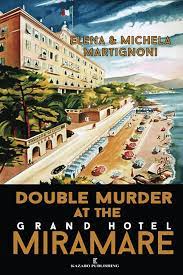
Double Murder at the Grand Hotel Miramare, by Elena and Michela Martignoni


9781948104241
Kazabo Publishing, 2023
originally published as Doppio delitto al Miramare, 2015
178 pp 

paperback

I really enjoy reading translated fiction, no matter the genre.  My last couple of reads (outside of crime) came from Argentina and Mexico, and I'm always delighted when something new in translation comes along.   I'm not quite sure who specifically translated this book, Double Murder at the Grand Hotel Miramare, but there is a baker's dozen of translators listed as being on the translation team, which is something I hadn't encountered before.    According to goodreads, this book is number five of the thirteen in the series featuring Deputy Assistant Chief of Police Luigi Berté,  written by these two women under the name of Emilio Martini.  [sidebar:  one of the books on the goodreads list is shown as number 4.5 so I have no idea what that means, exactly -- how do you write half a book?  It's always tough starting a series that's obviously well underway,  and  although the authors allude to some past events in Berté's life (a messy breakup, some sort of trouble in Milan and a move to his current location in Lungariva along the Ligurian coast),   I feel like I didn't quite have the entire story, which was a wee bit frustrating;  on the other hand, the holes in my knowledge didn't exactly hinder my reading experience too much so it was okay.  

It's Easter Monday, and Berté has his heart set on both a wonderful lunch at the Pensione Aurora and seeing Marzia, the married woman with whom he is in a secret relationship.  But, as he says after a phone call from his sergeant,  "a double murder has a way of distracting you from your thoughts, as well as ruining your plans."  Called to the luxe Hotel Miramare, he finds the two victims, "permanent guests" there,  together in bed in one of the hotel rooms, evidently shot while sleeping by someone  in a "blind rage" who was neither a professional nor someone too familiar with the use of weapons.  Both of them are employed by Countess Licia Trevisan, a very wealthy woman whose husband, the Count Van Der Meer, had made his fortune in South Africa. She is, as the manager notes, "one of our most important clients."   The male victim is Roberto Sommariva, an accountant, while the female victim, Ornella Ferrari, is the Countess' secretary.    After talking to his boss, Berté learns that along with his regular colleagues Pasquale Parodi and Francesca Belli, he has been assigned help from a homicide unit and a forensics team from Genoa.  He will need it -- not only is the hotel packed with guests who are all potential suspects,  but the Countess, who may just be a suspect herself, is being rather tight lipped with the police.  And quite frankly, she rubs Berté the wrong way from the start.  As the two teams get to work,  they discover that there is plenty of motive to go around; the further they get into the investigation, they realize that there are also plenty of secrets being kept that need to be unraveled if there is any hope at all of catching the killer. 


from Corbaccio


I enjoyed this book so much that when I'd finished it, I asked Chiara from Kazabo if any more of these books had been translated.  I got a no for an answer, but the point is that I was ready to hit the buy button if they had.  There's a lot to like here, beginning with the main character, who banters with his conscience that he's named "The Bastard" (whose words appear in italics), who is constantly razzed about this ponytail, and who has a good working relationship with his two main colleagues as well as with the team from Genoa.  Berté has a temper, can get angry in his job and likes to do things his way; at least he's smart enough to realize that in this investigation at least, there are times when he's walking on thin ice.  Like his father, also a member of the police force,  he is a huge fan of detective novels, and the authors have scattered different titles and writers throughout the novel that shed light on Berté's favorites (and obviously, their own influences in crime writing).    I also want to highlight the fact that the core mystery itself connects distant past with present, which I love in a novel of any genre.   And while there is romance involved here, it's not so distracting as to mess with the investigation/crime solving narrative, which I've seen happen all too often.  Finally,  Double Murder at the Grand Hotel Miramare is a nicely-plotted,  old-fashioned murder mystery written without gore or gratuitous sex,  making it a pleasure to read.   How often does that happen these days if you're not a cozy reader? 

I would like to thank Chiara for offering me the opportunity to read this novel and sending me an e-pub version, which I promptly forgot about until her much-needed but gentle nudge made me feel so guilty about sitting on it that I actually bought a copy.  I love what Kazabo does, offering crime fiction (and other books)  in translation from authors whose work has not yet reached an English-speaking readership.  I would recommend this book to anyone who is a fan of translated crime/mystery fiction, as well as to readers who just want to curl up with a good mystery novel where the focus is actually on the mystery itself.  


Saturday, July 22, 2023

The Devil's Flute Murders, by Seishi Yokomizo


9781782278849
Pushkin-Vertigo, 2023
originally published 1973 as Akuma ga kitarite fue o fuku (悪魔が来りて笛を吹く)
Translated by Jim Rion
256 pp

paperback (read earlier this month)

I really love these Kindaichi novels -- over the years I've become a huge, huge fangirl.  According to Wikipedia, it looks as if this book first appeared as a serialization that ran from 1951 through 1953.  It was later published in 1973 in book form, and now the good people at Pushkin Vertigo have published it in an English translation, thanks to Jim Rion.  Going with that same article in Wikipedia, The Devil's Flute Murders is number fifteen in the series starring Yokomizo's detective Kosuke Kindaichi; it is the fifth of the Kindaichi books to have been published in English by Pushkin Vertigo.  Just a heads up here: at the Wikipedia page for Seishi Yokomizo,  I noticed that there is another translation coming from Pushkin Vertigo in 2024, The Little Sparrow Murders.  I will be grabbing that one as well, of course.  

As I've said many times, I love mysteries based on events of the past and this one did not disappoint.   

Very briefly, the action begins  in Tokyo in 1947, and much of the city and other parts of the country are still in ruins after World War II.  It is also a time when the aristocracy class as a whole is marking the last of its days, a phenomenon, as the author notes, examined that very year by Osamu Dezai in his work The Setting Sun (1947)It would be later that year that the peerage came to its official end with the establishment of the new Japanese constitution, but when Viscount Hidesuke Tsubaki was found dead, he was still officially a member of the "sunset class." Before then, he had been a quiet and unassuming man with no cares about influence or ambition. He was also an accomplished flautist whose recording of "The Devil Comes and Plays His Flute" was quite popular.  His home in Tokyo had survived the firebombing of the city, but unfortunately that wasn't the case with his brother-in-law's residence, which was destroyed, prompting him to move into Tsubaki's home.   This relocation caused no end of stress for the Viscount; the addition of his wife's uncle Tamamushi coming to live at the estate only worsened the situation.   Then on March 1, Tsubaki simply vanished, leaving home "without a word of explanation to his family," never to return.   Some time passes before his body is discovered, identified by his daughter Mineko and other family/household members.   As this novel begins in earnest, in September Mineko has made her way to see private detective Kosuke Kindaichi  with a bizarre story that immediately captures his attention.  It seems that after Tsubaki's death, her mother Akiko, her maid Otane and her uncle's mistress Kikue had gone to the theatre where Kikue had clearly seen the Viscount sitting in the front row of the balcony.  He was gone by the time they had the courage to go and check it out, but seeing him had sent Akiko into a panic.  Kindaichi agrees to go to the Tsubaki home when Mineko mentions a "divination" (sort of like a séance) that is about to be held there.   He enters into a most surreal and strange experience resulting from that event that surprises everyone else as well, but that's just the beginning:  it is there for the first (but not the last) time that he hears the sound of Tsubaki playing his  "The Devil Comes and Plays His Flute," which, together with sightings of Tsubaki walking in the estate grounds, rattles everyone in the household.  From that point, Kindaichi is fully involved; what he can't possibly predict is that the deaths will pile up before he can get to the core of this mystery based on secrets that go well back in time. The Inugami Clan continues to remain at the top of the list of my favorite Kindaichi novels, but The Devil's Flute Murders definitely comes in a very close second.  While there is a solid mystery at its core, Yokomizo also examines the deleterious effects of wealth, social status and privilege, and in this case it's not just ugly, but deadly. 

 I've purposefully  offered only a barebones description  here since the book itself is quite involved with a level of complexity I haven't yet seen in this series; after having finished it, I can see why the serialization of this novel lasted so long.   Yokomizo obviously took his time,  allowing  Kindaichi to unravel each and every strand (and there are many) of this perplexing case until the detective can get to the bottom of it all.  It might be worth noting here that if you're someone who wants their mysteries solved quickly with a standard cut-and-dried, formulaic approach to a solution, you won't find that here.  Another thing:  the huge cast of characters is listed in the front in a sort of dramatis-personae type thing, but I became pretty frustrated at flipping back to that list time and again so I finally ended up just making a copy to leave nearby while reading.   And speaking of characters, at one point I actually said to my spouse that I believe this is the first time in reading a book where there were  only two people  I liked, and that was Kindaichi and the dead Tsubaki.    Reader beware -- if you're someone who has to like the people inhabiting your books, you might be a bit disappointed.    

I am beyond happy to report that I did not guess the who until nearly the end when Yokomizo almost hands it to the reader,  although I will say that I did sort of figure out the underlying why in a vague way a bit earlier.   If I explain what it was that made me get that far,  it wouldn't be fair to people who may decide to read this book, so we'll leave it there.  Bottom line: when all is said and done, The Devil's Flute Murders is a solid and compelling mystery that regular readers of Japanese mysteries in translation or regular readers of the Pushkin Vertigo Kindaichi series novels should absolutely not miss, although it is very different in many ways from its predecessors.   

*****************

As the book was winging its way to me, I had purchased a copy of the 1979 film adapted from this novel, but after  some research, I found at least two more adaptations, the earliest dated 1954.  If there are more I haven't found them yet so if anyone has any info, please let me know.   Toshiyuki Nishida has the role of the very, very scruffy Kindaichi, and while the movie is quite good, had I not read the novel prior to watching the film I think I would have been lost. The powers that be who put this movie together made several changes that detracted from the essence of the book, but it was still an entertaining film, complete with subtitles.

The version from 2018 (available with subtitles on YouTube) is the better of the two, with Hidetaka Yoshioka as a very angsty Kindaichi.  This adaptation was an NHK TV movie, and the storyline was 
clear and straightforward, making it easy to pick up on what's happening even if you haven't read the


from ho-lingnojikenbo

 book.  This was even better than the Kindaichi films I've watched that were done by Kon Ichikawa, which for me is saying a lot.


Tuesday, June 27, 2023

The Mill House Murders, by Yukito Ayatsuji


9781782278337
Pushkin Vertigo, 2023
originally published as Suishakan no Satsujin Shinsou Kateiban, 1988
translated by Ho-Ling Wong
253 pp

paperback

The Mill House Murders is apparently the second of several books by this author in what Wikipedia refers to as the "Bizarre House/Mansion Murders" series. I've previously read his The Decagon House Murders (also published by Pushkin Vertigo),  the first in the series and a really good mystery that cinched the deal when it came to preordering this book. And while I had the inklings of a solution to this mystery vaguely floating on the periphery of my brain, The Mill House Murders still managed to seriously stump me as I couldn't figure out either the who or more importantly, the how.  

The novel begins at 5:50 a.m., September 29, 1985, within a prologue in which we learn that it is nearly dawn, and the group of people staying at the home of Fujinuma Kiichi have had a very bad September 28th night. While a typhoon raged outside, things inside the Mill House had taken a horrific turn -- a woman had fallen from the tower room,  a painting had vanished, and one of the guests had simply  disappeared.  As if that's not bad enough, things are about to get worse, with the discovery of a dead man in the incinerator, "cut up in pieces and burnt."  It was, to quote Fujinuma, "a blood-soaked night."   Flash forward exactly one year later, and once again a major storm is making its way to the area, and once again guests are expected at the Mill House. Aside from a caretaker and a housekeeper,  Kiichi lives in the house along with Yurie, whose father's dying request was that Kiichi take her in.  Not too long after he had done so, Kiichi had been involved in a car accident that had left his limbs damaged along with his face, leaving him with the desire to withdraw from the world. He had Mill House built, and he and Yurie spent a rather solitary existence, with Yurie spending most of her life in the house's tower room until the two eventually married.  The Mill House is named for its three water wheels that provide the house with its electricity; as one of the guests remarks about them, they
"...  almost look like they are turning against the flow of time, keeping the house and everything in this valley frozen in a never-ending moment." 

It seems as though this is precisely what the reclusive Kiichi desires, but as idyllic as it sounds, it is evidently not meant to be.  

It seems that every year on September 28th,  a small group of Kiichi's acquaintances make their way to his home to view his collection of his famous-artist father's paintings, which he kept only for himself and not for public consumption in an exhibition.  It seems that these well-known paintings have strange effects on the viewer, often to the point of producing a hallucinatory reaction, but there is one that Kiichi will allow no one to look at known as "The Phantom Cluster," making his guests want to see it all the more.    This year there will be an extra, uninvited guest by the name of Shimada Kiyoshi who is not only interested in the events of September 28th of the previous year, but also a friend of the man who had disappeared at the time, who was thought to have been responsible for the theft of the painting and most likely for the death of the incinerated man.  As Shimada says to his host, "something about the case bothers me. There's something not right ..."   And yes indeedy, there is something very wrong in this house, beginning with the first death, bringing back fresh memories of that night a year earlier, as well as the question of  whether history might be repeating itself once again.  


2008 Japanese cover (which I must say beats PV's cover by a mile) from Amazon Japan


Shimada's theory is that the police investigation of the 1985 events was flawed, and he is there to try to find out "with my own eyes and ears" what had happened.   He is not there in any official capacity, nor is he there to catch the killer; his mission is to simply discover the truth.   As they say in Japan, 頑張ってね, -- ganbatte ne -- good luck.  He'll need it.  As he notes at one point, 
"... solving a problem is a lot like solving a jigsaw puzzle. However, in this case we don't have a picture of the completed puzzle, nor do we know how many pieces there are in total. And of course, the pieces of our mystery might not be flat, but three-dimensional, or perhaps they even have four or five dimensions. So depending on who is putting the pieces together, we could all end up with completely different pictures, or perhaps I should say 'shapes.'
 Given what's going on at the Mill House, solving this particular puzzle is  definitely not going to be easy. 

There is seriously nothing like reading a book that takes place during a major storm while in real life there's thunder and lightning at play all around you, making The Mill House Murders atmospheric and a bit creepy at the same time.   This story begins in the past, moves into the present, and continues in this way throughout the novel. At most points both timelines are set as a mirror of the other, as Shimada's questioning goes on and he gains more information and more clues as to what had happened in 1985.  That is not to say that 1986 doesn't have a few surprises in store; as I said at the beginning of this post,  I thought I had at least a sort of outline of the solution in my mind (I actually sort of did in a vague way guess a small part of it) but by the end, the various twists and turns taken throughout this story brought things to a level at which I would never have guessed.   The truth is that I'm always so happy to end a book with a with a huge gasp when all is revealed; this is twice now that it's happened with this author.  

At Pushkin's website, there is a short bio blurb that says that Ayatsuji is a 
"Japanese writer of mystery and horror novels and one of the founding members of the Honkaku Mystery Writers Club of Japan, dedicated to the writing of fair-play mysteries inspired by the Golden Age Greats. He started writing as a member of the Kyoto University Mystery Club, which has nurtured many of Japan's greatest crime writers."

I do hope that Pushkin Vertigo will go on to publish at least a few (if not all) of the remaining Bizarre House/Mansion Murders books by this author -- for me The Mill House Murders was very well done, highly satisfying and really quite ingenious.  I happen to love these sort of mysteries;  they aren't always for everyone but I thrive on puzzle solving of any sort and these books are definitely puzzlers, in a very good way. 

 Recommended to regular readers of Japanese crime fiction/mysteries.  

Wednesday, December 28, 2022

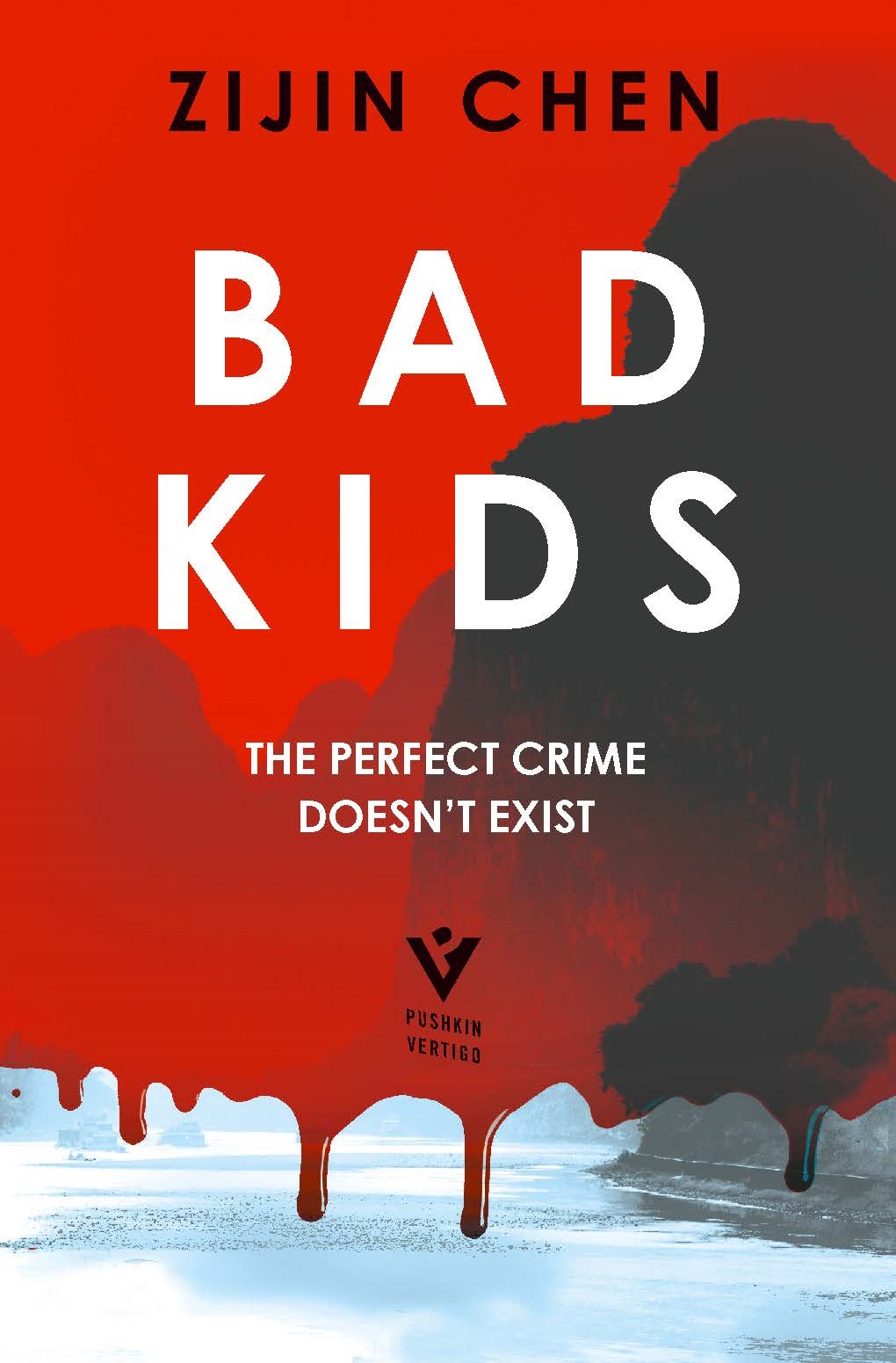
Bad Kids, by Zijin Chen


9781782277620
Pushkin Vertigo, 2022
translated by Michelle Deeter
332 pp

paperback (read earlier this month) 


Continuing to try to catch up on my posts here,  Bad Kids by Zijin Chen is yet another book in the Pushkin Vertigo collection, available in English for the first time.   There is another book by this author that has been translated from Chinese to English by Michelle Deeter, The Untouched Crime, published by Amazon Crossing.  Needless to say, when I found out about that one, I hit the buy button immediately.   

A brief word about Bad Kids:  the back-cover blurb labels this novel as "Dark, heart-stopping and violent," and I'll agree to dark and certainly to violent, but "heart-stopping" is a bit over the top.  However,  it is certainly one of the most twisty novels I've enjoyed in a while, meaning that just when you think the endgame has played out, there's more.  And then some.  

It's July, 2013, and Zhang Dongsheng has taken his wife's parents for an outing at Sanmingshan, "the most famous mountain in Ningbo," and now a nature park. The in-laws are happy to be there -- it's a popular and crowded place on holidays but on the day of their visit the park is "practically empty."   The "filial son-in-law" suggests that they make their way to an observation point,  where they'll take a break.  Once there, he looks around and sees no one nearby except three kids "clowning around near a pavilion," but "dismissed them as unimportant," then offers to take the in-laws-  picture with the great view behind them as backdrop, convincing them that they should sit on the wall for a better photo.  Once they've done that, he puts his hands on their shoulders as if to position them just so, and then, with a smile on his face, picks up their legs and it's 再见 (zaijian, bye-bye) to the in-laws as they go tumbling down the mountain.  Zhang knows that there is no way they could have survived that fall, yet a few people had heard the in-laws scream so he has to make it look legit and calls for help.   Outwardly he looks panicked; inwardly he's smiling at the thought that he'd committed the perfect crime; even the police label it accidental death.   What he doesn't know (and this is not spoiler territory -- it's on the back cover) is that while he thinks he got away with it,  those "unimportant" kids have inadvertently caught it all on video.  


Two of the three kids,  a boy by the name of Ding Hao and his friend, a girl called Pupu, had run away from an abusive situation in an orphanage  in Beijing,  and not wanting to return to their respective homes, had made their way to Ningbo and to the home of the third, Zhu Chaoyang, Ding Hao's friend in primary school.  To make a very long and complicated story a bit shorter,  Chaoyang's father gives him an old camera, and the kids decide to go to the nature park at Sanmingshan, where Chaoyang's mother works; it just so happens that they were there at the same time that Zhang Dongsheng was knocking off his in-laws.  The kids spend time taking photos, making videos and goofing around with the camera, and after arriving back at Chaoyang's place (and just before heading to KFC), Pupu discovers that they've picked up something completely unexpected on video -- the death of Zhang Dongsheng's in-laws as it really happened.   Chaoyang is ready to report the murder to the police, but is stopped by Pupu, who reminds him that the police just might ask who the other kids were on the video, and would likely send them back to the orphanage, which is an unacceptable choice.  As the back cover blurb notes, "an opportunity for blackmail presents itself," with Pupu deciding that she and Ding Hao could use the cash for their futures.   And so it begins ... with consequences unforeseen for all involved.  

If this were all there was to the plot, it would still be good.  But Zijin Chen isn't quite finished with his readers yet.  There's much more going on outside of the blackmail as one of the characters takes it upon himself to commit a horrific act that will also generate some serious fallout for everyone involved, and then, well let's just say that there will be more deaths than those of Zhang Donsheng's in-laws.   There is, of course, a police inspector looking into these, but for me the story was less about the investigation than the choices that were made in each instance and the resulting consequences.  

Bad Kids was a fun novel to read, and little by little as all of the unexpected twists and turns came into play, and characters played various battles of wit with each other,  it was seriously difficult to put the book down.  I have to admit to a few eyerolls here and there and thoughts of "as if" at different points, but the novel makes for hours of entertainment even as the author shines a light on the complicated nature of family relationships and more than a few social issues that show up within the story.  And by the way, the ending was perfect.  After reading this one,   I would really love to see more Chinese crime novels in translation (hint hint, Pushkin Vertigo).   

Recommended to people who enjoy twisty crime novels and who don't mind going deep into the dark in their reading.  

Thursday, July 28, 2022

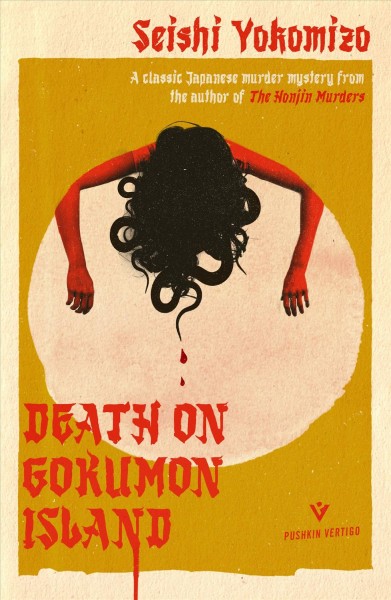
Death on Gokumon Island, by Seishi Yokomizo


9781782277415
Pushkin Vertigo, 2022
originally published as Gokumon-To, originally serialized 1947-1948
translated by Louise Heal Kawai
310 pp

paperback

Completely overjoyed when I learned last year that this book was going to be published by Pushkin Vertigo, I hit the preorder button at lightning speed.  At the same time, I bought a dvd of the 1977 film made from this novel, directed by Kon Ichikawa, which I watched last night after finishing Death on Gokumon Island.  More on that later.    

It's September, 1946 and as the novel opens, a ferry is making its way to a few different islands in Japan's  Seto Inland Sea.   It drops its passengers until there are only three left, all heading for a small island, Gokumon-to, which translates to Hell's Gate Island.  One of these people is Kosuke Kindaichi, who overhears a conversation between the other two -- a priest who had gone to pick up the once-confiscated, now-returned bell belonging to Senkoji Temple, and another man who informs the priest that someone named Hitoshi was "supposed to be coming home soon."  He had heard the news from a soldier in Hitoshi's regiment who had come to the island a few days earlier, when the guy had turned up to tell the family that Hitoshi had sent him to let them know not only that he would be returning, but also that he hadn't been injured in the war.  The priest then asks about someone named Chimata, which captures Kindaichi's attention, sparking a conversation among the three men.  It turns out that Kindaichi, a friend of Chimata, had come to Gokumon-to let the Kito family know of his death aboard a transport ship just a month earlier. 

Kindaichi, "like every other young man in Japan," had been drafted into the army, where he had spent two years in China before being deployed "between different islands to the south." His last stop had been in Wewak, New Guinea, where his division had been defeated, causing them to retreat; his division had joined others and it was then that Kindaichi had met and befriended Chimata-san,  helping him through his bouts of a very bad case of malaria and spending time together while the other soldiers "fell one after the other."   While they eventually made it out okay when the war ended,  each time Chimata fell ill Kindaichi noted that he suffered from "an extreme fear of death."  All was well, it seemed, until Chimata fell ill on board the repatriation ship; before he died he had told Kindaichi that he didn't want to die, and that he had to go home.  Otherwise, he said,  his "three sisters will be murdered."    Exactly why this might be is not explained until the end, but by then, it's too late -- it seems that Chimata had been right, and now our detective must try to discover who is behind these (quoting the back cover) "grotesquely staged" deaths that start not too long after he lands on the island. 


1971 cover from Mandarake


He will definitely have his work cut out for him, since the islanders tend to regard anyone not from there as suspicious; he is even arrested once by the local police sergeant who has no idea of his prowess as a "famed detective" and who views him as prime suspect in the case.  With the arrival of his old friend Inspector Isokawa (from The Honjin Murders) Kindaichi is released (to the sergeant's great  chagrin, I might add), but even then it will not be smooth sailing because, as he says to Isokawa, "everyone here on Gokumon Island is crazy. They're all out of their minds."   Perhaps, but while the Inspector makes note of the insanity behind the murders, Kindaichi eventually realizes that there is most certainly a method behind the madness on the part of whoever is responsible.  

What is done very well is the description of the longstanding power structure on the island and then there's the novel's  immediate postwar setting which captures the  demobilizations that are still ongoing, the families who continue to wait for their loved ones to return home and sit by the radio to hear the latest repatriation news, and a real sense of how the war has interrupted the flow of life for most people such as Isokawa, whose career had basically stalled during World War II and remains unsettled at the moment.   At the same time, the real payoff  in reading Death on Gokumon Island must wait for the end.  I was actually becoming a bit frustrated partway through because the story becomes more than a bit muddled and clunky at times; to be fair to the author, he does toss out clues here and there but they are on the impossible side of figuring out until all is revealed and things fall into place.  Trust me -- even the most seasoned armchair detectives will not be able to figure this one out.  Word to the wise: pay attention to the list of characters offered up front; I found myself returning to it several times.

 So far, Pushkin Vertigo has published four of the books in Seishi Yokomizo's Kosuke Kindaichi series:  The Honjin Murders, The Inugami Curse, The Village of Eight Graves and now this one.  According to Thrilling Detective, there are seventy-seven books featuring Kindaichi, so with any luck (crossing fingers) we may be seeing more in translation.   As I've noted before, my favorite is The Inugami Curse apa The Inugami Clan, but with another seventy-three left, who knows what little gems are yet to be uncovered in this series!  Despite my reading reservations at times,  Gokumon Island ends up being not only clever, but the author injects more than a twisted sense of destiny as well as a sort of tragic irony into this story once all is said and done.  Recommended for fans of the series and for Japanese crime fiction in general; it may be a bit slow in the telling but the reward is well worth waiting for. 


from TMDB

The Japanese film (1977) based on this novel (directed by Kon Ichikawa, whose The Burmese Harp I could watch on a continuous loop) starts with the same premise as the book, but for some reason I still can't fathom, the powers that be here then changed the storyline, including the identity of the killer.  Also unexpected and producing a very loud "wtf"  was a decapitation scene, and I have to say that I actually cringed every time Kindaichi scratched his head releasing clouds of very visible dandruff. Ick.  On the other hand, it streamlines the rather convoluted story making it easier to follow, but I'm glad I read the novel before viewing the movie.   All in all a fun experience but in my humble opinion, not quite as well done as the movie based on Yokomizo's Inugami Clan, also done in the 70s but miles better than this one.  


Monday, January 17, 2022

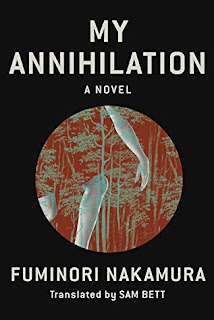
My Annihilation, by Fuminori Nakamura


9781641292726
Soho Crime, 2021
originally published as Watashi no Shometsu, 2016
translated by Sam Bett
257 pp

hardcover

My Annihilation is yet another book I'm reluctant to label as simply crime fiction -- there are layers upon layers to unfold during the reading, and as the author himself notes in an afterword, in this novel he is exploring 
"questions about what it means to be human, and what it means to exist in the world,"
as well as the question "what is a self?"  

It doesn't take too long to become completely immersed in this novel, which begins in "a cramped room in a rundown mountain lodge," where our narrator is considering the "various forms of identification" in his bag, all belonging to someone named Ryodai Kozuka.   In a corner of the room is a white suitcase which he did not bring there, and on the desk is a manuscript, which he believes just might be Kozuka's life story.  As he begins to read, he finds a warning:
"Turn this page, and you may give up your entire life," 

but the narrator reveals that he has "no intention" of giving up his "old life;" all he wants is Kozuka's identity.   Noting that while Kozuka may have left some "unfinished business" behind, he assures himself that "it was no business of mine."    It's at this point (and we're only on page four) that I realized that it may have been a smart thing to heed that warning, but on into the manuscript he goes.  

What he discovers within is unsettling, at best.  It begins with Kozuka's narrative about his childhood experiences, about which after only one-third of the way through, the narrator observes a similarity to his own story.  Reading on, he comes to a passage where Kozuka, looking back, notes that 
"... It doesn't even feel like this is me. It's all so blurry, like something shrouded in a distant fog.  But evidently somebody is going to take my place. Someone willing to take over for me, accepting all the horrors ... I'm going to be saved."  

This bit obviously disturbs the narrator, but only momentarily;  continuing on he comes to the story of  real-life serial killer  Tsutomu Miyazaki,  "one of the most infamous criminals in Japan."  And while the narrator asks himself "What was all that about?"  we know that there are certain things that link both Miyazaki and the author of the manuscript, which I won't mention to avoid spoilers.  Yet for our narrator, nothing seems more important at the time than opening that white suitcase, until he is interrupted by the ringing of a bell to his room.  That's when things, if not weird enough already, start to take the reader far, far down the rabbit hole.  

Without spoiling things for potential readers, what actually emerges here is a sinister plot for revenge,  and I must say it's one of the creepiest I've encountered, with the actual mystery behind it all taking a number of  surprising twists and turns before all is revealed.   Underlying this novel is the answer to the question of "what is a self,"  to which the author responds that  "Under a particular set of circumstances, it becomes impossible to tell."  Using various forms of textual material throughout the novel, the author runs with this idea, revealing just how easy it is "to get inside a person's head," an idea at the very heart of this story.  He raises questions of identity and memory, especially the ways in which they might be changed or in this case, even created. With that then comes the question of what happens to the original self that must somewhere continue to exist; this sort of philosophical/psychological underpinning  is why I noted my reluctance at the outset to define My Annihilation as just another crime novel. At the same time, it moves this book well and deeply into the literary zone, and as the back-cover blurb notes, "into the darkest corners of human consciousness."   In short, it's right up my alley.  

I love to try to solve mysteries as I read them, but My Annihilation is  one of those books where just when you think you have a handle on things, there's a shift and you realize you're completely off base.  As quickly as things change here, for me it became a matter of just giving up, going with the flow and letting things reveal themselves.   I'm not sure I'd recommend this one to all crime/mystery readers, but it's definitely for people who like their reading on the darker side.