Showing posts with label Valancourt Books. Show all posts

Saturday, April 8, 2023

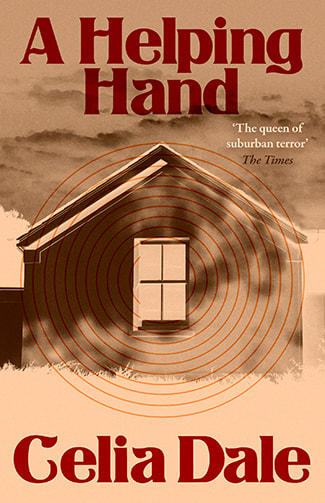
A Helping Hand, by Celia Dale


9781954321878
Valancourt Books, 2023
originally published 1966
paperback

173 pp


Before I start chatting away about this book, I have to say that we had a death in our family that left us mentally flat at the end of January, continuing on through February and well into most of  March. It's been absolutely terrible, and as I said elsewhere, it's  really only now that I'm getting back to the mindspace to be back reading and posting my thoughts.  I have a bit of a post backlog that needs catching up but hope to get to everything asap. 

Valancourt Books has recently published new editions of two of Celia Dale's novels, A Dark Corner and this book, A Helping Hand.  I read A Dark Corner some time ago and have plans to reread it soon, but A Helping Hand is completely new to me.   As I discovered, even at less than two hundred pages it's worth taking your time on this one -- if ever a novel could be labeled as a creeping slow burn, it is this one; on the flip side it's also one of the darkest books I've read in quite a while as well as a true gut puncher.

Maisie and Josh Evans  are on holiday in Italy.   While Josh sits and takes in the sun, Maisie brings a couple of British ladies along with her to the terrace to meet her husband and have tea. The older woman is the widow Mrs. Cynthia Fingal, the younger her niece, Lena Kemp.  Mrs. Fingal had come to live with Lena, and they are also on their holiday, eager for some sun.  As Maisie explains, she and Josh had needed a break after the death of "Auntie Flo," who had been living with the Evans' while being  nursed by Maisie.  The four get along splendidly, and decide to meet up later in Rimini.  When they reconnect, Mrs. Fingal takes a definite liking to Josh, spilling forth all her woes about living with Lena, while Lena finds an audience for her problems with her aunt in Maisie.  Long story short: before the respective couples return to England, it's been arranged that Mrs. Fingal will come to live with Josh and Maisie.  Back at home, after having moved in as a "paying guest," Mrs. Fingal soaks up the attention paid to her by Josh, which she greatly craves and which he doesn't mind giving. At first it seems that the arrangement was a good one all around,  but it isn't too long before the reader starts noticing that things are more than a wee bit off and that there's something not quite right at the Evans home.  I will say no more -- to tell in this case is definitely to spoil. 


from goodreads


On the back cover there's a blurb from the Buffalo News that most perfectly describes A Helping Hand as  "A little gem of a thriller ... evil most monstrous."   It's a good thing that I am one of those readers who doesn't need to find something likeable with the characters in a book because with only one or two exceptions, the people in A Helping Hand are absolutely vile.  The author writes so vividly that at times I felt like I was right there in the house as an observer of the appalling wretchedness, and I had to stop reading every so often just to move out of the dark and back into the light because she is so good at creating a claustrophic atmosphere.   

While the usual elements of a standard crime story will not be found in this novel, what happens here certainly falls within the realm of the genre, and given that this book was written in the 1960s, it remains extremely pertinent in our contemporary world which makes what happens even more frightening.  The one and only thing I found to be on the negative side is that right after a rather stunning twist the story comes to a quick, almost rushed ending which was a bit disappointing, but in the long run it's really more about the getting there. 

I can most certainly recommend this one, and my thanks to Valancourt for bringing it back into print.  My advice: find a nice sunny spot for reading -- you'll need it.  

Monday, January 10, 2022

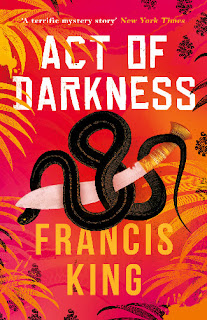
Act of Darkness, by Francis King


9781948405997
Valancourt Books, 2021
originally published 1983
305 pp

hardcover


I'm actually on the fence about labeling this book as crime fiction, because really, there's so much more to it.  I mean,  there is a crime (quite a heinous one in fact), there is a bit of an investigation and a number of possible suspects who might have been responsible.  At the same time, it ventures well into the literary zone, as the author delves into and  unravels human souls, exposing people for who they really are, and it works on a metaphorical level as well.   The bottom line, however, is that it's quite good, very dark, highly atmospheric and well, anything but typical.  


Just very briefly and excruciatingly barebones so as not to spoil things for anyone who may want to read this novel, Act of Darkness is structured in five parts, and it is in the first of these, the appropriately-entitled "Omens,"  that we meet the Thompson family.   Set in India in the 1930s, they are at home  in the hill-station villa where they've gone to escape the hot summer weather of the plains.   Toby Thompson is the head of this family, although business and other matters interest him far more than his home life.  He is married to second wife Isabel, now pregnant, and they have a young six-year old son named Peter who can often be annoying and definitely curious.  Toby's daughter from his first marriage, Helen, a sort of cold young woman who feels out of place and somewhat resentful,  has recently returned from boarding school in England, and  also living in the home is Clare, Peter's governess, who likes things simple, unmessy and uncomplicated. These characters are introduced from his or her own perspective; by doing it this way King allows the reader to glean an understanding of the complexities and the tensions within their interactions with each other, and most importantly, careful readers will be able to pick out the "omens" of what's to come. 

The central "Act" of this novel is a horrific murder that happens in the middle of one night, but it's the aftereffects that are at the heart of this story.  As the author writes,
"A slow, expected death has a way of irresistibly sucking the members of a family together down its dark funnel. This death, as violent and unexpected as the explosion following the detonation of a bomb, had the opposite effect of blowing the members of the Thompson family in separate directions, however much they struggled to cling to each other." 

The murder also lays bare some of  the pent-up frustrations, jealousies and suspicions that have been simmering and chipped away at under the surface within this household.  The author absolutely excels here as he traces the effects of this crime on those left behind over the years that follow,  offering more than one or two surprising twists as he comes down to its solution.

I loved this book -- King has created an atmosphere seething with dark, sometimes violent  undercurrents running below the surface both within this family and also in India under British rule; that tension, once picked up on in the reading, just doesn't go away.  I will say that not too far after the murder, I had this sense that I already knew this story, and rifling through my brain it hit me where I'd previously experienced it.  I won't give away any hints as to what it reminded me of  (just in case), except that it was a particular and sensational crime that had occurred in England during the Victorian era.   Once it dawned on me, I was a bit upset,  thinking "well, I already know how this turns out," but as it happens, I wasn't at all prepared once the truth was revealed.  I can certainly and highly recommend this book, especially to readers who are more into the why behind  things rather than just the who.  It is a memorable story that I still see flashes of in my head  even though I finished reading it a few days ago; it's also a book that I absolutely could not put down.  


Tuesday, October 8, 2019

'tis the season, part two: He Arrived at Dusk, by R.C. Ashby.

9781939140449
Valancourt Books, 2013
originally published 1933
218 pp

paperback

Another book I pulled off the shelf for October reading, He Arrived at Dusk gave me such immense pleasure that I actually applauded at the end.  I do that sometimes (little claps and a "bravo" here and there that no one but myself can hear) when I like a novel as much as I enjoyed this one.  It really is the perfect crime read for the Halloween season, as the author blends mystery and more than a hint of the supernatural, and does it in a rather ingenious fashion.  And what is there not to love about the cover art?

For a short blurb about the author, Ruby Constance Ashby (Ferguson), you can click on through to Valancourt's website. 

As is revealed at the outset,
"The story as here presented is in three parts; three stories in one, three points of view; in fact, murder through the eyes of three men of widely differing mentality and outlook."
The first of these is Mertoun's account, which begins as he is in his club.  Something he's heard has seriously distressed him, and he reveals to another gentleman that he is "haunted."  That man, a certain Mr. Ahrman, has him relate what's happened to him over the previous three weeks; Mertoun agrees, in the hope that Ahrman will believe what will turn out to be a rather bizarre story.    It seems that Mertoun had been engaged by a certain Colonel Barr  to "value the contents" of his remote house in the Northumberland moors, The Broch, which derived its name from a nearby ancient ruin of a tower said to be haunted.   On entering the house to begin his work he immediately experiences a "hideous feeling,"  a "coldness" that hit him like "an electric shock from an unearthly battery."  After waiting some time, he meets Charlie Barr, who reveals to him that his uncle is ill, confined to his room, and is under the charge of a nurse, and that nobody is allowed to see him, not even his nephew.   The next day he also learns that the house has its own resident poltergeist.  When he finally meets the nurse, Miss Goff, she offers him another job, to arrange and catalogue the books in the Colonel's library, a task which should take Mertoun about two weeks.   It is during that time that Charlie tells him the story of an ancient Roman soldier whose ghost haunts the area around the Broch.  The legend is well known by the locals of the nearby village, who refuse to go anywhere near it, except for a shepherd who has, it seems, taken his flock to the tower ruins.    It is also during this time that he begins to experience some strange experiences in the house, which culminate in a rather bizarre seance (!) held there at the behest of a local doctor who wishes to contact his wife; it is shortly after this event that a seemingly-impossible, ghostly murder occurs.  However, that's not the only shock that awaits the inhabitants of the house.


RC Ashby, from Persephone Books


As Mark Valentine notes in his introduction, He Arrived at Dusk  is a "chilling story of apparitions, uncanny incidents, and dark legends... " and clearly the author has laid the foundations for such a tale  in the way she evokes the atmosphere that permeates this entire story.  The house at the edge of Northern Sea, the moors that could swallow an unsuspecting person,  the periodic sweeping of the lighthouse beam across the landscape, and the superstition surrounding the old tower itself all combine to create the perfect backdrop for what takes place here.  Add to that Mertoun's own sense of something "hideous" on entering the house for the first time and his recounting of his own strange experiences there, the mysterious Nurse Goff, and the scene is more than set for the strangeness that follows in the next two accounts.   However, there is also a seriously good mystery at the heart of it all, and as a keen reader of these old novels, for me the solution was almost as satisfying as the journey. 

For devotees of these older books, or for people looking for something a wee bit different than your standard British mystery, you really can't do much better.  He Arrived at Dusk is one of those hidden gems I live to discover, and my serious thanks go to Valancourt for bringing it back into print. 


Thursday, August 30, 2018

*The Complete Judith Lee Adventures, by Richard Marsh (ed.) Minna Vuohelainen

9781943910229
Valancourt Books, 2016
546 pp

paperback

"Judith Lee is a young woman who calls herself a teacher of the deaf and dumb; in reality she is the most dangerous thing in England." -- 371

 In August, 1911 the popular magazine The Strand (Vol. 2, #248) first began to serialize the adventures of a young woman in a short story written by Richard Marsh (1857-1915) called  "Judith Lee. Pages from Her Life: I -- The Man Who Cut Off My Hair."  The book is really one of a kind in terms of the literary female detective to this point in time; it is also a stunning collection that is very much a valued addition to my own home library of early crime/mystery fiction. 

Judith Lee is a "teacher of the deaf and dumb," and uses what she calls "the oral system -- that is the lip-reading system" in her work.  Her father was, in fact, "one of the originators" of the system; her mother was deaf with a speech impediment "which made her practically dumb," but through lip reading quickly became able to understand what people were saying and to speak. As a result,  Judith has "lived in the atmosphere of lip-reading" all of her life.   Beginning with "The Man Who Cut Off My Hair," an adventure that she recounts as having taken place when she was a young girl, "this knack of mine," as she says, has led her into "the most singular situations ... the cause of many really extraordinary adventures." 

my photo from "The Man Who Cut Off My Hair," (17). Illustration by W.R.S. Stott


Over the course of these twenty-two adventures, Judith Lee will tackle (among many others)  jewel thieves, a bride with a penchant for disappearing, the Mafia, the theft of deadly curare, mysterious deaths in a lonely house;  while the stories are great, it's really Miss Lee that drew my interest throughout the book.  She is fiercely independent, has no plans or desire to marry ("Never, never, never!")  and travels the world as part of her work. She says of herself that she is a "woman, but no weakling," and takes lessons in jiu-jitsu as part of a duty to "keep my body in proper condition."   Her "gift," which includes being able to read lips in multiple languages, gives her the ability of "entering into people's confidence," but she expresses ambivalence about it at times.  For example, in "Eavesdropping at Interlachen," she says that
"There have been occasions on which, before I knew it, I have been made cognisant of conversations, of confidences, which were meant to be sacred, and, though such knowledge has been acquired through no fault of mine, I have felt ashamed, just as if I had been listening at a keyhole, and I have almost wished that the power which Nature gave me, and which years of practice have made perfect, was not mine at all." 
However, she goes on to acknowledge that "there have been times indeed when I was very glad indeed that I was able to play the part of eavesdropper."  Sometimes her eavesdropping becomes intentional as she notices people who just look wrong (for example in "Conscience"), and often she has "premonitory little shivers" which she feels are sent to her "as warnings," as in "Uncle Jack."  While some of the adventures in this book begin with Miss Lee trying to right a wrong, as in the case of a men wrongly sentenced to death, she also describes herself as "Nemesis," thwarting evildoers to the point of gaining a reputation among them, as noted in "The Finchley Puzzle:"
"Judith Lee is a young woman who calls herself a teacher of the deaf and dumb; in reality she is the most dangerous thing in England."
I didn't discuss these stories in any detail for a reason since this is a book that should be gone into with very little awareness of what they entail. The Complete Judith Lee Adventures is a joy to read, and in this edition we have the great fortune to have an excellent and most eye-opening introduction by Marsh scholar Minna Vuohelainen, who has written extensively on her subject, and who examines not only this book, but puts it into context along with Marsh's other work.  She also quotes Kestner's Sherlock's Sisters, which no aficionado of early female detective fiction should be without; he goes into the Judith Lee stories extensively as well.  It is truly one of my favorite crime/mystery reads this year, and I can't recommend it highly enough.


-------


note:
While I hate to draw attention away from Valancourt Books, there is another edition of Lee's complete adventures available from Black Coat Press, who is also in my top tier of small, independent publishers.

Thursday, March 15, 2018

*Prince Zaleski, by M.P. Shiel

9781934555033
Valancourt Books, 2010
originally published 1895
84 pp
paperback

With Prince Zaleski, my time in the 1890s and the nineteenth century comes to an end, although I still have tons of books sitting here from that decade which I'll eventually come back to.  And that brings up a good question -- with all of  the books from that time sitting here still unread, why Prince Zaleski? The answer is simple: it combines mystery/detective fiction with  fin-de-siècle Decadence, something I hadn't yet encountered in British detective fiction of the period.

Briefly, Prince Zaleski was published as part of John Lane's Keynotes fiction series of books published between 1893 and 1897. As we learn in the introduction to this edition by Paul Fox, contemporary reviews were mixed.  For example, H.G. Wells panned the book, saying that Lane  "in his short but brilliant career" had never "published anything half so bad before." He calls Zaleski "Sherlock -- demented..." while he goes on to say that "the book is too foolish even to keep one laughing at it," questioning its placement in the Keynotes series.  Oops. At the same time, Vanity Fair gave it a fine review, calling it "a very superior article altogether," a book that was "intended for the delight of a very superior class of readers." (x)   

In Prince Zaleski the strange mysteries that he ponders are brought to him by a character named "Shiel." As the first story, "The Race of Orven," opens, Shiel (who is unnamed at this point) reveals that Prince Zaleski had been a victim of a
 "too importunate, too unfortunate Love, which the fulgor of the throne itself could not abash; exile perforce from his native land, and voluntary exile from the rest of  men!"
He lives in a "place of hermitage," a "brooding-place so desolate for the passage of his days," which Shiel sees as a "vast tomb of Mausolus." It is an old mansion which has definitely seen better days -- in the hall, for example, which was built along the lines of a "Roman atrium" complete with "oblong pool of turgid water," Shiel encounters a "troop of fat and otiose rats."  Dust clouds are everywhere, and Shiel  describes a  "funereal gloom" that permeates the place. He finds Zaleski is at home in a small apartment in "remote tower of the building," the entrance of which is guarded by his manservant Ham.  Evidently the Prince is quite fond of pot -- the air was "heavy" with the "fumes" of cannibis sativa.   There are all manner of Asian curios surrounding Zaleski, none the least of which is a sarcophagus with a rotting mummy within, culminating in an effect of a "bizarrerie of half-weird sheen and gloom."

 After some hash smoking and breakfast the next day, Shiel gets to the point of his visit, which has to do with the mysterious death of a certain Lord Pharanx.   After Zaleski manages to solve that particular enigma, two more cases are presented to him: "The Stone of the Edmundsbury Monks" and "The S.S."  While I'm not going to go into particulars of any of the three cases here,  Zaleski combines his encyclopedic brain and his powers of deduction  to provide answers via the armchair detective method in the first two cases, while taking on a more active role of investigator in the third.

There might be something to the "Sherlock -- demented" comment by H.G. Wells, but it becomes obvious not too long into the book that Prince Zaleski seemed to have been written more with Poe's Auguste Dupin as a model for the detective side of the main character.  Having read Poe's Dupin stories just last year, I can say that Shiel employs the same sort of "ratiocination" technique here as did Poe with his detective.  I have very mixed feelings about Prince Zaleski, precisely because of the style in which the solutions were given (which I didn't care for in the Dupin stories either) in the first two stories,  but I thoroughly enjoyed the sort of arcane and esoteric lore that comes out of Zaleski's head that helps him to solve his cases.  My favorite mystery is "The S.S." which is a horrific case of either mass suicides or murders; this one continues to have relevance to our times, but in my opinion it is the best of three cases here.

Prince Zaleski is the quintessential aesthete, which appeals to me, as does the Decadence tone of the book as a whole.  In his Glorious Perversity, Brian Stableford sets Prince Zaleski in the group of "most intensely lurid products of English Decadence"  between 1893 and 1896 including Studies of Death, by Count Eric Steinbock, The Stone-Dragon and Other Tragic Romances, by R. Murray Gilchrist, Machen's The Great God Pan and the Inmost Light, and Shiel's own Shapes in the Fire. (119).

Bottom line: while it's probably not going to grab the hearts and minds of modern crime/detective fiction readers, it is very much worth reading for others who are more inclined toward the weird, the esoteric and the just-plain strange.  This is not at all an average Victorian detective book, and it takes an extremely brave and patient reader to get through it.  But it is definitely a book I'm very happy to have read.

Wednesday, March 7, 2018

*Miss Cayley's Adventures, by Grant Allen

9781934555439
Valancourt Books, 2016
originally serialized in The Strand, 1898-1899
220 pp

paperback

"I am an adventuress ... and I am in quest of adventures." 
                                                                 -- 36


Continuing on with my look at crime/mystery/detective novels of yesteryear, Miss Cayley's Adventures presents a bit of a surprise.  To be very honest, I hadn't heard of it until 2016 when it was republished by Valancourt, and even then I bought it and shelved it thinking I'd get to it sooner or later.  As I began to research exactly what books I wanted to read in my little independent survey here, I kept coming across this title, so here we are.

Because I don't really read reviews or too much in the way of plot synopses before I pick up a book, I assumed this book was going to be another Victorian work of the exploits of a  female detective much along the lines of the previous ones I've read and talked about here. But no -- with Miss Lois Cayley I got way more than I bargained for.  She is, like Loveday Brooke, an example of the "New Woman" of fin-de-siècle Victorian literature; at the same time, unlike Loveday Brooke, Miss Cayley does not make detection her specific profession. She is 21, has just finished her studies at Girton College and although (according to her friend Elsie Petheridge) her next logical step would be to teach, Miss Cayley is not at all interested in becoming one of the group of "dear good schoolmistresses."


from Project Gutenberg


Instead, she views herself as "a bit of a rebel," and has devised a plan of
"going out, simply in search of adventure. What adventure may come, I have not at the moment the faintest conception. The fun lies in the search, the uncertainty, the toss-up of it."
She also has only twopence in her pocket, but has made up her mind to "go round the world."  Her first opportunity for adventure arises when she overhears a "Cantankerous Old Lady" complaining loudly about having lost her maid just as she's about to go abroad and head for the waters at Schlagenbad.  Lois offers herself as traveling companion to the woman, Lady Georgina Fawley, to travel with her and to stay for one week, giving Lady Georgina plenty of time to find a replacement maid. After all, as Lois considers,
"The Rhine leads you on to the Danube, the Danube to the Black Sea, the Black Sea to Asia; and so by way of India, China, and Japan, you reach the Pacific and San Francisco; whence one returns quite easily by New York and the White Star Liners... the Cantankerous Old Lady was the thin end of the wedge -- the first rung of the ladder!"
Lady Georgina accepts, and Miss Cawley's journey begins; she proves her worth early on, even before they arrive in Germany, by thwarting the theft of Lady Georgina's jewels by a fellow passenger whom she knows only as "The Count."  This is only the first of many adventures that will befall Miss Cawley as she makes her way to several destinations; along the way she will compete in a cycling competition against German army soldiers, take on a mountain rescue when Lady Georgina's nephew takes a nasty tumble and can't climb back up, unmask  a bogus faith healer, take part in a tiger hunt, and much, much more. Her detection skills serve her best when they are most needed, especially at the end of the book.

"I gripped the rope and let myself down."  from Project Gutenberg

One thing that the author does very carefully here is to discern between connotations of the word  "adventuress."  This is one of the main themes running throughout the book, beginning with Lady Georgina's worries that her nephew Harold (who has fallen for our heroine and wants to marry her) will be tempted by "some fascinating adventuress" who will "try to marry him out of hand," and that she must make sure that he is saved from "the clever clutches of designing creatures." Lois considers herself an "adventuress," but not in the negative term as set forth by Lady Georgina -- but because of what his aunt has said, feels the need to refuse Harold's proposal of marriage. As she says:
"I dare not tell you how much I like him. He is a dear, good, kind fellow. But I cannot rest under the cruel imputation of being moved by his wealth and having tried to capture him." 
To put it briefly into context (and just FYI, I find I get much more out of my reading by doing so, not because I want to be an "authority," but to make myself a more informed reader), according to Joseph A. Kestner in Sherlock's Sisters: The British Female Detective 1864-1913, the author here is offering a repudiation to an essay written by the "virulently anti-feminist" essayist Eliza Linn Lynton, whose "animosity towards....the New Woman" was noted even in her obituary.  She referred to them as "Wild Women" who had about them "an unpleasant suggestion of the adventuress."  While Linton's name appears in the text of Miss Cayley's Adventures, it seems that, as Kestner notes, "many aspects of Lois Cayley's character seem created to challenge the predispositions of opponents of the New Woman." (124)  And once again, as in the case of Loveday Brooke, we find the question referring to the meaning of "ladylike"  come up more than once. 

Miss Cayley's Adventures is a surprisingly fun hybrid of detection, travel narrative and adventure, with a bit of romance thrown in, but it's so much more. The words "plucky heroine" come to mind, but that's really sort of belittling what the author does here with his lead character.  It's a book I could chat about for hours, and is a refreshing and never-dull  take on the Victorian New Woman, but there's much, much more going on here as well.   And the fact that it was written by a man makes it even more interesting, in my opinion.  

While my copy is from Valancourt, it is also available online at Project Gutenberg. Very much recommended, especially to those looking for something different in their reading or for early detective novels featuring an independent woman as a lead character.  It's also a book to just relax and have fun with while looking forward to whatever adventure waits around the corner for our Miss Cayley. Dear reader,  I loved her. 

Thursday, February 22, 2018

Obscure, yes, but oh so good: The Six Queer Things, by Christopher St. John Sprigg


978193910694
Valancourt Books, 2018
originally published 1937
222 pp
paperback

"... the whole web of horror behind them had been brought to light; but somewhere there still lurked the spider who had spun it all..."


The word sinister doesn't even begin to describe what happens in this book.  Originally published in 1937, The Six Queer Things is definitely not your average Golden Age mystery novel; in fact, I can honestly say that I've never read anything quite like it.  It is not only sinister, but it is also one of the most claustrophobic novels I've read from this period, and the author keeps you guessing right up until the last four pages before ending it on a most cruel note.   Before getting to that point, however, this story takes some unexpected and bizarre twists and turns, and the answer to who can be trusted here changes on a regular basis. The only times I put this book down once I started was for sleep and a session at the gym, and I had to make myself do both.  The best way to describe it is that it's like reading an ongoing nightmare from which there is little chance of escape.  

Marjorie Easton has been living with her uncle Samuel Burton since the death of her parents. He is described on the cover blurb as miserly, but Marjorie
"had had a long first-hand experience of absolute absorption in himself, his pettiness, and the supreme importance he attached to money."
She works as a junior typist, making only enough for personal needs with anything left over going to directly to her uncle.  He constantly reminds her of the fact that he had "fed, clothed and educated her," and that she owes him.  The bright spot in her life is her boyfriend Ted, but they can't marry until Ted feels he has enough money to take care of her properly.  Marjorie can't wait to get away from Uncle Samuel, so when she is offered a job that pays much more than she currently makes, she jumps at the opportunity.  The offer comes about as result of a chance meeting, and she finds herself in the employ of Michael Crispin, who takes her on as a sort of research assistant.  As it turns out, Crispin is a well-known medium, and along with his sister Bella, holds regular seances at the family home where Marjorie is expected to live while in their employment.   It is during one of these seances that Marjorie finds herself the object of a visit from the great beyond; soon Marjorie begins to believe that she herself has some psychic gifts of her own.   She sets herself apart from Ted to work on her psychic abilities, and Ted isn't too happy.  Worse, Marjorie's focus on her mediumistic tendencies leave her headed for a breakdown, further separating herself from Ted while she is under medical care.  But everyone's life is upended when Crispin suddenly dies just after a seance; from there this story takes on a life of its own as the police try to figure out who killed Crispin and why.  But this is, as I said, no ordinary mystery and while the police are doing their job, both Marjorie and Ted become locked into frightening nightmares of their own.


The New York Times review blurb quoted on the back of my book says that it is "Mystery and horror, laid on with a trowel," and that's about right.  It is filled with nice Victorian Gothic flourishes as well as contemporary policing, but at the heart of this story lies a most sinister plot with a villain who, even when "the whole web of horror...had been brought to light," still remains the unknown and mysterious "spider who had spun it all" from the beginning.

Hats off to Valancourt yet again for finding and publishing something quite out of the ordinary.  When I say that this book is unputdownable, I'm not kidding.  This book has it all -- a bit of meandering into the realm of the occult (and a sideways commentary on spiritualism in general by the author underneath it all),  a claustrophobic atmosphere that doesn't let up, and a strange mystery at the heart of it all  that will keep you turning pages because once things take that turn toward the strange nightmarish story it becomes,  you will absolutely want to find out what kind of mind it is that could dream up such sheer evil. And while it's probably not going to join the ranks of the greatest literature or greatest crime novel ever written, for me it all comes down to the fun I had while reading it. 

Don't blow it off because it's from the 1930s -- trust me -- you haven't read anything quite like it.


Monday, July 17, 2017

*Paul Ferroll, by Caroline Clive


9781934555613
Valancourt Books, 2008
originally published 1855
256 pp

paperback

First things first: anyone who loves old mystery/crime novels should check out Valancourt Books -- they are my favorite small indie press and they specialize in obscure or forgotten titles, perfect for die-hard bookworms like me who prefer works published in the past. I'm very sure  that other people don't get as worked up as I do about finding new old authors to read, but it's something that's quite meaningful to me so it's a big deal. So many male writers from this time period have names and work that have never been forgotten or have yet to lapse into obscurity, but that's not the case with a huge number of female writers, especially those whose work crosses into the crime/mystery area. 

Now on with the show -- I discovered Paul Ferroll while reading Kate Watson's Women Writing Crime Fiction 1860-1880.  Watson notes that Paul Ferroll is  "further evidence of women writers challenging convention and contributing to the nascent crime and detective genre." (23)  Caroline Clive (1801-1873) was a British poet as well as novelist; she published her first book, a volume of religious essays in 1827 under the pseudonym of, oddly enough, Paul Ferroll.  Her second book, a collection of poetry, was published in 1840 under the name of V.; Paul Ferroll was her first novel, followed by another (which I'll also talk about here) in 1860. As the Oxford Dictionary of National Biography tells us, accidents in 1860 and 1863 left her confined to a wheelchair before she suffered a stroke in 1865; two days after sustaining injuries from her dress catching on fire in her library, she died in 1873. 

When Paul Ferroll was first published, it was both praised and condemned by critics. According to the introduction in this edition, its earliest reviewers thought it had "power and originality," while at the same time found fault with its "subject matter and lack of moral comment."   Watson reveals that writer Elizabeth Gaskell was an advocate for this novel; another scholar reveals that she had written a letter to Louis Hachette in France recommending it as a "work of fiction of remarkable merit."  She also noted that in Britain, "People here condemn the book as the work of a she-devil," but that they were buying and reading it to the point that within six weeks, another edition had to be published.   According to one scholar who got her information from Desmond Flowers' A Century of Best Sellers, 1830-1930, Clive's novel went on to become "the British Bestseller of 1855," along with Westward Ho!, by Charles Kingsley.  For the most part, largely outside of academic circles, Paul Ferroll  has joined the ranks of other obscure, long-forgotten books that somehow rarely (and sadly) see the light of day any more.  One more thing -- in terms of this novel's placement in terms of early crime writing,  Lucy Sussex says in Women Writers and Detectives in Nineteenth-Century Crime Fiction that 

"Despite Paul Ferroll's success, in writing a detective-less novel Clive was working against the trend. During the 1850s the sleuth would increasingly occupy the centre of the text."

I found the character of Paul Ferroll to be pretty odious -- in modern parlance I thought he was a major jerk; but then again, I'm sure that Clive was leaving it to the reader to decide just what sort of person he is because every so often he has his moments of redemption, most especially toward the end of the novel.   What starts out quite peacefully with a picture of the "calm loveliness" falling over the Ferroll country home of the Tower of Mainwarey is interrupted with  Ferroll being summoned home with the news that "Your lady has been murdered," and indeed, she'd been found with her throat slit.  By whom was never really discovered, since the gardener, Mr. Franks, who'd been accused of her death was acquitted.  Ferroll gives Franks and his wife money to emigrate to Canada, after which Ferroll disappears for a "good while,"  only to return with new wife and "a little toddling child in tow."  As Janet, the Ferroll's daughter, grows into young womanhood, Ferroll remains aloof from his neighbors, ignores his daughter and actually seems to resent her presence in his home; it often sounds like he would have preferred it to have been just he and his wife Elinor living together. Neglecting Janet doesn't necessarily mean that he steps out of her life; he steadfastly refuses to allow her to have a relationship with the one young man who idolizes her, and fails to accompany her to social gatherings. 

Ferroll is considered an upstanding member of the community to the point where even when he is found guilty of murder after shooting and killing one of the ringleaders of a worker's riot, he receives a pardon. Time passes while the family spends time in France, and things are going pretty well for the Ferrolls until Mrs. Franks decides to return from Canada and is found with some of his dead wife's jewelry, at which point things take a rather strange turn.  For me, it turned out to be one of those stories where all you can do is to guess at the motivations behind the main character here, since right up until the last few pages, there is absolutely no clue as to why he does what he does.  It's frustrating, but it pays off. 

The ending of this novel caused no end of consternation, and it was likely because of this reason that Clive felt the necessity to add a "concluding notice" to a later edition of the book.  As Lucy Sussex states,  the book was " ... outrageous for the time." As she notes, 
"It lacked sanctimonious moralizing, then almost compulsory, as authors justified their satisfying of the popular demand for thrilling crime." (65)
Clive, whom Sussex notes as being "sensitive to audience reaction," ended up writing a prequel to this book in 1860 that sets the scene prior to Ferroll's wife's murder.  In doing so, Sussex believes (as do I) that Clive managed to retreat "from the apparent amorality" at the end of Paul Ferroll by offering an excuse as to why the first Mrs. Ferroll may have been killed.  We know from Paul Ferroll that she was an awful person, but after having read the prequel, I can solemnly swear that the woman was a nasty piece of work, pulling out all the possible stops in order to have her way.   I'm leaving the title of that particular book out of this post -- anyone who may be interested can find it through any of the links above, but beware -- all of the names have changed with only one exception -- and considering that Paul Ferroll's name appears in the title of that book, well, one would expect to find a character so named, but even his name has been changed. Don't let it throw you off -- while that book isn't nearly as well done as this one, it's still worth reading.

My advice for anyone who may consider reading Paul Ferroll is not to read anything that gives away the complete plot of this story because really, the fun here is in getting to the end of the book.  It's extremely tame in terms of modern-day crime reading, but once again, it was worthwhile because it was a good story and more importantly, because I've unearthed yet another author I'd never heard of before.  


Friday, April 21, 2017

* Eugene Aram, by Edward Bulwer-Lytton

9781934555194
Valancourt Books, 2010
originally published 1832
516 pp

paperback

"I looked on the deed I was about to commit as a great and solemn sacrifice to Knowledge, whose Priest I was." 

 Edward Bulwer-Lytton isn't exactly a household name, but in a way, everyone has some teensy measure of  familiarity with this 19th century author, since he was the guy who coined the famous phrase "It was a dark and stormy night," in his novel Paul Clifford (1830), which gained fame via Charles Schulz (see cartoon below) and via the annual (since 1982)  Bulwer-Lytton contest, a
" whimsical literary competition that challenges entrants to compose the opening sentence to the worst of all possible novels." 

As a word of friendly warning, I should note that Bulwer-Lytton's style of writing has been labeled as "florid," "turgid," and one of my online friends referred to it as the "paid-by-the-word" style -- in short, he's extremely verbose, a yammerer extraordinaire, and devoted to wordiness to the point where reading is a chore.   I consider myself to be a very patient reader but I almost lost my cool after reading six pages devoted to absolutely nothing but one man trying to convince another to look after his cat while he was off on his travels. I knew this was going to be rough going pretty much at the outset.


However, in spite of the extreme verbosity, Eugene Aram turns out to be a pretty decent book, a tale very loosely based on the real-life story of the titular character.   According to the Newgate Calendar, aka The Malefactors' Bloody Register,  the real Aram,  was "A Self-Educated man, with remarkable Linguistic Attainments, who was executed at York on the 6th of August, 1759, for a Murder discovered Fourteen Years after its Commission."  Bulwer's Eugene Aram is just one example of the body of work known as the "Newgate Novel,"
"so-called because the characters of its stories might have been found in the pages of Newgate Calendars, a collection of criminal biographies that first appeared in 1728."
This sort of book "focused on the lives of real or invented criminals,"  and are of huge  importance to the history of crime fiction, since as stated briefly in a blurb for chapter eight of  The Oxford History of the Novel in English: Volume 3: The Nineteenth-Century Novel 1820-1880,  
" These novels and others like them set in place themes and tropes that shaped early fictional narratives of crime.They incorporated factual events, revolved round the figure of the criminal, and promoted a didactic political and social message."   
In other words, according to one literary scholar, the Newgate novel "emerged in the 1830s as a response to contemporary issues within the social, legal and penal systems of Victorian London." For further information, there are all sorts of resources online and in print about the Newgate novel; now it's on to Eugene Aram. 

 Aside from the overly-excessive verbiage here, the novel isn't half bad.  Divided into three volumes, the first few chapters introduce us to the main characters of this book, and situate us somewhere in the English countryside, in the village of Grassdale.  The backstory to what is to come is also introduced, concerning the disappearance of one Geoffrey Lester, brother to squire Rowland Lester and father of Walter Lester. Geoffrey had married a woman with a "competent and respectable fortune," stayed with her a few years even though the marriage wasn't a good one, and then just took off leaving young Walter behind to grow up in the home of his uncle Rowland. Every effort had been made to find Geoffrey, but to no avail.

As he grew older, Walter fell for his cousin Madeline, but she only has eyes for the mild, reclusive scholar who lives nearby,  Eugene Aram.  With the handwriting on the wall regarding that relationship, and with no love lost between Walter and Aram, Walter decides it's time he goes out into the world.  While he's out there, he plans to seek news of his long-lost father. As we're told,
"The deep mystery that for so many years had hung over the fate of his parent, it might indeed be his lot to pierce; and with a common waywardness in our nature, the restless son felt his interest in that parent the livelier from the very circumstance of remembering nothing of his person."
Off he goes and it isn't too long after he begins his quest that he finds the first clue having to do with his missing father; following that up sends him on to yet another place and so on until he is ready to return to Grassdale, as it just so happens, on the day set for the marriage between Madeline and Eugene Aram. But the wedding plans are off after Walter reveals everything he's learned over the course of his travels -- as the back-cover of my copy reveals, Walter's quest will "lead to the discovery of a long-hidden and horrible crime and the trial of Eugene Aram for murder!"

the real Eugene Aram, from Wikipedia

The story goes back and forth between Walter's adventures and scenes between the Lester family and Eugene Aram back in Grassdale, until both come together with Walter's return.  That's really all I'll say about plot, because while it was fun traveling along with Walter through all of his adventures (and there are many), of greater interest to me was Aram's motivation for his role in the crime. He's a complicated man, a closed-off, quiet, yet very respectable scholar and as Walter discovers, there are few in this book who have anything but great things to say about him. Yet, as we know from the real case, Eugene Aram turned out to be a murderer.  So what made Bulwer-Lytton's Aram tick?  I actually struggled with that question right up until I got to to page 400 something when the turning point/aha  moment  for me came as I read the following from a statement given by Aram, in which he says that he
"looked on the deed I was about to commit as a great and solemn sacrifice to Knowledge, whose Priest I was" 
at which point I was actually sort of floored with the conceit of this guy.   How this is so I won't reveal, but it's a somewhat twisted logic Bulwer-Lytton uses here, and I'm afraid that I'm in agreement with many of his contemporaries who called him out for turning his Eugene Aram into sort of  as Winifred Hughes says in her The Maniac in the Cellar,  a "criminal-hero."

I've noted above the hazards of the writing style in this book, but I will also say that despite the testing of my endurance, Eugene Aram turned out to be a good read for me.  It takes a very patient reader to make it through this book, but it's worth it for many reasons, none the least of which is that it is a part of crime-fiction history.  When  earlier I posted my thoughts on Richmond I said that "it's a narrow circle of readers who will be attracted to this book, making it what I call an "NFE" read -- not for everyone..." and I will say that the circle  of people who would be attracted by Eugene Aram is probably even narrower.  I would, however, certainly recommend it to readers who are interested in the evolution of crime fiction, and for those readers who are interested in pre-Victorian British fiction as well.


Tuesday, June 7, 2016

a little belladonna with your bovril broth? The Deadly Dowager, by Edwin Greenwood

9781943910380
Valancourt Books, 2016
(originally published 1934)
233 pp

paperback

"There's only one thing that matters, ... and that is the Family."

So sayeth the grande dame Arabella, Lady Engleton of the de Birketts, a family whose "fortune -- or misfortune" came into being with a reward from none other than Thomas Cromwell during the reign of Henry VIII.  Flash forward a few centuries, and meet the entire de Birkett clan, and do it quickly before something terrible happens to them.

Arabella, now 83,  has for the last 65 years of her life devoted her energies to restoring the de Birkett's fallen fortunes, with very little in the way of results.  She's pinned her hopes on her young grandson Henry, age 20, whose mother died when he was three, and who's been in Arabella's care ever since.  Her goal is to
"somehow set the Family on its feet again, enable Henry to wear his coronet in the House of Lords and look his peers in the eye without the stigma of poverty hanging round his head like some disreputable halo."
So, as the novel opens, Arabella seems to have hit on a marvelous scheme for ensuring that Henry will be well provided for and that the de Birketts will continue to maintain their place among their noble peers.  She has called a "Family conclave," bringing anyone connected by blood or marriage (however tenuous that connection may be in some cases) together at their home in Mount Street, London.  Her idea: to insure all of their lives up to twenty thousand pounds. That way, when the policies mature, young Lord Henry should find himself with well over forty thousand pounds to "sustain his position in the world and his dignity in the House of Lords."  God help anyone who doesn't agree, like poor old Uncle Alfred, who is "leaving his little bit to charities," because death has a funny way of making an appearance -- along with a new will leaving it all to Henry.    And the body count begins to rise, slowly but surely. I mean, seriously -- they all should have figured out that this was just a very bad idea.

One would think that the "deadly dowager" would be happy at this juncture, but no, that's not quite all that is up her sleeve.  While young Henry's fortune is being planned (and, if you'll pardon me,  executed), Arabella has other plans for her young grandson that involve marrying into a wealthy family to better secure the de Birkett position and lineage. The problem is that Henry's already in love with Dora, and well, to the Lady Engleton, his choice is simply not acceptable.

So now people may be thinking "oh great. You've just wrecked the whole plot, the whole storyline, the whole book, in fact," but the truth is that I  haven't given away any more than the back-jacket blurb reveals. The fun is actually in waiting to see what our dear, deadly Arabella is going to do next, as well as the truly ingenious characters in her orbit.   As Mark Valentine has written in his introduction to this novel,
 "Greenwood took care to provide an (as it were) full-bodied supporting cast" 
aside from "the book's eponymous assassin," and the resulting ensemble makes for great fun, as does the lovely satire on class in 1930s England.  There is also budding romance here which normally I don't care for, but here it works and is another reason for all of the out-loud chuckles coming from me that kept coming the entire time I was reading this book.  There is a great one liner from the New York Times contemporary review of this novel that pretty well sums it all up:
"Quite the jolliest crime story that has come our way in many moons."
I know murder isn't supposed to be funny, but well, sometimes it's just refreshing that way.

While the 1930s may not be everyone's favorite period for crime reading, The Deadly Dowager was just plain absolutely delightful -- farcical, yes, in its own way, but I defy anyone to read this and not laugh at some point during this novel. Crime light, indeed -- a perfect summer read to toss in the beach bag, lay back and totally enjoy.  I just loved it.


Monday, May 16, 2016

another dynamic duo during dedicated down days, this time from Valancourt Books: Wax, by Ethel Lina White and Gilded Needles, by Michael McDowell

 Valancourt Books publishes old crime fiction, supernatural fiction, horror fiction and long-ago forgotten novels, and they've kept me entertained ever since I discovered they existed. My shelves are teeming with their books, precisely because I crave the obscure and because I haven't yet met a Valancourt  novel I didn't like.  Two more books now join the vacation reads:  Wax, by Ethel Lina White and Gilded Needles, by Michael McDowell.  They are two totally different animals -- Wax is pure vintage British mystery while Gilded Needles is more of a dark, historical crime novel of revenge set in New York in 1882.  Gilded Needles gave me a case of the willies and as I noted somewhere, caused me to pretty much stop breathing during the last 1/4 of the book.  Wax, on the other hand,  is more along the lines of a whodunit set in a most incredibly creepy atmosphere that doesn't let up throughout the entire novel.  Both, though, gave me the most intense satisfaction, which is all I can hope for when I'm enjoying vacation time.  I only brought a limited number of books with me, so I got very lucky with these two.  

First up is Wax, by Ethel Lina White, probably best known for her novel The Lady Vanishes. 

9781941147597
Valancourt Books, 2015
187 pp
paperback

Sadly, this particular version is not available in the US, but I bought mine at Book Depository and it was here in no time. Luckily,  Kindle readers  can get a copy for about six dollars.   It is an old novel originally published in 1935, and as soon as I opened it to the first page, I found myself already soaking in atmosphere.  At two a.m., Mr. Ames, who along with his wife serves as a caretaker for the old waxworks museum just outside of the small town of Riverpool, wakes up and remembers that he may have left a candle burning in "the Horrors."  When his wife goes to investigate, she gets a creepy vibe from the wax figures, "a company of -- poisoners" whom she felt "resented her presence," since "At this hour, the gallery belonged to Them." Her fear drives her home in a hurry, where she tells Mr. Ames that
"...those figures were up to some business of their own. And I felt in my bones that it was no good business either." 
Seriously -- what a cool opening!   The Waxwork Gallery was built in 1833, and had been "almost unlucky almost from its beginning." Evidently, the builder had hanged himself in the Hall of Horrors, then in the next decade a dead "tramp" was discovered there.  In the 1890s, a prostitute was murdered there in the alcove, "wherein was staged -- appropriately -- the final tableau in the career of Vice."  Moving the show into the 20th century, the body of a "commercial traveler" was discovered, this time with Virtue as a companion.  Opening the door of the Waxwork Gallery reveals a dimly-lit space with panelled walls draped with black velvet, coated in dust. Some of the figures have seen better days; for example, Mary of Scotland is wearing moth-eaten black velvet and is described by Mrs. Ames as being "germy" and in need of replacement.

When young Sonia Thompson comes to town to take a job at the local newspaper, the Gallery is the first place she visits, and thinks she sees two people come to life. Mrs. Ames tells her that she herself saw no one, so Sonia puts it down to an illusion.  However, she's not at all comfortable -- as we are told,
"She saw the Waxworks, not as harmless dummies, but as malign agents in a corrupt traffic..."
and feels as if the walls themselves were rocking in the "rushes of darkness."  She was, in short, "filled with horror of the Gallery."  As Sonia begins to acquaint herself with the people of Riverpool, she is warned away from the wax museum more than once -- sage advice, as it turns out, since a body is discovered there.  But it's not just the Waxworks that give Sonia the willies, since she soon finds herself wading knee deep into closely-held secrets that no one, absolutely no one, wants revealed and people who will go to great lengths to keep these hidden.   Sonia can't help herself though -- after all, she is a reporter and she wants to discover exactly what is going on in this small town.  She decides that there is only one way to get to the truth, and that is to spend a night on her own inside the Gallery.

Yowie zowie -- what a fun book!  What sets this book apart from a number of other works of the time is the The Gallery, which as I noted earlier, is the focal point of this book, and is in its own way, connected to pretty much everything that goes on in the town. It is not as taut as I generally like my mystery novels to be, and it took a while to get to used to the author's sort of rambling style. On the flip side, what I discovered is that although it seems like there is a wee bit o' the babble going on here, there are important clues to be uncovered throughout the story, so there were places that I went back to in order to pick up what I'd missed.  I have to say that I was hooked immediately, and that the novel turned out to be a fun read with a quite an ending.   Vintage crime readers will definitely enjoy this one, as will readers looking for something just a bit off the beaten path.  I will be revisiting Ethel Lina White later this year, as I plan to read her Some Must Watch (aka The Spiral Staircase) as well as her The Man Who Was Not There, both of which became films in the 1940s.

And now, moving right along to part two of this post, Gilded Needles is one of the darkest, creepiest tales of revenge that I've ever had the pleasure to have read.

9781941147917
Valancourt, 2015
paperback, 284 pp


The setting of Gilded Needles is New York, 1882.  The first thing that struck me on opening the book was the most excellent panoramic view of the city as the old year changes into the new.  The author provides us here with a glimpse across the spectrum  into what's happening at that moment, giving us a peek at the lives of  "... the poor whose poverty was such that they would die of it," the "criminals whose criminality was no final guarantee against the poverty they tried to escape," the "mildly prosperous and moderately respectable," and finally, for the "very rich who needn't trouble themselves with respectability." But most importantly for the purposes of this book, there is the "Black Triangle," a "little space that lies west of MacDougal, between say Canal and Bleecker Streets."  It is a place where "horror festers," located "within half an hour's walk of the most fashionable houses of the city."  It is in this small slice of the city that "Black" Lena Shanks and her family run their criminal enterprises; everything from illegal abortions, receiving stolen goods, selling dead bodies, you name it.  However, the denizens of the Black Triangle aren't limited to the poor or the criminal -- it is also a favorite locale for the more "respectable" citizens on its outskirts for gambling, picking up prostitutes, and whatever other pleasures they desire that are definitely not found say, in Gramercy Park.

It is just one of these "respectable" people who sets this story in motion.  Young Benjamin Stallworth is having his fun slumming in the Black Triangle, when he notices Lena.  She recognizes his eyes, remembering the time when a certain Judge Stallworth sentenced her husband to death and had her children taken away while she also went to prison.  In the meantime,  the Judge and his son-in-law, Duncan Phair, have decided to build their political and social clout by trying to take down the criminals and exposing the "evils" of the Black Triangle, publicizing their efforts in the newspaper.  But while the plan seems to be working, one particular event sends Lena and her family over the edge, and now she's looking for revenge.  And it definitely isn't going to be pretty.  The novel goes back and forth between the Shanks family and the Stallworths, who really don't help themselves with their own arrogance and their lack of understanding of human nature.

Gilded Needles is written in a way that reminds me so very much of the 19th-century "city mysteries" novels I've read,  exposing the city's dark, seamy underbelly and scratching off the veneer of respectability.  McDowell has captured the style of this sort of old novel while making it his own; he is one of the best dark fiction writers whose work I've had the pleasure to have read.  Gilded Needles  is one of the most horrific non-horror stories I've read in a while -- bleak, very Dickensian and well, let's just say that it's definitely not for the faint of heart.  At the same time, it is absolutely one of those books that once picked up will not easily be put down, and to be honest, I was still shaking after I'd  finally turned the last page.   I highly, highly recommend this one -- a definite no miss for readers of dark fiction and historical crime fiction.
Wednesday, April 13, 2016

it's weird, it's obscure, but most of all, it's fun: The Mummy, by Riccardo Stephens

9781943910298
Valancourt Books, 2016
originally published 1912
232 pp

paperback

There are just some times when I want to curl up with a cup of hot chai tea (milk, no sugar,  thank you very much) and read something just for fun. No serious thought needed, no brain strain, just fun. And it doesn't hurt when there's a mummy involved -- it brings back good memories of childhood not only in terms of sprawling on the couch on a Saturday afternoon to watch the old black and white mummy movies, but also of reading countless pulpy stories involving Egypt, which I found fascinating back then. So when Valancourt announced that they were coming out with this book, I pressed that buy button faster than you could say Imhotep. I wasn't quite sure what to expect, but when I started reading it, it turned out that it's indeed much more of a good, old-fashioned mystery novel rather than a book where a mummy is brought back to life by tana leaves.

As it also turns out, it's a book I can't really talk about too much without spoiling things for potential readers. The basic outline goes something like this:  a certain Doctor Armiston, who lives and has his practice in the West End of London, is called upon one day to come to give his opinion on how a man met his death.  He is taken to the Albany where he finds a young man who has died from a broken neck. After giving his opinion on the matter and sending for the police, he gets up to leave.  Opening the wrong door to go out, he finds himself staring at a strange object, which he is told is a mummy case, with a mummy inside.  According to the good doctor,
"It was my first introduction to the Mummy. I wish it had been my last."
And indeed, there will be more deaths, and with each one, the mummy case is on the premises.   Eventually, Armiston learns that the strange writing on the outside of the case contains a curse, promising vengeance on anyone who dares to upset the mummy's rest.  Being a man of science, Armiston isn't buying it, but no one involved is talking.  He is brought in to a society of "Plain Speakers," where, now that he is a member, he is privy to the truth of things.  Armiston will take it upon himself to try and figure out exactly what's behind this so-called curse before there are any further deaths, which are still unexplained.

Now, if this doesn't grab your attention, I don't know what will.  Granted, it sounds like the prelude to a horror film, but I can guarantee that this is a first-class mystery with a number of elements that blend with that same pulpy aesthetic that I've always loved. There are gentlemen at their clubs, strange "bohemian" societies, science gone awry, and of course, the element of detection.  On the back of this book there is a blurb that says this book "bears comparison with the works of Conan Doyle and Robert Louis Stevenson," and that is a good description that I can live with.

It won't be everyone's cup of tea, but it is most certainly mine. Granted, it can be boggy and slow in parts, but patient readers will be rewarded.   Highly, highly recommended to anyone interested in vintage mysteries with a touch of pulp on the side.  Very high on my internal shrieks-of-delightometer.


Tuesday, March 17, 2015

Harriet, by Elizabeth Jenkins

9781941147719
Valancourt Books, 2015
197 pp

paperback

My hat is off to Valancourt for bringing this book back into print. Originally written in 1934, Harriet is based on an actual British murder case from the 1870s known as  "The Penge Murder Mystery." It is  one of the more disturbing books I've read, although I must say it is also one of the best historical crime novels I've had in my hands in a very long time.  While information is widely available online about the Penge Murders or The Staunton Case (the real name of the fictional title character), I held off reading the facts of the actual case until I finished the novel, because I didn't want to have any expectations at all going into this book.

The titular Harriet is an only child and still living at home at age 32. She is rather simple, as the novel says, what would have been called "a natural," which in an afterword by Catherine Pope is explained as "having learning difficulties." Harriet's  "continued presence in any household was a strain."  After her mother remarried,  Harriet was often sent to stay for a time with "various relations," who were paid to have her at their homes.  As the novel opens, Harriet has been sent to stay with her mother's cousin Mrs. Hoppner, who has two daughters. Unlike Harriet's family, which is very well off, with Harriet having her own money and a future inheritance, Mrs. Hoppner and her daughter Alice have need for the eight pounds a month they'll get from having Harriet stay there. She shows up just after the arrival of Mrs. Hoppner's daughter Elizabeth and her husband Patrick Oman, who are on the verge of moving to the country for both economic reasons and because living there would be "more suited to the pursuing of Patrick's profession" as an artist. Patrick, "made scarcely a penny and kept Elizabeth in a poor way."   Patrick's brother Lewis, who is particularly fond of Alice, is also at chez Hoppner, and is warned by Alice to be nice to Harriet because they don't want Harriet complaining to her mother and going home.  Once Lewis finds out exactly how much Harriet's worth he is beyond nice to her and it is not long before he comes up with a plan to marry her for her money.  A rift forms between Harriet and her mother over marriage plans because Mamma has seen right through him, and eventually, without her family there with her, Harriet becomes Mrs. Lewis Oman. And that's when the trouble begins.

At this point, I found myself totally  unprepared for what happens next, and I'm not just talking in terms of  events.  Here I am sitting at my breakfast table, reading in between bread risings, and I was so taken aback that when the timer beeped I literally could not move from the chair.  It's bad enough that the principals take advantage of Harriet for her money; even worse is how conscience, compassion  and basic morality fall by the wayside when self interest is involved. It's absolutely frightening how these seemingly ordinary people can sink to a subhuman level, all the while able to  justify their actions to  themselves. The author's strength in this novel is showing exactly how this sort of thing can happen -- how festering resentments,  lack of money, a need for control  and other factors can easily change seemingly decent people into monsters.  She employs the use of contrast and irony to great effect, she spends a great deal of time in her characters' heads  so that the reader can see exactly how such behavior is justified, and through it all, she never has to resort to graphic detail to get Harriet's horrific situation across to the reader.

To say I walked away from this novel completely floored is an understatement.  One the one hand, it was extremely disturbing in the sense that it's amazing how anyone could do what these people did for the sake of money without ever batting an eye.  On the other, this book was so well done that even without knowing anything about the case, I could see it all happening right in front of me.

I love these old books and I am in awe that Valancourt continues to find such great works to bring back into print. I highly, highly recommend this novel to anyone who is appreciative of good writing, to anyone who reads and enjoys writers of the Interwar period, and to anyone who wants something far above ordinary crime fiction. It's also a great choice for people who enjoy crime fiction based on real cases.  Oh my god, people, this is one of the best historically-based novels ever.