Showing posts with label Séptimo Círculo. Show all posts

Tuesday, March 8, 2022

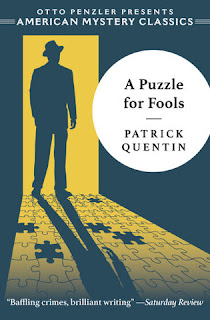
A Puzzle for Fools, by Patrick Quentin


 9781613161258
American Mystery Classics, Penzler Publishers
originally published 1936
237 pp

paperback


"It had been a puzzle for fools..."


A Puzzle for Fools is #21 on the Borges/Bioy Séptimo Círculo list, and it's a good one.  It is also the mystery series opener for the nine books featuring Peter Duluth, Broadway producer, ranging datewise from 1936 to 1954.    

Peter Duluth has known his share of tragedy.  His wife Magdalene had died in a fire in the theater, and as a result his life started to hit the skids.  After "drinking to an eight-hour-a-day schedule" over the last couple of years,  and not "particularly reluctant" to drink himself to death, he decided that some time in a sanitarium might be a good idea.  Detoxing was pretty tough at first, but he made it through the worst and now, under the care of a trusted psychiatrist, he seems to be doing pretty well.  His "spells of depression" are less frequent and his physical self was also improving.  As this story begins though, he's not sure sure of himself -- it seems that in the dark of his room, he hears his own voice whispering to him he must get away, and that "There will be murder."  He knows he's not saying these things, and his fright overtakes him until he speaks to his psychiatrist, Dr. Lenz,  who lets him know that "this is not the first disturbing thing which has been reported recently," and that whatever he sees or hears "out of the ordinary, that thing is real and has its basis in fact."   The doctor also feels that there is a "subversive influence" at work in his sanitarium, causing him to worry about the patients and asks Peter for his help. While patients might not reveal things to him that upset them, they might say something to a "fellow inmate."   

It isn't long until he learns about the strange things that are happening among the other patients, including a few who, like Peter,  have also heard themselves talking when they know they weren't.   More talk of murder follows, and it isn't too long until talk gives way to action and someone is actually killed in a way that leaves no traces of violence.  It's a bizarre crime on the impossible side, and while Peter has been allowed to keep up with the police and their investigation in confidence,  he has some ideas of his own as to how to discover who among them is a killer.   However, before he can make any real progress, the strange occurrences continue to plague the patients, and then there's another death. 

After my less than great experience with A Puzzle for Players I was more than a bit  reluctant to once again wade into this series, but  I was surprised at how very much I enjoyed this one.  For one thing, the atmosphere is set at the beginning and doesn't let up over the course of the story.  There's just something compelling about the scene of the crime being inside of a sanitarium with its darkened corridors, locked doors and secrets; even better, this story really is a puzzle -- the author offers any number of clues to put together to get to the heart of this mystery, and his characters are so nicely drawn that at some point I realized that nearly every person in the sanitarium was a potential candidate for suspect, and that ultimately in this story, you can't really trust anyone.   

Don't miss the introduction by Otto Penzler; while I don't quite agree with Penzler's assessment of Puzzle for Fools as a "suspense thriller in the Alfred Hitchcock mode," it still makes for a good few hours of fun and unputdownable reading.    Recommended to those readers who enjoy these older mysteries.  The armchair detective in me was highly satisfied -- I never guessed the who and so I was completely taken by surprise when all was revealed.  I call that a win. 


Friday, September 10, 2021

The Corpse in the Waxworks, by John Dickson Carr

"The purpose, the illusion, the spirit of a waxworks. It is an atmosphere of death."


9780712353731
British Library, 2021
originally published 1932
256 pp

paperback
(read earlier) 


A quotation from Poe's "Masque of the Red Death" serves as one of two epigraphs for this book and as it turns out, it is beyond appropriate.  Words like "grotesque," "phantasm," "delirious fancies," leap out immediately, but it's more Poe's conjuring of 
"much of the wanton, much of the bizarre, something of the terrible, and not a little of that which might have excited disgust" 

that truly fits the atmosphere, the setting, and the overall action in The Corpse in the Waxworks.   

More often than not I tend to forget that John Dickson Carr was an American author since he wrote so many novels set in the UK. He did spend a good twenty years there before returning back to the US, and according to most biographies, was one of only a very few American writers to be admitted into the Detection Club.    The Corpse in the Waxworks throws yet another curveball: it's set in France, and features M. Henri Bencolin, who is described in the book just prior to this one, The Lost Gallows (Poisoned Pen Press, 2021),   as "a tall and lazy Mephisto," as well as  "juge d'instruction of the Seine, the head of the Paris Police  and the most dangerous man in Europe" (4).   In the present book, he is  also noticed as a "man-hunting dandy," with an associate by the name of Jeff Marle who also serves as narrator.   

The "official" blurb for this British Library edition can be found here at the British Library's website; however, the one on the back of my old Collier paperback (1969) edition of this book is much more fun, with a teaser on the front that reads
"A Dead Girl in a Satyr's Arms -- A Club Devoted to Nocturnal Orgies"

 and then on the back the salacious detail of a "notorious club ... whose masked members revel in carefully planned orgies," as well as mentioning "nocturnal debauches."   


Seriously, who could resist?  

The action in this novel begins with the body of a young woman who had been stabbed and then found floating in the Seine.   Mademoiselle Odette Duchêne had last been seen alive going into the Musée Augustin, a wax museum complete with a "Gallery of Horrors."  Her fiancé, a certain Captain Chaumont, had spoken to her the day she went to the museum, when she phoned to cancel a date for tea with him and a friend "giving no reason."  Curious, he went to her home just in time to see her drive away in  a taxi, so he followed until she was let out in front of the museum.  With only half an hour until closing time, he waited, "and she did not come out."  Now she is dead, and he wants answers.  At the museum, Marle makes his way to the Gallery of Horrors, where he comes across the waxwork of a satyr.  After looking at it for a while, he makes his way back to the others who see that he's a bit unnerved, and when asked what's wrong, he tells them that the satyr figure  was "damned good, the whole expression of the satyr, and the woman in his arms."  There's just one problem, as M. Augustin informs him,  "There is no woman in the satyr's arms."  Well, as Bencolin notes, there is one now, "a real woman. And she is dead."  

But what about that club where they go for "carefully planned orgies" and "nocturnal debauches" you might ask, and all I will say is that as the investigation into the body found in the arms of the satyr gets rolling, the connections between the two will make themselves known.  The case begins in earnest with this second death, and the sleuthing begins. In typical Carr fashion, witnesses are discovered, spoken to, bits of information are given out carefully, and there's even a clever prime suspect.  The thing is though that Carr does a bit of sleight of hand here -- just when you believe he's given away the show much too early because there are still several chapters left in the book,  well, trust me, there are still a number of surprises waiting.  


The Corpse in the Waxworks is notable not just for the mystery at hand, but also for the atmosphere that Carr establishes from the beginning.  Marle's initial impressions of his first trip into the Gallery of Horrors are absolutely stunning, including the staircase that suggested "walls pressing in with the terrors so that you might not be able to escape,"  the exhibits imbued with a "pallor on each" face, the soundless terror caught on the faces of a particular group of wax figures,  the ghastliness of the  "shadowy people" who did not move, and the "choking stuffiness of wax and wigs" that left him needing "light and the knowledge of human presence."  But what really sets this book apart is the second half of the story, where pretty much everything that happens is completely unexpected.  And oh, that ending! Whoa! 

Don't miss Martin Edwards' fine introduction, and the added bonus of a short story (also featuring Bencolin), "The Murder in Number Four."  And my many thanks to the British Library for reprinting this novel, since my little Collier paperback is pretty much on its last legs.  Needless to say, I had a great time with this book, and it's one I can definitely recommend. 


Puzzle for Players, by Patrick Quentin


Mysterious Press/Open Road, 2018
originally published 1938
kindle version

294 pp


Moving on to book #17 on the Séptimo Círculo list,  I actually thought I would die of old age before getting through this one.  It is the rare book that tries my patience, but that's exactly what happened here.  The saving grace for me was that not only did I never guess the who, but when all was made known, it was someone I never would have suspected in a million years.  

Puzzle for Players is book number two in Quentin's series featuring Peter Duluth, but it is the first time I've read anything by this author.  The story begins as Duluth is hoping to make a bit of a comeback after having been "tabbed" as the "youngest has-been producer on record."  Re-entering the theatrical arena after having been "tentatively cured" of  a daily "two quarts of rye" drinking problem during his time in a sanitarium,  Duluth is now ready for his "big come-back," after having read the script of a new play called Troubled Waters.  A lot rides on Duluth's success, including regaining his "solvency" and  "lost self-respect," and the fact that the play is to make its appearance in a theater with a reputation of being "jinxed" means nothing to him.  It does, however, seem to make some of the cast of Troubled Waters nervous -- as part of its creepy past, for example, in 1902 a young woman had been discovered "hanging dead" in an actor's wardrobe, very likely a suicide.   But Duluth, while sympathetic, is convinced that this play will restore his reputation, and he's got a fine cast to help make that happen.  

It isn't long until the first of the weird incidents begin, but really, these are the least of Peter's problems. First,  some pretty shady people arrive on the scene, each with an agenda and all adding to Peter's woes.  Events begin taking their toll on the cast and especially on Peter himself, but above all, the show must go on.  However, after two strange deaths, he's not so sure that will be possible.

I have to say that I was quite taken with the haunted theater idea, and while the author it ran with it for a while, creepy atmosphere and all,  it just sort of fizzled.   A shame, really, because to me, there was much more he could have done with it and didn't.   The focus is very much the characters in this novel, many of whom are harboring secrets and some of whom are actively doing what they can to cause chaos while the cast is gearing up for opening night.  And while all of the mayhem is certainly engaging, the story tends to be weighed down by the psychological aspects brought in by Peter's doctor, various romance moments, and the sheer volume of red herrings that are added to the story so that by the time the end came, I was ready to be done.   Personally, I think that some careful editing might have given this story more teeth, which is what it needed, in my humble mystery-reader opinion. 

I will be encountering another Peter Duluth mystery shortly, A Puzzle for Fools from 1936, so I'm sort of wary at the moment.  I know there are any number of readers who enjoyed Puzzle for Players, but I can't really count myself among them.   I will say that the final revelation was completely unexpected, which is what saved this novel for me, but the reality is that a good solution does not necessarily a good mystery make. 


Thursday, August 5, 2021

Midsummer Murder, by Clifford Witting

 #16 on the Séptimo Círculo list, Clifford Witting's Midsummer Murder  brings me back to crime reading once again , although I had hoped to have read much more of that list by now. I've fallen so behind in everything that I'll likely spend the rest of the year catching up.  Oh well. 


Hodder and Stoughton, 1953
originally published 1937
184 pp

paperback

I went looking for older, contemporary reviews of this novel after finishing it, and in  googling "Midsummer Murder Witting" without the quotation marks, got thousands of results for Midsomer Murders.  I was a bit annoyed at first but then laughed because even though this book has nothing to do with Tom Barnaby and the gang from Causton CID, there is a character in this story who reminded me of Mrs. Rainbird from The Killings At Badger's Drift (which I recently read with a group on goodreads).  Not unlike that creepy lady who spied on everyone in her village in Caroline Graham's book,  there is a woman in this story who keeps a card file on everyone in her village.  I guess the Mrs. Busybody must be a reality in some villages; on the other hand, both Barnaby and the Inspector in this book, Harry Charlton, came to a point where information gleaned from these  respective sources became invaluable.  

Midsummer Murder is book number two in Witting's Harry Charlton series, which begins with Murder in Blue (1937).  I had to really go digging online for a copy of the edition of Midsummer Murder I have, but luckily, it seems that I won't have to work as hard to pick up the series opener, since the people at Galileo Publishers have seen fit to put that one back into circulation, to be released (at least here in the US) next month.  Pre-ordered, for sure, along with his Measure For Murder (1941, book #5).  His Catt Out of the Bag, book #4 from 1939 is already available for purchase, so I bought that one as well.  As all of this buying might reveal, I liked the lead character, Inspector Charlton.  I didn't particularly love the book itself, but the man intrigued me to the point where I would like to read more of his adventures in crime solving.  As for the novel, I was more than mildly annoyed with the underlying motive that connected all of the crimes (yes, there are more than one), which to me was tenuous, at best.   As an aside, anyone in 1953 who wasn't quite sure of the definition of that word could have easily turned to their Thorndike-Barnhart dictionary advertised on the back cover:


The story begins with a shooting in the Paulsfield Village square on market day, the first Tuesday of the Month.  Set between the wars in 1936, it was close to noon "and the tumult of the fortnighly gathering was at its zenith," including  all manner of livestock which "bleated, grunted and lowed," salesmen calling out their wares, a Punch-and-Judy show going on with a barrel organ for competition and construction complete with pneumatic drills.   It's a bustling, chaotic scene, and in its midst a bull escapes, and at that moment someone decides to let go with a gun and kill Thomas Earnshaw, the man cleaning the statue mid-square. 


frontispiece, the Square (oh! the map!!)


Inspector Charlton is called in to investigate, but finds an appalling lack of clues other than the bullet, a determination of the angle at which it had been fired into the victim, and sightings of a mysterious van that may or may not have something to do with the case.  All he can do at present is to talk to everyone around the square to see who might have a gun matching the murder weapon.  Progress on the case is little to none, and when a second person falls victim to the same fate, he reasons that  
"the murderer either had his intended victim playing right into his hands, or ... was waiting there like a watchful, blood-lusting spider for some innocent sacrifice to come along."

 Even worse, there is a third victim, and yet no one knows if these people had been randomly chosen or if there was some sort of link between the three in a "larger prearranged plan."  The killings have caused people to remain in their homes causing havoc for the shopkeepers, and while the police are starting to make connections, the question of who is responsible remains a mystery and leaves  the Paulsfield Sniper to remain at large.  

As this is my first experience with Clifford Witting's mystery novels, I have no idea whether or not he does this in all of his books, but here he leads the reader on quite a merry chase through the police investigation before we realize at the very end that we've been had in a nice bout of misdirection.   And I was fine up until that point, enjoying the mystery, putting the clues together in my head and even taking notes while reading.  Normally the author's sort of "gotcha" moment is a good one, meaning that he or she has put together a story whose solution I never would have guessed because I was following the trail of red herrings.  And while that happened here, when the killer was disclosed it was so out of left field that I had to go back and reread certain chapters just to try to figure it out.  Still, it was fun up to that point so I can't complain too much, but somehow that final moment  just didn't seem fair.  Be warned that this book ends so abruptly that I was looking for evidence that some of the pages had been torn out of my copy.  

Not great, but not bad, sort of middle of the road with an interesting lead character.  In my mind, not quite as nicely done as the previous  Séptimo Círculo books, but still a good read.  


Friday, June 11, 2021

There's Trouble Brewing, by Nicholas Blake


9781912194025
Ipso books, 2017
originally published 1937

paperback

The back-cover blurb is short but succinct, and reveals that a local brewery owner loses his dog in one of the brewery's vats.  It will also go on to reveal that said brewery owner will later be found in the same vat (more on that later).   I'm not kidding when I say that my mind immediately flashed to particular episodes of Midsomer Murders, Inspector Morse, New Tricks and even Brokenwood in a variation on the theme (a fermentation vat for wine instead of beer).  I'm sure there are more that I've missed, but it seems that death in a vat is quite a popular way to go.  Of course, all of the above came long after There's Trouble Brewing,  which made its appearance in 1937.   This is the second novel I've read by Nicholas Blake after The Beast Must Die, both read out of series order.  There's Trouble Brewing is number three  in the series featuring Blake's Nigel Strangeways, and I'll confess to enjoying his The Beast Must Die, number four, much much more than this one.  


When Strangeways accepts an invitation to speak to a local literary society in Maiden Astbury (Dorset),  he has no idea that his stay there will last a bit longer than he'd intended. During dinner with his hosts, Herbert and Sophie Cammison,  which includes a bottle of beer from Bunnett's Brewery,  the conversation turns to the brewery's owner, Eustace Bunnett, or at least to his dog Truffles, who had been found dead in one of the vats at Bunnett's Brewery.  Later, after Nigel gives his talk on Caroline Poets,  Bennett approaches him and tells him that he is positive that Truffles had been murdered and that he is "exceedingly anxious to find out who did it."   He then makes a request than Nigel finds "bizarre," asking him to find out who sent Truffles to his untimely death.  Nigel doesn't want to do it, but having been warned earlier not to "sauce" Eustace Bennett and after one of the members of the society urges him to do it, as "none of us will get a moment's peace" until the matter is "cleared up,"  he agrees.   

At the brewery next day to begin his investigation,  he is shown around while waiting for Bennett, but everything comes to a halt when a body is discovered in a "pressure copper."  Well, not quite a body, but a "half-disjointed skeleton" wearing the "soaked and tattered remnants of a dinner-jacket and boiled shirt."  When certain other articles are discovered, rumor starts that the remains belong to "the guv'nor" himself.  While the police are brought in, Nigel stays on to help and soon discovers that there are any number of people who wouldn't have minded seeing Eustace Bennett dead for many reasons.  He was, apparently,  the most odious person in the small community, and it seems that nobody is sad that he's gone.   As Nigel himself says, "Eustace was a crook, a menace, and a stunger." 


probably my favorite cover image of this novel, from Coverbrowser


I very much enjoyed the writing here, and only after two books now I have become a fan of  Nigel Strangeways.  I like his wife Georgia who sadly makes only a brief appearance here -- they are perfect for each other.  And who doesn't love a story  in which  a character is so particularly  loathsome that no one's going to be shedding a tear when he or she is dead?   With the number of possible suspects and possible motivations that Strangeways uncovers here, it should have been a great read.   The thing is though that Blake gives away the show much too early here with a particular remark that I took notice of  that colored my thinking,  so that by the time Strangeways cottons on to the solution, I'd already been there and was just waiting for our erstwhile detective to catch up.  At  chapter thirteen where Strangeways is going over the timetable of the case and makes an important discovery, I was just about ready to skip  and get to the ending I knew was coming.  It's a shame when that happens, really, because this could have been a most intriguing mystery novel otherwise.   

Thursday, June 3, 2021

Catching up in double time: The Shooting Party by Anton Chekhov and Mr. Digweed and Mr. Lumb, by Eden Philpotts

Since I was last here there's been more calamity here at casa mia,  but things are starting to look up and life is moving on in a more positive direction.  Unfortunately, the setbacks mean I'm behind in my crime/mystery reading so today it's a double feature: The Shooting Party, by Anton Chekhov from 1885 and a more obscure title from 1933, Eden Phillpotts' Mr. Digweed and Mr. Lumb. Both of these books offer an interesting puzzle worthy of armchair detecting, making for hours of reading pleasure; as posted at internationalcrimefiction.org,  what ties these two books together and what appealed to Borges and Bioy Casares in putting together their list of novels in the Séptimo Círculo collection are the "mysteries, puzzles, tales of logic and clues" that are  "hidden behind surfaces of respectability."  That is certainly the case here.  


9780140448986
Penguin, 2004
originally published 1885
translated by Ronald Wilks
199 pp

paperback

As John Sutherland says in his introduction to this edition of The Shooting Party,  while readers are used to a "dash of internationalism" in the twenty-first century, excluding Dostoevsky's Crime and Punishment,  the Russian novel has not been a "strong presence" in the realm of  detective fiction.  Like many fine mystery stories of yesteryear, The Shooting Party started out as a feuilleton in serial form, and given the fame of Anton Chekhov and his later dramatic works, has remained "unjustly ignored."  A shame, really, because the mystery itself is quite good, and as Sutherland also notes, the book is "an accomplished crime novel in its own right."  I tend to agree with him when he says that "few who start reading the work will be tempted to lay it down," because that's precisely what happened with me.  

April, 1880.  A man walks into a newspaper office, hoping for an appointment with "the Editor."  After identifying himself as Ivan Petrovich Kamyshev, former investigating magistrate, he asks the Editor to read his manuscript, and if possible, to publish it. The subject, Kamyshev says, is "love, murder," and he calls it From the Memoirs of an Investigating Magistrate,  swearing that the story "happened before his eyes," -- in fact he was both "eyewitness and even an active participant." The Editor isn't quick to bite, citing the readers who have "for far too long now... have had their teeth set on edge by Gaboriau and Shklyarevsky" and are 
"sick and tired of all these mysterious murders, these detectives' artful ruses, the phenomenal quick-wittedness of investigating magistrates."

The particular story under consideration is called The Shooting Party, and eventually the Editor agrees to read it, telling Kamyshev to come back in three months' time during which  he'll make his decision.  What follows is the story-within-the-story, as the Editor offers Kamyshev's story for the reader's "perusal" after reading it,  assuring that it is "a page-turner."   That it is, and it begins as the local magistrate, here named Sergey Petrovich Zinovyev, goes to visit his old friend Count Alexei Karneyev at his country estate that has for some time been in a state of decline.  Karneyev's world is largely defined by debauchery, and Zinovyev is quickly sucked in to that space of drinking and partying, where an orgy is not an unusual event.   But the estate is also where Sergey Petrovich meets the beautiful Olenka, daughter of the forester Skvortsov, now living in a state of madness from perpetual drinking,  and is immediately drawn to this "girl in red."   The problem is that the same is true of  Urbenin, a widower with two children serving as Karneyev's estate manager, and the Count himself.  Olenka, who has "aristocratic pretensions," surprises everyone with the news that she has agreed to marry Urbenin, setting off a chain of events that will end in murder one fine day during a shooting party on the estate. Motives are plenty, as are suspects, but the question of the actual murderer has to wait until the very end.   

That is all I will reveal about plot; anyone who prefers the element of surprise and reads anything about this book that takes plot and the possible identity of the who any further will end up kicking himself or herself in the long run.  And while it may not be one of the best crime novels I've read, it is certainly very much worth the read -- this may have been one of Chekhov's earliest works, but he is a master of characterization here which is much more important than the crime or its solution.   He wrote this in the 1880s, while Russia was still under Czarist rule, but he seems to have keen, almost uncanny insight into the future of class and social structure (including the roles and expectations of women)  in an empire that in just a short while will be completely transformed.   Definitely recommended.  


My copy of  Mr. Digweed and Mr. Lumb, complete with chipped corner on the dustjacket where it looks like someone took a bite out of the skull, is the first American edition, published by Macmillan in 1934.  The first British edition was published by Hutchinson in 1933, but I can't seem to find a cover image anywhere.  

Two men of completely opposite temperament and circumstances live in separate houses on Heathfield Chine, west of Wellbrook-on-Sea in Hampshire.  Mr. Benjamin Digweed of The Anchorage, a "man of very modest means" with a love of gardening, tends to keep to himself enjoying the company of others only occasionally with his neighbor Mr. Martin Lumb of The Haven, and Lumb's factotum Higgs.  Mr. Lumb, who travels to London now and again, has no money worries, is an avid collector of  and an expert on Aviation Issue stamps.  The two dwelt in "perfect amity" so when Mr. Digweed disappears, Mr. Lumb is shaken and calls in the local police.  Two days had gone by with absolutely no word, and the clincher comes when the housekeeper arrives and finds the door of the Anchorage locked, leaves, returns the next day and there's still no one home.  The policeman (and narrator of this story) is Sergeant William Cartright, who catches the case since his superior is away temporarily; on hearing Lumb's story Cartright makes his way to The Anchorage where he finds a note indicating that a desperate Digweed has fallen on hard times, with no money left to live on and no means of supporting himself, and has thus decided to end it all.   The police accept the obvious, but a bit later Mr. Lumb "smelled a mystery" when he discovered that every bit of Mr. Digweed's clothing remained in his house and when the boat he was going to use in his suicide was discovered in an unexpected place.  While the police begin to look into Mr. Lumb's worries there's another death, but this time it's Cartright's bride-to-be and her father who take charge. 

Again, not the greatest example of a 1930s mystery ever, but there's just something about Phillpotts' ability to put together a good yarn and to provide a challenge that appeals.  Eden Phillpotts may not be a household name in the realm of mystery reading, but I've now read two of his books (this one and The Red Redmaynes) that were both engaging and fun, definitely requiring concentration because the solutions don't lend themselves easily.  I will say that at some point while reading this one, I wrote a note with my theory and stuck it on a certain page where the light bulb started to blink on over my head, only to discover later that I was partly right but mostly wrong.  While there is definitely police presence in this novel, it is not what I'd consider an early procedural, since the crime is actually solved by someone else using intuition and logic;  while they do work on the case, the policemen become somewhat of a captive audience as the solution is revealed to them.    Recommended.  

Monday, February 15, 2021

Lament for a Maker, by Michael Innes

978191294148
ipso books, 2017
originally published 1938
275 pp

paperback

"Sen for the deth remeid is non,
Best that we for deth dispone
Eftir our deth that lif may we;
Timor Mortis conturbat me." 


Right at about page 165 of this book I stopped and made a comment on my goodreads group's "currently reading?" thread in which I said that it seems that everything has been laid out by now, and I'm stumped.  Looking back on it now,  it turns out that I may have jumped the gun a bit there thinking I had all pertinent information, but I still had no clue, and continued to remain in the dark until the very end.   This book is hands down one of the twistiest and strangest crime novels I've ever read, which is a good thing; at the same time, I had to really work at this one which raised my level of frustration more than once.  

The main action takes place, as the blurb for this book states, "in the depths of a howling winter night"  in a "remote castle isolated in the Scottish Highlands."  Down below Glen Echany is the village of Kinkeig where, when news came of the suicide of Randalf Guthrie, current laird of Echany,  "there was little grieving."  In fact, as we learn right away, "folk hated his very name."   This information comes from Ewan Bell, the shoemaker of Kinkeig, who lays the groundwork for this story and introduces us to the somewhat strange Guthrie and the castle's inhabitants (niece Christine, Hardcastle the sinister-seeming factor and his wife) before turning over the narration to others who will "tell of their own part in it."  Someone somewhere (maybe on goodreads? I don't remember now) mentioned "Rashomon-style," but for me the telling was much more in the vein of Wilkie Collins' The Moonstone.  By the end of the story, four other people will offer their voices to the furthering of the tale:  Noel Gylby, a young man on his way home to London and ends up "benighted" at the castle with the young woman whose car he crashed into during a blinding snowstorm;  Aljo Wedderburn, attorney; John Appleby, detective-inspector from Scotland Yard and finally the "testament" from "the doctor"  before the narrative is handed off once more to two people already heard from.  Here's the thing:  piecing together their individual accounts, it seems that perhaps there is much more going on here than Ranald Guthrie simply taking "his own ungodly life" -- and yet, if it wasn't suicide, then what exactly happened that night? 

The title of this book derives from a poem written by William Dunbar (as this brief article notes, one of  "a group of medieval Scots poets known as the makars" -- or "makers" ), and according to Christine, it is  often chanted by her uncle as he roamed about his castle.   The haunting last line of each stanza "Timor mortis conturbat me" (fear of death disturbs me") adds to the already Gothic-ish atmosphere provided by the setting, the overall strangeness that pervades this novel, and even the sighting of ghosts by various people.  While it was written during the Golden Age, it comes across as an example of an atypical story of this time, which I actually prefer. For me it's a case of the stranger the better.

 I quite enjoyed Lament for A Maker, which aside from its bizarre story appealed to my puzzle-solver self who loves a challenge, and I definitely got that here.  I will also admit that the joke was on me more than once, when I thought I had figured it out and really hadn't,  but I'd much rather things go that way than actually solving a mystery early on.    Aside from Innes' The Mysterious Commission which wasn't a John Appleby novel, I haven't read any of his other books, so I'm pretty stoked to read more right now.   Yet, as noted earlier, I did have to put a lot of effort into this one. My main issue with this book is that  it's not often that I sit with my iPad at the ready while reading a mystery novel -- that's usually what I do while reading nonfiction or more esoteric, out-there kind of books --  but here it was almost a necessity, at least at first,  since the entire first chapter was offered in a Scots dialect causing much frustration and necessitating multiple google visits.  It took me a while to warm up to this story, but in the long run, it was well worth it. 

Readers who make it through that first chapter will find a fine puzzler here, so don't give up.  


Tuesday, January 26, 2021

The Problem of the Green Capsule, by John Dickson Carr


Bantam, 1964 (reprint)
originally published 1939
168 pp

mass market paperback


"...there was a trick in it somehow..."


The second book in the séptimo círculo collection, The Problem of the Green Capsule is book number ten in Carr's Gideon Fell series.  I have to be honest: I haven't read many of these novels -- after collecting them from library/yard sales for what seems like forever, they've been living in wicker shelf baskets for years.  It feels weird not to be starting with the first novel of this series as Carr refers to past Fell adventures in this book, but I didn't mind  --  he gave nothing away in terms of plot so I can go back and read them without knowing anything.  

Given what happens here, the original UK title, The Black Spectacles, makes much more sense than its American title (more on that later).    The cover is a bit more appropriate (and much better artistically) as well, with the main action of the story in plain view for everyone to see.  At the same time, I own a lot of these old Bantam reprints where they've put what just might be several key clues on the cover.  I used to think this was cool, but now it's just a bit annoying knowing what I'm supposed to be looking for. 


from Wikipedia


Detective Inspector Andrew MacAndrew Elliot of Scotland Yard's CID has been assigned to look into a case in the village of Sodbury Cross, where someone has been poisoning chocolates in Mrs. Terry's tobacco-and-sweet shop, somehow substituting strychnine-laced confections for the chocolate creams kept on the  shop's counter.     Sadly, eight year-old Frankie Dell died after he'd "wolfed down the lot" he'd bought, while the children of another family and their "maidservant" who had also picked up a half pound of the tainted chocolates became very ill.  The young niece of local businessman Marcus Chesney, Marjorie Wills (for reasons I won't go into here),  is the main suspect.  As Elliot begins to work with the local police on that case,  word arrives that Marcus Chesney is dead.  After arriving at the Chesney home, the detectives hear a fantastic story: as it happened, Chesney's murder not only occurred in front of a small group of people, but that 

"every one of 'em saw the murderer and followed every move he made."

Even more surprising is that "they can't agree on anything that happened."   


What comes next is unlike anything I've ever read before.

Chesney, who has as a hobby "the study of crime," had earlier invited his niece, her fiancé George Harding, his brother Joe and a friend of theirs, a professor Ingram, to a "performance,"  a sort of "psychological test" to start at midnight.  His helper Wilbur Emmet, one of the men who worked at the Chesney home, was to have a role in this scene, and after it was over, Chesney would have a list of questions that the participants were to answer, based on what they'd seen.  George was to film the entire thing as well.   What happens next went according to plan, except for the fact that Chesney was murdered and Emmet was found severely wounded outside next to a bundle of clothing and other props used during Chesney's little game.  The problem is that the potential suspects were all together at the time, never out of sight of one another.  When another murder occurs, a rather mystified Elliot turns to Dr. Fell, who is staying in a hotel in nearby Bath, enlisting his help to solve this rather baffling crime.  

I mentioned earlier that the original UK title, The Black Spectacles, turns out to be more appropriate than its American counterpart.  In a letter from Marcus Chesney written earlier to Fell which he doesn't hand over right away to the police, Chesney had noted the following:

"All witnesses, metaphorically, wear black spectacles. They can neither see clearly, nor interpret what they see in the proper colours. They do not know what goes on on the stage, still less what goes on in the audience.  Show them a black-and-white record of it afterwards, and they will believe you; but even then they will be unable to interpret what they see."

 As Dr. Fell says  before he goes off to observe George's film record of that strange night,  "that, together with what we are going to see and hear to-night, should complete our case." 

 I'll confess that I had absolutely no clue as to the who and the how before reaching the end and the big reveal, always a good sign.   I'm also sure that the phrase "jaw-dropping" was more than appropriate at that point, garnering silent but worthy praise for the mind that put this puzzler together. At just over 160 pages it should have been a quick read, but there are a number of elements at play here, each to be unfurled slowly,  mused over, and put on hold in the brain as the story progresses.    Not only is there a solid, impossible mystery here, but one of the added perks from my point of view is a brief, whirlwind history of infamous real-life poisoners, in which Fell expounds on the psychological make-up of people who had turned to this method of killing.   Another clue that The Problem of the Green Capsule is not going to be your run-of-the-mill Golden-Age detection story comes from the book's subtitle, "Being the Psychologist's Murder Case."  Add to that the author's  remarkable construction of the sleight-of-hand, misdirection and illusion that rule the day in this well-plotted novel, and it becomes something rather ingenious.  I also had great fun with this book, which in the end, is the most important thing.

Definitely recommended.